Lobby wants nutritional data on chain-restaurant menus
Advertisement
Read this article for free:
or
Already have an account? Log in here »
To continue reading, please subscribe:
Digital Subscription
One year of digital access for only $1.44 a week*
- Enjoy unlimited reading on winnipegfreepress.com
- Read the E-Edition, our digital replica newspaper
- Access News Break, our award-winning app
- Play interactive puzzles
*Billed as $5.77 plus GST every four weeks. After 52 weeks, price increases to the regular rate of $19.95 plus GST every four weeks. Offer available to new and qualified returning subscribers only. Cancel any time.
To continue reading, please subscribe:
Add Free Press access to your Brandon Sun subscription for only an additional
$1 for the first 4 weeks*
- Enjoy unlimited reading on winnipegfreepress.com
- Read the E-Edition, our digital replica newspaper
- Access News Break, our award-winning app
- Play interactive puzzles
*Your next Brandon Sun subscription payment will increase by $1.00 and you will be charged $17.95 plus GST for four weeks. After four weeks, your payment will increase to $24.95 plus GST every four weeks.
Read unlimited articles for free today:
or
Already have an account? Log in here »
Hey there, time traveller!
This article was published 10/09/2012 (5158 days ago), so information in it may no longer be current.
You’re at your favourite restaurant and you open the familiar menu. You’re surprised to find something new beside each item: its calorie count.
On further inspection you notice the side of bread you usually order to go along with your soup contains a shocking 706 calories, not to mention that your beloved salad, even without the dressing, contains more than 850 calories. Plan on the soup, and you’re getting another 334 calories.
Your proposed dinner adds up to a whopping 1,890 calories — approximately your total caloric requirement for the whole day, not including beverages.
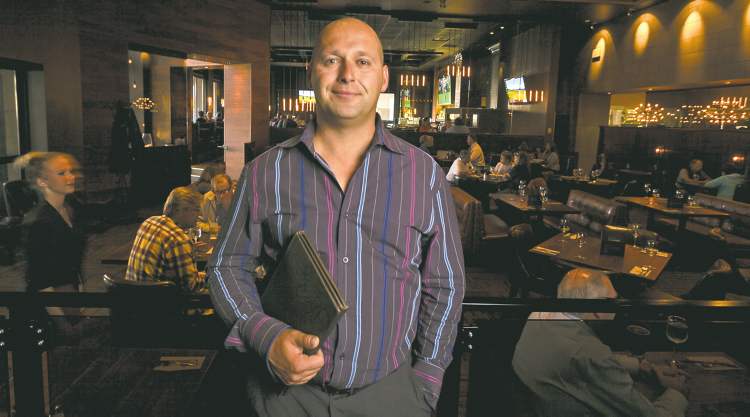
Bill Jeffery, head of the Canadian arm of Centre For Science in the Public Interest (CSPI), hopes this imaginary scenario will eventually become reality.
He and his Ottawa-based lobby group will be in Winnipeg tomorrow (call 613-244-7337 for ticket information) to host Writing on the Wall, a five-city symposium series about putting nutrition information on chain restaurant menus. Local and international researchers will present their findings on the subject. He’s also taking the symposium to Vancouver, Toronto, Ottawa and Halifax.
The purpose: To convince the public, health organizations and federal, provincial and municipal governments to legislate rules that would force chain restaurants to print calorie counts — and perhaps sodium counts — on their menus.
It’s a move, Jeffery believes, that will help reduce the waistlines and boost the health of Canadians.
“In a lot of ways, restaurants have gotten away scot-free because they haven’t had to be up front with their customers about the nutritional profiles of their foods,” says Jeffery, noting that half of Canadians’ food dollars are spent in restaurants. “This will make them more transparent from a nutritional perspective.”
The United States Congress passed a law in 2010 requiring restaurant chains to publish calorie counts on menus and menu boards. The FDA is working on the menu rules — set to go into effect soon — according to the Washington branch of CSPI.
Jeffery says he won’t cease his crusade until he sees similar rules in this country. The advocate spent six years successfully lobbying the federal government to enforce the mandatory nutrition labelling on pre-packaged goods we see today.
He was also part of the Sodium Working Group, a task force set up in 2007 by Health Canada to come up with strategies to cut Canadians’ dangerously high sodium intake, a factor directly related to high blood pressure and heart disease. The task force’s 2010 report called for Canadians to reduce sodium intake from 3,400 milligrams daily (the current national average intake) to 2,300 milligrams by 2016, based on the food industry volunteering to cut salt in their products.
(Health Canada has since disbanded the task force and handed over the salt-reduction campaign to a group critics say has close ties to the food industry).
Meanwhile, although menu labelling was left out of the pre-packaged food labelling rules, the Canadian Restaurant and Foodservices Association created a program in which participating restaurants voluntarily put the association’s nutrition information label on their websites and on handouts.
“It’s almost completely useless. It’s great for researchers. But it’s almost no good for the public,” says Jeffery, who believes consumers need to see the information when they are ordering.
He says such disclosure on menus would force chains to reformulate their recipes. “They’ll use a little bit less oil, a little bit less sugar.”
Earls is one such eatery that voluntarily discloses its nutritional content online. The chain has 50 restaurants around North America, including four locations in Winnipeg.
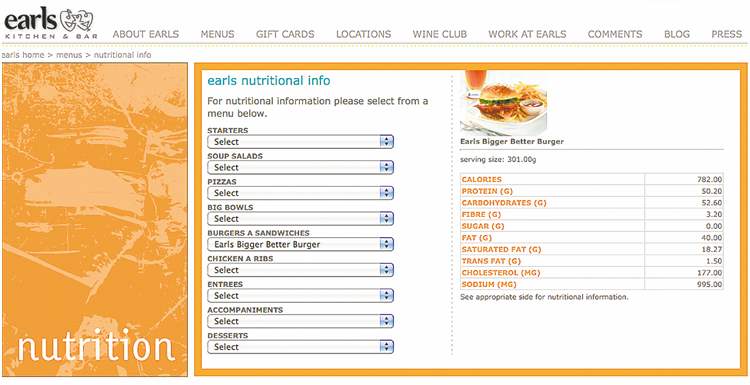
Cate Simpson, communications manager at the company’s Vancouver head office says the decision was purely “altruistic”–mostly to let customers know about potential allergens.
She says the esthetics of putting calorie counts on menus wouldn’t be so pretty.
“I think from a graphic (design) point of view, it wouldn’t be as appealing,” she says, noting that it’s easy for customers to get the nutritional info about her restaurant online — or to ask for a printout from restaurant staff.
She says if chain restaurants are forced to comply with calorie labelling on menus, so should independent restaurants.
Kris Kopansky, managing partner of Earls Polo Park, says his customers have told him they aren’t interested in the calorie counts of the items they order, although they like to know the information is available.
Nevertheless, the Winnipegger says he would have no objections if rules changed, obligating his restaurant to print nutritional information on its menus.
“I’d be fine with that,” says Kopansky. “It’s important for restaurants to be held responsible for what they’re putting in their food. It’s part of doing business.”
Some registered dietitians are against the idea of mandatory calorie labelling on menus because they believe Canadians might sacrifice a nutritious item with something low in calories but light on vitamins.
The Dietitians of Canada says in its official position statement that “more research is needed on this issue to determine its full potential as a way to promote healthier food choices and possibly prevent obesity.”
CancerCare Manitoba President and CEO Dr. Dhali Dhaliwal says listing calorie counts on menus is one of many factors that can help Canadians reduce their weight and, therefore, their cancer risk.
Dhaliwal, an oncologist, says weight is the second leading contributor to cancer after smoking.
“The amount of smokers over the past 30 years has been cut in half,” he says. “Meanwhile, the opposite is true when it comes to weight.”
He says less than 30 per cent of the population was overweight three decades ago. Now, he says, 50 to 60 per cent of the population is overweight or obese.

He says colon cancer, colorectal cancer, esophageal cancer, pancreas cancer, breast cancer, kidney cancer, endometrial cancer and gall bladder cancer are all related to weight.
“The number of calories has been increasing progressively over each decade,” he says, noting that Canadians, along with reducing their overall calorie count, need to up their intake of fruits and vegetables.
“This hasn’t just occurred out of the blue. It’s driven partly by our lifestyle related to eating out a lot more and cheap calories being available readily,” says Dhaliwal.
River Heights resident Priscilla Kerr agrees, although she’s not interested in seeing calorie counts on restaurant menus.
“When I want to diet, I cook at home. I have control what I’m going to eat,” says Kerr, who dines out once every couple of months. “When I’m going (out to a restaurant) I just go and have fun. I don’t want to be stressed about what I’m eating.”

The acupuncturist and pain specialist–who was a family physician in Brazil before she immigrated to Winnipeg — says Canadians who overdose on “fast food and garbage” most likely won’t change their dining habits based on menu labelling.
“I’m not sure it’s going to make a huge difference.”
Have an interesting story you’d like Shamona to write about? Contact her at Shamona.harnett@freepress.mb.ca
Follow Shamona on Twitter: @ShamonaHarnett