

Pulling your weight
Versatile, adaptable old-school calisthenics have broad appeal

Advertisement
Read this article for free:
or
Already have an account? Log in here »
To continue reading, please subscribe:
Monthly Digital Subscription
$1 per week for 24 weeks*
- Enjoy unlimited reading on winnipegfreepress.com
- Read the E-Edition, our digital replica newspaper
- Access News Break, our award-winning app
- Play interactive puzzles
*Billed as $4.00 plus GST every four weeks. After 24 weeks, price increases to the regular rate of $19.95 plus GST every four weeks. Offer available to new and qualified returning subscribers only. Cancel any time.
Monthly Digital Subscription
$4.99/week*
- Enjoy unlimited reading on winnipegfreepress.com
- Read the E-Edition, our digital replica newspaper
- Access News Break, our award-winning app
- Play interactive puzzles
*Billed as $19.95 plus GST every four weeks. Cancel any time.
To continue reading, please subscribe:
Add Free Press access to your Brandon Sun subscription for only an additional
$1 for the first 4 weeks*
*Your next subscription payment will increase by $1.00 and you will be charged $16.99 plus GST for four weeks. After four weeks, your payment will increase to $23.99 plus GST every four weeks.
Read unlimited articles for free today:
or
Already have an account? Log in here »
Hey there, time traveller!
This article was published 11/04/2016 (3640 days ago), so information in it may no longer be current.
The excuses for not working out are dwindling by the day.
Calisthenics — or body-weight training — exercises aren’t exactly new. In fact, they’ve trended before in the fitness world before cooling off, falling into place with myriad other things to do to get in shape.
But in 2016, they’ve returned and it makes perfect sense, experts and participants say.
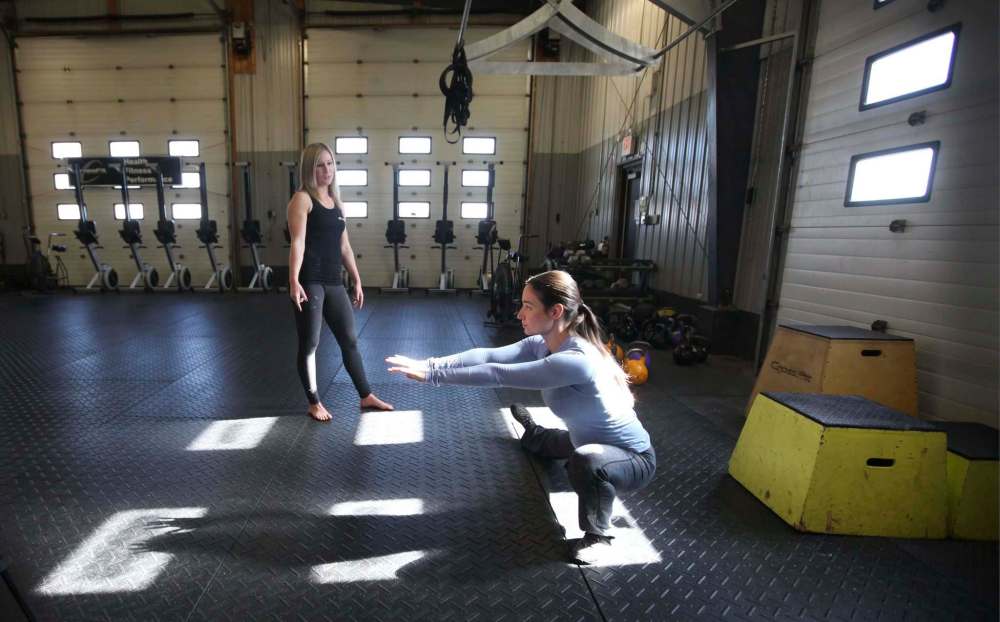
“I feel like it’s been transformed into something completely different this time around — it’s a lot more skill-based,” says Tania Vrga, who runs CrossFit Winnipeg. “People don’t just want to get in shape anymore; they want to learn some cool things. They want to learn to do a handstand, a chin-up or a muscle-up. I think that’s attractive to people and I think that’s why it is coming back.”
Rene Hebert, 54, joined the cardiac rehabilitation program at the Reh-Fit Centre, and says body-weight training got him back in shape.
“They started me off with planks, and from there they pushed me toward a higher and more strenuous exercise program — push-ups, burpees and things like that,” Hebert says. “It helped tremendously.”
Herbert said the free-ranging appeal to body-weight training drew him in and has kept him there.
“It’s a lot easier,” he says. “You don’t have to worry about finding equipment; you just find a spot on the floor and have at it. You don’t need to find a certain weight or a machine — it’s just your own body.”
And the effects of his workout plan have been substantial, he says.
“My endurance and stamina have been a lot better,” Hebert says. “I’m a lot leaner after losing some pounds here and there. I’m trim and physically fit. I’ve been able to do these workouts outside of Reh-Fit.”
The portability Hebert talks about is a massive draw for people, Vrga says.
“That’s one of the top reasons why body-weight training is coming back,” she says. “The convenience and economics of it — you don’t have to pay for equipment at all, you can do it anywhere and you don’t need a gym membership.”
David Holder says the versatility of body-weight workouts allow him to mimic the movements he makes when he races kayaks.
Holder does assisted body-weight workouts, in which he uses tools such as a TRX strap — a stretchable nylon belt with handles that attaches to inside doors, or trees, poles or other anchored locations outdoors — to help him focus on specific muscles and rotations.
“The ability to recreate that with a high resistance, I’ve found it to be way more effective at working on my core than any machine has been able to do,” he says.
“You can be a bit more creative with the workouts and gravity, rather than being tied to a machine that really limits you. I can better simulate the type of action I want to do.”
Jennifer McLaren, a fitness consultant at Reh-Fit, says the functionality of body-weight training offers a level of practicality other workout regimens don’t.
“Being on machines, it doesn’t transfer as well into everyday life, whether it’s sports or just getting groceries,” she says. “(Body-weight training is) time-efficient, cheap and you can take it everywhere. You can do it with friends anywhere, and it doesn’t take a lot of time to plan.”
McLaren says using a TRX or similar strap is beneficial for both beginners and more experienced exercisers.
“You can also make it very difficult, based on the angles you can achieve with using it,” she says.
“For people with balance issues, the straps can assist with their training exercises.”
A strap costs in the $150 range, she says.
scott.billeck@freepress.mb.ca
Scott Billeck is a general assignment reporter for the Free Press. A Creative Communications graduate from Red River College, Scott has more than a decade’s worth of experience covering hockey, football and global pandemics. He joined the Free Press in 2024. Read more about Scott.
Every piece of reporting Scott produces is reviewed by an editing team before it is posted online or published in print — part of the Free Press‘s tradition, since 1872, of producing reliable independent journalism. Read more about Free Press’s history and mandate, and learn how our newsroom operates.
Our newsroom depends on a growing audience of readers to power our journalism. If you are not a paid reader, please consider becoming a subscriber.
Our newsroom depends on its audience of readers to power our journalism. Thank you for your support.
‘Drop and gimme 20!’
A sample of the hundreds of body-weight exercises out there:
• Pushups
• Pull-ups
• Planks
• Lunges
• Squats
• Tuck jumps
• Bear crawl
• Burpees
• Calf raises
• Russian twists
Scott Billeck is a general assignment reporter for the Free Press. A Creative Communications graduate from Red River College, Scott has more than a decade’s worth of experience covering hockey, football and global pandemics. He joined the Free Press in 2024. Read more about Scott.
Every piece of reporting Scott produces is reviewed by an editing team before it is posted online or published in print — part of the Free Press‘s tradition, since 1872, of producing reliable independent journalism. Read more about Free Press’s history and mandate, and learn how our newsroom operates.
Our newsroom depends on a growing audience of readers to power our journalism. If you are not a paid reader, please consider becoming a subscriber.
Our newsroom depends on its audience of readers to power our journalism. Thank you for your support.
Advertisement Advertise With Us
Advertisement Advertise With Us