Transit providers take measures to safeguard against COVID-19

Advertisement

Advertise with us

Some Canadian transit agencies are quietly taking steps to protect customers against the novel coronavirus that's been sounding alarm bells around the world.

Read this article for free:


or

Already have an account? Log in here »

To continue reading, please subscribe:

Subscribe and receive a limited-edition Free Press branded hat or tote.

Digital Subscription

One year of digital access for only $205*

  • Enjoy unlimited reading on winnipegfreepress.com
  • Read the E-Edition, our digital replica newspaper
  • Access News Break, our award-winning app
  • Play interactive puzzles

*First annual payment billed as $205.00 + GST for one year. This annual subscription will automatically renew at $233.00 + GST every 52 weeks (10% off the regular annual price of $259.35). Offer available to new and qualified returning subscribers only. Cancel any time.

To continue reading, please subscribe:

Add Free Press access to your Brandon Sun subscription for only an additional

$1 for the first 4 weeks*

  • Enjoy unlimited reading on winnipegfreepress.com
  • Read the E-Edition, our digital replica newspaper
  • Access News Break, our award-winning app
  • Play interactive puzzles
Start now

*Your next Brandon Sun subscription payment will increase by $1.00 and you will be charged $17.95 plus GST for four weeks. After four weeks, your payment will increase to $24.95 plus GST every four weeks.

Hey there, time traveller!
This article was published 03/03/2020 (2405 days ago), so information in it may no longer be current.

Some Canadian transit agencies are quietly taking steps to protect customers against the novel coronavirus that’s been sounding alarm bells around the world.

Several say they have stepped up efforts to clean vehicles and stations and switched to more aggressive anti-microbial cleansers as a precaution.

Public transit services say there is still no need for concern even as the number of Canadians diagnosed with the virus known as COVID-19 continues to climb.
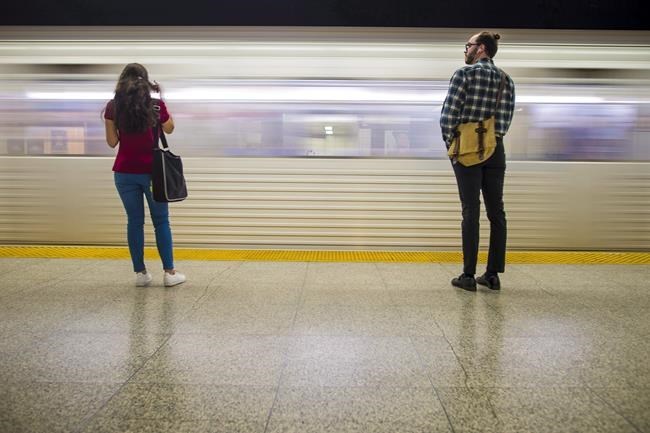
Commuters wait to take the subway at Ossington Station in Toronto on Friday, June 22, 2018. Some Canadian transit agencies are quietly taking steps to protect customers against the novel coronavirus that's been sounding alarm bells around the world. THE CANADIAN PRESS/ Tijana Martin

Health officials have recorded at least 33 cases in the country so far, with Ontario reporting the highest number at 20.

One regional transit provider operating a heavily travelled bus and rail network in southern Ontario says it has already documented one instance of an infected passenger travelling on one of its vehicles.

Metrolinx spokeswoman Anne Marie Aikins says long-lasting disinfectant spray was tested on one of its GO Transit trains recently, and is being rolled out to the entire network after a patient who tested positive for COVID-19 used one of its vehicles to travel home from the airport.

Aikins said the product primarily targets bacteria and mould rather than viruses, but the company views it as a sensible precaution.

“We think it’s just incumbent on us to do whatever we can to protect our staff and our customers,” she said.

Aikins said the presence of an infected passenger was not unexpected and could happen again as the outbreak runs its course, but the company is prepared.

Aikins said the bus on which the patient travelled has also been taken out of service for thorough decontamination. All other vehicles and terminals are being subjected to more regular cleaning, she said, adding hand sanitizer is also being made more widely available to passengers.

Similar measures are being taken at the Toronto Transit Commission, said spokesman Stuart Green.

Railings and other regular points of contact in TTC stations are getting daily wipedowns rather than weekly, he said, adding a disinfectant wipedown has also been added to the daily bathroom-cleaning routine.

Similar measures are in place on the transit provider’s subways, buses and streetcars, he said, adding the company is also considering switching to a long-lasting disinfectant.

Green said the TTC’s action plan is based on advice from Toronto Public Health, which along with comparable agencies across the country has described the risk of contracting the virus as very low.

“Right now they’ve told us that what we’re doing is fine,” he said, “so we’re comfortable that we’re doing all we need to do now.”

Transit agencies in Montreal and Vancouver said they, too, are taking cues from public health officials, who have long maintained that individual measures such as washing hands regularly, covering coughs and sneezes and staying home if ill offer the most effective protection from the virus.

“Provincial Health Services says the risk to the public and staff remains low and it has not directed us to make any operational changes at this time,” said a statement from Vancouver’s TransLink. “We are working closely with Provincial Health Services Authority to monitor this situation.”

The Societe de Transport de Montreal said it’s urging passengers and staff to observe recommended hygiene protocols, but offered no other details.

The outbreak of COVID-19, which originated in the Chinese city of Wuhan, has sickened tens of thousands of people around the world. The global death toll has climbed over 3,100, but Canadian authorities have not reported any fatalities.

Almost nine times more cases were reported outside China than inside it between Sunday and Monday, according to the head of the World Health Organization, Tedros Adhanom Ghebreyesus. The organization, however, has not classified the outbreak as a pandemic, and Ghebreyesus said on Monday that there’s still time to contain the spread of the virus.

This report by The Canadian Press was first published March 3, 2020.

Report Error Submit a Tip

More Stories

Six high school hockey programs ceased operations following new Hockey Manitoba policy

Joshua Frey-Sam 7 minute read Preview

Six high school hockey programs ceased operations following new Hockey Manitoba policy

Joshua Frey-Sam 7 minute read Updated: Yesterday at 8:19 PM CDT

She lived the best of both worlds.

For the last three years, the 17-year-old wore a sweater for two different hockey programs — her high school team and AAA club in the Manitoba Female Hockey League — and was preparing to flourish in both colours again this winter.

Recently, however, the blue-liner was disappointed to learn she is no longer eligible to play her Grade 12 season with her school owing to a new policy imposed by Hockey Manitoba that bans players from participating in the Manitoba Women’s High School Hockey League if they are rostered on a U18 AAA team.

The rule applies to all athletes who play for both Winnipeg-based and rural AAA teams.

Read
Updated: Yesterday at 8:19 PM CDT

Health minister warns $1.2 billion in annual federal funding set to expire in March

Scott Billeck 4 minute read Preview

Health minister warns $1.2 billion in annual federal funding set to expire in March

Scott Billeck 4 minute read Thursday, Oct. 1, 2026

Manitoba’s health minister is warning of possible cuts to health care with $1.2 billion in annual funding from Ottawa set to expire next year.

“We’re very concerned that what would be the largest cut to health care in a generation is right in front of us,” Health Minister Uzoma Asagwara said Thursday at the Manitoba legislature. “It means that services that Manitobans depend on will be in jeopardy and be at risk.

“Any reductions, any cuts from Canada, will have direct impacts on the health outcomes of Manitobans.”

Asagwara, who serves as the provincial and territorial health minister lead, chaired a virtual meeting Tuesday with provincial and territorial health ministers to discuss federal funding for health care, mental health care and substance use services, which is scheduled to expire March 31, 2027.

Read
Thursday, Oct. 1, 2026

Kent Monkman debuts beaver sculpture in Toronto’s ambitious new waterfront park

Alex Nino Gheciu, The Canadian Press 2 minute read Preview

Kent Monkman debuts beaver sculpture in Toronto’s ambitious new waterfront park

Alex Nino Gheciu, The Canadian Press 2 minute read Updated: Yesterday at 3:33 PM CDT

TORONTO - Kent Monkman’s first-ever public art installation is dam good.

The celebrated Cree artist’s new permanent sculpture, dubbed “The Colony,” debuts Wednesday in Toronto’s east end.

The 15-foot-high bronze structure features beavers dancing, feasting and celebrating, evoking Indigenous ceremonies.

It highlights the vital role of beavers in the natural, Indigenous and colonial histories of Turtle Island, says a release.

Read
Updated: Yesterday at 3:33 PM CDT

Khan should’ve taken high road: Goertzen

Carol Sanders 5 minute read Preview

Khan should’ve taken high road: Goertzen

Carol Sanders 5 minute read Yesterday at 6:39 PM CDT

The veteran Progressive Conservative who championed Obby Khan’s leadership bid says the former Blue Bomber dropped the ball by dissing his Tory teammates before he stepped down.

“I wouldn’t recommend it, and I didn’t recommend it,” Kelvin Goertzen (Steinbach) said in an interview Friday.

Khan resigned as PC leader and quit the caucus Monday saying some members were secretly plotting his ouster, even after he won a confidence vote on Sept. 25.

On Tuesday, Khan lashed out in a CJOB interview, naming the alleged plotters, saying constituents deserved to know which of their elected representatives “lacked moral integrity.” Khan told the Free Press he was “deeply emotionally hurt,” and felt stabbed in the back.

Read
Yesterday at 6:39 PM CDT

A spiritual vision will help anchor a health civic outlook

John Longhurst 5 minute read 2:01 AM CDT

We have an election coming up. With that in mind, the Free Press asked some of their columnists to write about the challenges ahead and how the city can become better.

For Tom Brodbeck, the main challenge is finances — and how candidates will pay for their many promises for fixing roads, improving public safety and making transit better.

Rebecca Chambers said that the concerns of inner-city residents need to be taken seriously by those who aspire to work at city hall.

Niigaan Sinclair said the most pressing issue in Winnipeg isn’t construction projects, light-rail transit, public safety, taxes or social services. For him, it’s the city’s relationship with Indigenous people.

May be whiff of truth to ex’s odour ardour

Maureen Scurfield 5 minute read 2:01 AM CDT

DEAR MISS LONELYHEARTS: I ran into an old boyfriend I used to curl on a team with, and we went for drinks. We’ve been almost eight years apart, and I couldn’t remember why we broke up, as we always had such a great time together.

It wasn’t until the second date — this time on a weekend — that it came back to me, with a jolt. Pee-yew! I remembered he doesn’t use deodorant on weekends. Why? He enjoys his own body odour. I recalled that a bit too late, and it was just as awful as ever! I went home early.

Tonight, he called and I refused him another date. I said, “Think back. You remember why we broke up?” Then he said, “Oh yeah, you hated my no-deodorant weekend policy. Well, guess what? Some women don’t mind!” I said I really doubted that, and that ended the conversation. Miss L., wouldn’t any women find stinky underarms offensive?

— Sensitive Nose, Fort Richmond