Archaic paper records submitted by fax hold up real-time COVID-19 data

Advertisement

Advertise with us

OTTAWA - The old-fashioned way Canada records deaths means the country could be missing out on data important to addressing the COVID-19 crisis.

Read this article for free:


or

Already have an account? Log in here »

To continue reading, please subscribe:

Subscribe and receive a limited-edition Free Press branded hat or tote.

Digital Subscription

One year of digital access for only $205*

  • Enjoy unlimited reading on winnipegfreepress.com
  • Read the E-Edition, our digital replica newspaper
  • Access News Break, our award-winning app
  • Play interactive puzzles

*First annual payment billed as $205.00 + GST for one year. This annual subscription will automatically renew at $233.00 + GST every 52 weeks (10% off the regular annual price of $259.35). Offer available to new and qualified returning subscribers only. Cancel any time.

To continue reading, please subscribe:

Add Free Press access to your Brandon Sun subscription for only an additional

$1 for the first 4 weeks*

  • Enjoy unlimited reading on winnipegfreepress.com
  • Read the E-Edition, our digital replica newspaper
  • Access News Break, our award-winning app
  • Play interactive puzzles
Start now

*Your next Brandon Sun subscription payment will increase by $1.00 and you will be charged $17.95 plus GST for four weeks. After four weeks, your payment will increase to $24.95 plus GST every four weeks.

Hey there, time traveller!
This article was published 12/05/2020 (2335 days ago), so information in it may no longer be current.

OTTAWA – The old-fashioned way Canada records deaths means the country could be missing out on data important to addressing the COVID-19 crisis.

The confirmed number of COVID-19 deaths — about 4,900 across Canada as of Monday afternoon — represents people who have tested positive for the viral disease.

Experts suggest that may not tell the whole story.
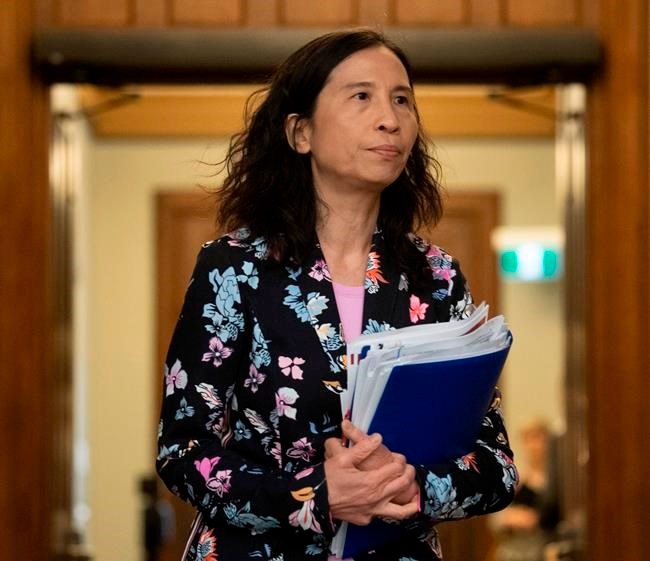
Canada's Chief Public Health Officer Theresa Tam arrives for a daily news conference on Parliament Hill, Monday, May 11, 2020 in Ottawa. Health research experts say the archaic way Canada records deaths means the country could be missing out on important data to help address the COVID-19 crisis. THE CANADIAN PRESS/Adrian Wyld

Testing protocols vary province to province, making confirmed cases an imperfect measure of the true impact of the virus.

Comparing the total number of deaths to previous years could offer a better insight, and the government is working with Statistics Canada to gather and analyze that information.

But according to Laura Rosella, an associate professor of public health at the University of Toronto, it’s difficult to get the data quickly enough for it to be useful in Canada.

“The way we gather death information is quite archaic,” said Rosella, who also serves as the scientific director for the university’s Population Health Analytics Laboratory.

When someone dies in Canada, a doctor typically fills out a death certificate on paper and faxes it to the provincial body responsible for processing those statistics.

That means it can take several years to get verified data about the number of people who die in a given year.

The numbers are also sometimes reported by hospitals or coroners using different methods, resulting in different numbers — which then need to be reconciled to be of any use.

“Our system is not set up for any type of real-time feedback of mortality,” Rosella said, making it hard for governments to make data-driven decisions.

Former federal health minister Jane Philpott, who has been on the front lines in the battle against COVID-19 at Markham Stouffville Hospital in Markham, Ont., expressed her frustration with Canada’s data situation.

“We are infuriatingly decades behind in data technology for public health,” Philpott, a former Liberal and then Independent MP who is set to take on a new role as dean at the health sciences faculty at Queen’s University, wrote on Twitter Sunday.

In a crisis, governments often work to speed up the process for certain types of deaths.

Canada’s chief public health officer Dr. Theresa Tam said that’s what happened during the opioids crisis, for example, as the government looked for new ways to record overdose deaths.

She said Ottawa hopes to use the same methods to get more timely access to COVID-19 data.

“We have highlighted some of the gaps in real-time information on the COVID-19 deaths themselves,” Tam said Monday at a briefing in Ottawa. “We are doing our very best with the provinces to try to see if we can address those gaps.”

Data in the United Kingdom shows a greater spike in total deaths since March than total confirmed COVID-19 cases would suggest, according to The Health Foundation in Britain.

Information about how many more people are dying overall this year compared to 2019 would also give insight into some of the other consequences of the pandemic, Tam said.

Doctors across the country have noted lower rates of emergency room visits, suggesting people may not be going to the hospital when they need help.

“Excess mortality is something we have to look at in parallel with the COVID-19 deaths,” she said.

Comparing the number of deaths to previous years is often used to look back on a flu season to measure how severe it was, said Rosella, who often uses mortality data in her research.

She said there are many areas of research and public health that would benefit from more up-to-date information.

“I actually think mortality tells us a lot about the health system,” she said. “Without the timely information, we actually can’t act on it and can’t use as an indicator in a meaningful way.”

There’s been talk for years about improving Canada’s processes by making them digital and creating a national database or registry, she said.

But those improvements require investment, and so far there’s been no action.

This report by The Canadian Press was first published May 12, 2020.

Report Error Submit a Tip

More Stories

May be whiff of truth to ex’s odour ardour

Maureen Scurfield 5 minute read 2:01 AM CDT

DEAR MISS LONELYHEARTS: I ran into an old boyfriend I used to curl on a team with, and we went for drinks. We’ve been almost eight years apart, and I couldn’t remember why we broke up, as we always had such a great time together.

It wasn’t until the second date — this time on a weekend — that it came back to me, with a jolt. Pee-yew! I remembered he doesn’t use deodorant on weekends. Why? He enjoys his own body odour. I recalled that a bit too late, and it was just as awful as ever! I went home early.

Tonight, he called and I refused him another date. I said, “Think back. You remember why we broke up?” Then he said, “Oh yeah, you hated my no-deodorant weekend policy. Well, guess what? Some women don’t mind!” I said I really doubted that, and that ended the conversation. Miss L., wouldn’t any women find stinky underarms offensive?

— Sensitive Nose, Fort Richmond

Six high school hockey programs ceased operations following new Hockey Manitoba policy

Joshua Frey-Sam 7 minute read Preview

Six high school hockey programs ceased operations following new Hockey Manitoba policy

Joshua Frey-Sam 7 minute read Updated: Yesterday at 8:19 PM CDT

She lived the best of both worlds.

For the last three years, the 17-year-old wore a sweater for two different hockey programs — her high school team and AAA club in the Manitoba Female Hockey League — and was preparing to flourish in both colours again this winter.

Recently, however, the blue-liner was disappointed to learn she is no longer eligible to play her Grade 12 season with her school owing to a new policy imposed by Hockey Manitoba that bans players from participating in the Manitoba Women’s High School Hockey League if they are rostered on a U18 AAA team.

The rule applies to all athletes who play for both Winnipeg-based and rural AAA teams.

Read
Updated: Yesterday at 8:19 PM CDT

A day on the campaign trail: Winnipeg's mayor, seeking a second term, does double duty

Malak Abas 12 minute read Preview

A day on the campaign trail: Winnipeg's mayor, seeking a second term, does double duty

Malak Abas 12 minute read Updated: Yesterday at 5:56 PM CDT

In the weeks leading up to the civic election, Scott Gillingham has been performing a juggling act: he’s running to be Winnipeg’s 45th mayor, while still serving as its 44th.

“If someone asks me about the campaign, I’m going to answer them. But I think for most people, I’m the mayor of Winnipeg, even if I’m showing up as a candidate,” Gillingham, 58, says. “I try to do all I can to maintain that distinction.”

The Free Press joined Gillingham on a recent rainy September Saturday on the campaign trail, where he served in both roles during an event-laden day. City council’s final meeting before the Oct. 28 election was days earlier.

In Winnipeg, it’s rare for an incumbent to be defeated. But Gillingham knows his win in 2022 wasn’t exactly a landslide — he won with 27.5 per cent of the vote — and he’s been thinking about his second term ever since.

Read
Updated: Yesterday at 5:56 PM CDT

Jets bench boss Arniel talks rebuilding from last season’s struggles

Mike McIntyre and Ken Wiebe 12 minute read Preview

Jets bench boss Arniel talks rebuilding from last season’s struggles

Mike McIntyre and Ken Wiebe 12 minute read Thursday, Oct. 1, 2026

Scott Arniel has a lot on his plate these days.

But the head coach of the Winnipeg Jets took some time Thursday to sit down with Free Press hockey writers Mike McIntyre and Ken Wiebe to discuss a number of topics on the eve of a new hockey season. This interview has been condensed and edited for clarity.

Wiebe: What was the evaluation of last season like? What did you personally do in an attempt to improve after going from first-overall to 26th-overall?

I just went back and looked at things and made sure my communication was where it needed to be with my players. Was my communication where it needed to be with my boss, with my general manager (Kevin Cheveldayoff)? How our coaching staff worked. How we handled highs and lows. Things I felt I could have done better.

Read
Thursday, Oct. 1, 2026

A 22-year-old man is dead and an 18-year-old is in hospital in critical condition after a two-vehicle crash on Highway 8 on Thursday evening.

A Gimli RCMP officer was driving north on the highway, near Riverton, when he witnessed the collision at about 6:45 p.m.

A vehicle headed north had passed the Mountie at a high speed before colliding with an SUV that was turning west onto Provincial Road 329 from Highway 8.

The driver of the first vehicle, an 18-year-old man from Arborg, was rushed to hospital by a helicopter ambulance with injuries RCMP describe as serious and life-threatening.

Mayoral candidate Vogiatzakis criticized for living outside Winnipeg

Malak Abas 4 minute read Preview

Mayoral candidate Vogiatzakis criticized for living outside Winnipeg

Malak Abas 4 minute read Updated: Yesterday at 6:03 PM CDT

A mayoral hopeful took heat from other candidates Friday for living outside Winnipeg while running in the civic election.

Mike Vogiatzakis’s primary residence is in the Rural Municipality of St. Andrews, about 25 kilometres north of Winnipeg — a community with its own mayor and councillors.

But the funeral director said he owns a home in Winnipeg where he divides his time, and he would move to the city full-time if elected mayor.

“It doesn’t matter where a person lives. Why are we dividing St. Andrews and Manitoba and Winnipeg? I’ve met the criteria to run for mayor,” Vogiatzakis said Friday morning.

Read
Updated: Yesterday at 6:03 PM CDT