COVID-19 pandemic highlights need for more public toilets, experts say

Advertisement

Advertise with us

TORONTO - The COVID-19 pandemic is highlighting the need for more public toilets in communities across Canada, particularly as softening restrictions encourage people to spend more time outside their homes, advocates and experts say.

Read this article for free:


or

Already have an account? Log in here »

To continue reading, please subscribe:

Subscribe and receive a limited-edition Free Press branded hat or tote.

Digital Subscription

One year of digital access for only $205*

  • Enjoy unlimited reading on winnipegfreepress.com
  • Read the E-Edition, our digital replica newspaper
  • Access News Break, our award-winning app
  • Play interactive puzzles

*First annual payment billed as $205.00 + GST for one year. This annual subscription will automatically renew at $233.00 + GST every 52 weeks (10% off the regular annual price of $259.35). Offer available to new and qualified returning subscribers only. Cancel any time.

To continue reading, please subscribe:

Add Free Press access to your Brandon Sun subscription for only an additional

$1 for the first 4 weeks*

  • Enjoy unlimited reading on winnipegfreepress.com
  • Read the E-Edition, our digital replica newspaper
  • Access News Break, our award-winning app
  • Play interactive puzzles
Start now

*Your next Brandon Sun subscription payment will increase by $1.00 and you will be charged $17.95 plus GST for four weeks. After four weeks, your payment will increase to $24.95 plus GST every four weeks.

Hey there, time traveller!
This article was published 21/05/2020 (2327 days ago), so information in it may no longer be current.

TORONTO – The COVID-19 pandemic is highlighting the need for more public toilets in communities across Canada, particularly as softening restrictions encourage people to spend more time outside their homes, advocates and experts say.

The health crisis is drawing broader attention to an issue that has long been a barrier for racialized, trans and disabled people, as well those dealing with homelessness or poverty, the experts say.

Scarce access to washrooms was recently raised as a hurdle for essential workers, such as transit and truck drivers who could no longer rely on coffee shops and other businesses once those were ordered closed.
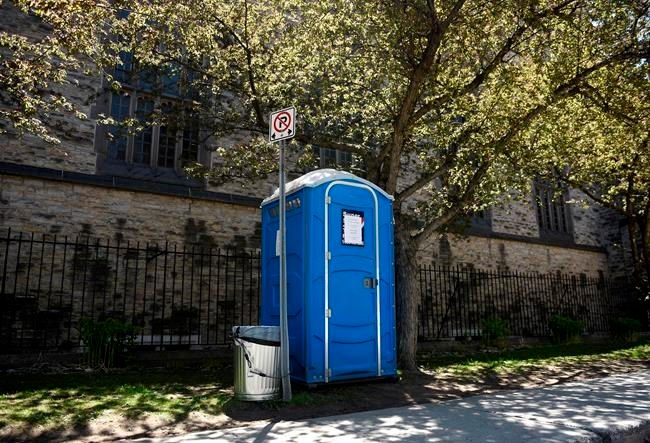
A porta-pottie beside Knox Presbyterian Church in downtown Ottawa, placed to allow people including those who are homeless or precariously housed to access a washroom, is seen on Wednesday, May 20, 2020 during the COVID-19 pandemic. THE CANADIAN PRESS/Justin Tang

In the early days of Ontario’s lockdown, Toronto Mayor John Tory pleaded with shuttered businesses to allow essential workers to use their bathrooms.

But as some provinces begin to reopen their economies — and residents increasingly venture outside — the demand for restrooms will rise, even though commercial facilities will remain largely off-limits, said Lezlie Lowe, author of “No Place To Go: How Public Toilets Fail Our Private Needs.”

“We don’t have this tradition of on-street, accessible, paid-for-by-municipal-governments bathroom provision. What we have in Canada is, we have Starbucks and Tim Hortons and McDonald’s and the other cafes and restaurants involved that we go into,” she said.

“We really consider those public toilets, but they’re not — they’re publicly accessible toilets, they’re effectively customer toilets.”

With those still out of commission, “people are going to have a sort of slap in the face and realize, ‘Oh my god, I was making do all this time with these publicly accessible toilets,’ and now people will hopefully start to realize how bad it is,” she said.

The dearth of public toilets could also undermine the economic recovery by preventing people from staying out longer and spending more money, Lowe said.

Some Canadian cities, including Toronto and Ottawa, have installed temporary portable washrooms and handwashing stations to help offset the closure of commercial and civic spaces.

“The city continues to explore opportunities to locate additional portable toilets and handwashing stations at strategic locations across the city,” Toronto Coun. Joe Cressy wrote in announcing the new facilities earlier this month.

In Prince George, B.C., municipal officials have reopened public washrooms in a downtown plaza for the duration of the pandemic, with the facilities in operation and monitored in the mornings and evenings.

While so-called porta-potties serve an important purpose, they don’t fulfill the same range of needs as permanent facilities, which are often used for child care, administering medication and other things, said Emily Scoular, who wrote her master’s thesis at the University of British Columbia on public washrooms.

The costs of building and maintaining public toilets have typically been a deterrent for municipalities, but Scoular said the current situation shows a need to rethink how much of that responsibility has been relegated to private business.

“You’re asking people to be healthy, leave their homes, get exercise, participate in the public realm, and I think the city and city facilities need to kind of come and meet us on that,” she said.

“I know Toronto and Vancouver are closing streets to allow (physical) distancing, and that’s one thing that encourages people to leave their houses, but another is making sure needs are met.”

For some advocates whose calls for more public toilets vastly predate the pandemic, the attention recently given to the issue is an encouraging first step.

“Maybe this is what it takes to get some serious attention paid to public health, including toi­lets,” those behind Ottawa’s “GottaGo!” campaign wrote in a recent op-ed published in a local community newspaper.

“A crisis can be an opportunity, so now is the time for all of us to advocate for a network of public toi­lets that include running water and soap for handwashing.”

This report by The Canadian Press was first published on May 21, 2020.
Report Error Submit a Tip

More Stories

’Disgusting’ posters being investigated by police

Morgan Modjeski 4 minute read Yesterday at 2:22 PM CDT

The Winnipeg Police Service major crimes unit is investigating what some have labelled offensive and hateful posters on full-display at a Winnipeg home.

One of the people irked by the display is Gracie Garrett. She’s has lived on Ashburn Street in Winnipeg’s Minto neighbourhood for almost ten years. She’s never felt unsafe in the neighbourhood before, but now, a set of posters plastered on a nearby house are making her feel uneasy.

The five signs, posted facing the street prominently on a front window, contain a slur, refer to Nazis as “heroes” and call Muslims, Christians and other groups “evil.”

Learning of the signs Friday, Garrett said she’ll be reporting the posters to police, as she worries they incite and promote violence.

Brandonmeat packer thriving on its own

Abiola Odutola 3 minute read Preview

Brandonmeat packer thriving on its own

Abiola Odutola 3 minute read Yesterday at 2:01 AM CDT

BRANDON — Canada Packers has strengthened its business and laid the foundation for future growth during its first year as an independent company, its president says.

The Brandon-based pork producer, separated from Maple Leaf Foods in October 2025, established its own leadership, strategy, systems, culture and identity while continuing operations across its hog production farms and regional hog barns in southern and eastern Manitoba.

The company’s first year was focused on building a successful standalone business while continuing to serve customers, communities and shareholders, president Dennis Organ said.

“Market conditions over the past year have been more challenging than we anticipated when we became a separate entity,” he said in an email. “Despite that, we continued to execute against our priorities, including increasing processing volumes, maintaining disciplined operations and strengthening the business.”

Read
Yesterday at 2:01 AM CDT

Living the dream

Ken Wiebe 7 minute read Preview

Living the dream

Ken Wiebe 7 minute read Yesterday at 4:48 PM CDT

DETROIT – As Tyrel Bauer took a left turn out of the tunnel from the Winnipeg Jets dressing room and into the stands, he was met with a hearty round of applause from the 25 friends and family members who had made the trek from various points around North America.

Bauer had just realized a childhood dream and the significance of the moment was not lost on some of his biggest supporters.

“It was a special walk, for sure. A special walk,” Bauer said on Saturday afternoon before the Jets departed for a two-game road trip that begins on Sunday in Detroit against the Red Wings. “Those people who came – and many more that weren’t there and were cheering on from afar – they’ve always been there.

“I wanted that for my family, maybe even more than I wanted it for me. They’ve been through thick and thin. I’ve stressed mom out quite a bit over the years doing my job. That meant a lot for them and I’m really happy they could be there for it.”

Read
Yesterday at 4:48 PM CDT

Volunteer pop-up library axed from Manitoba Youth Centre

Matthew Frank 4 minute read Preview

Volunteer pop-up library axed from Manitoba Youth Centre

Matthew Frank 4 minute read Updated: Yesterday at 11:25 AM CDT

Manitoba Corrections has cancelled a pop-up library program at the Manitoba Youth Centre, leaving inmates without librarian services and fewer options to borrow certain books.

The Prison Libraries Committee, part of the non-profit Manitoba Library Association, operated and funded the volunteer program since 2024 before it was shut down by the province last month. The group previously partnered with the province to offer the service because the facility has no dedicated library of its own.

“It is concerning that community members who are incarcerated, especially youth, are losing out on meaningful programming, access to information and rehabilitation efforts, which are offered at no cost to (Manitoba) Corrections. We urge Manitoba Justice to promote more library services and programming, not less,” said a Sept. 24 letter from the non-profit addressed to the justice minister.

Ashley Huot, chair of the Prison Libraries Committee, said she was puzzled when she received an email last month from Manitoba Corrections stating that the pop-up library was no longer needed.

Read
Updated: Yesterday at 11:25 AM CDT

Six high school hockey programs ceased operations following new Hockey Manitoba policy

Joshua Frey-Sam 7 minute read Preview

Six high school hockey programs ceased operations following new Hockey Manitoba policy

Joshua Frey-Sam 7 minute read Friday, Oct. 2, 2026

She lived the best of both worlds.

For the last three years, the 17-year-old wore a sweater for two different hockey programs — her high school team and AAA club in the Manitoba Female Hockey League — and was preparing to flourish in both colours again this winter.

Recently, however, the blue-liner was disappointed to learn she is no longer eligible to play her Grade 12 season with her school owing to a new policy imposed by Hockey Manitoba that bans players from participating in the Manitoba Women’s High School Hockey League if they are rostered on a U18 AAA team.

The rule applies to all athletes who play for both Winnipeg-based and rural AAA teams.

Read
Friday, Oct. 2, 2026

May be whiff of truth to ex’s odour ardour

Maureen Scurfield 5 minute read Yesterday at 2:01 AM CDT

DEAR MISS LONELYHEARTS: I ran into an old boyfriend I used to curl on a team with, and we went for drinks. We’ve been almost eight years apart, and I couldn’t remember why we broke up, as we always had such a great time together.

It wasn’t until the second date — this time on a weekend — that it came back to me, with a jolt. Pee-yew! I remembered he doesn’t use deodorant on weekends. Why? He enjoys his own body odour. I recalled that a bit too late, and it was just as awful as ever! I went home early.

Tonight, he called and I refused him another date. I said, “Think back. You remember why we broke up?” Then he said, “Oh yeah, you hated my no-deodorant weekend policy. Well, guess what? Some women don’t mind!” I said I really doubted that, and that ended the conversation. Miss L., wouldn’t any women find stinky underarms offensive?

— Sensitive Nose, Fort Richmond