Palliative care has been put on the backburner during pandemic, experts say
Advertisement
Read this article for free:
or
Already have an account? Log in here »
To continue reading, please subscribe:

Digital Subscription
One year of digital access for only $205*
- Enjoy unlimited reading on winnipegfreepress.com
- Read the E-Edition, our digital replica newspaper
- Access News Break, our award-winning app
- Play interactive puzzles
*First annual payment billed as $205.00 + GST for one year. This annual subscription will automatically renew at $233.00 + GST every 52 weeks (10% off the regular annual price of $259.35). Offer available to new and qualified returning subscribers only. Cancel any time.
To continue reading, please subscribe:
Add Free Press access to your Brandon Sun subscription for only an additional
$1 for the first 4 weeks*
- Enjoy unlimited reading on winnipegfreepress.com
- Read the E-Edition, our digital replica newspaper
- Access News Break, our award-winning app
- Play interactive puzzles
*Your next Brandon Sun subscription payment will increase by $1.00 and you will be charged $17.95 plus GST for four weeks. After four weeks, your payment will increase to $24.95 plus GST every four weeks.
Read unlimited articles for free today:
or
Already have an account? Log in here »
Hey there, time traveller!
This article was published 31/05/2020 (2324 days ago), so information in it may no longer be current.
When Kathryn Butler Malette learned her younger sister was diagnosed with COVID-19, she was confronted with a waking nightmare: that her beloved sibling might die alone.
While Ontario’s government has said facilities can allow end-of-life visits, Butler Malette said she was told the Ottawa-area long-term care home where her sister lives didn’t want to chance it, given the magnitude of the outbreak they were experiencing.
“I was there when my mother passed away. I was holding her when she passed away. And the thought that I could not be there for my sister, I couldn’t bear it. I could not bear the thought of it,” she said.
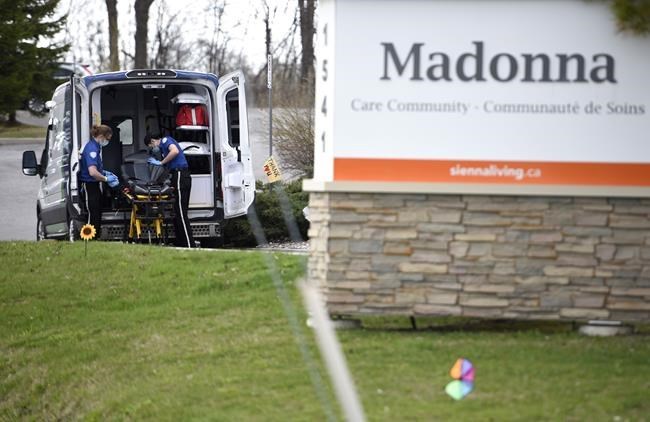
Experts and insiders say that palliative care, which focuses on comfort, has become less of a priority during the COVID-19 pandemic, primarily due to visitor restrictions and even bans born out of staffing shortages and a need to limit exposure to the virus.
But some say it’s time to loosen those restrictions and find a balance between keeping everyone safe and allowing dying patients to say goodbye to their loved ones.
Butler Malette’s mother had also lived in that same long-term care home until her death last year, and she said until now the family’s experience there had been overwhelmingly positive.
But the facility today is almost unrecognizable. The 160-bed home has seen 43 of 58 residents infected with COVID-19 die. Dozens of staff members also fell ill with the novel coronavirus, including a personal support worker who died.
The facility, Madonna Care Community in Orleans, Ont., did not comment on specific cases but said in a written statement that it has always worked to make sure family members could have end-of-life visits.
Butler Malette said that through conversations with staff, she learned that her sister was unlikely to do well on a ventilator, making her prognosis bleak.
They were able to speak on the phone, but her sister was so ill — with a fever, aches and pains — she was only able to carry a conversation for a matter of minutes.
“But if I’d been there, I could have sat with her, just read to her, just been in the room,” she said.
Butler Malette would have done anything to be able to be with her sister through her sickness, worn any personal protective equipment, taken any precautions, she said — especially if her sister were to have reached end of life.
It didn’t get that far — after a few dips, Butler Malette’s sister has recovered, though the two have yet to be reunited — but the predicament is playing out in long-term care homes and hospices across the country, said Sharon Baxter, executive director of the Canadian Hospice Palliative Care Association.
While many provinces are loosening their policies on visiting dying family members, Baxter said, the facilities caring for patients are not always following suit.
She said it’s time for that to change.
“We’re wanting to call attention to the issue that we could do much better with compassionate protocols. And now that things are starting to loosen up … now’s the time for us to look at, can we provide PPE for family members?” she said. “Can we make sure that family members can get in and say their goodbyes?”
She said that during this crisis, palliative care has been put on the backburner.
“They do dying, but they don’t necessarily do hospice and palliative care,” Baxter said. “We hope that most of them do a great job, but it’s hit and miss.”
That reality was put on stark display last week when the Canadian Armed Forces released a report on the harrowing conditions in many of the Ontario and Quebec long-term care homes where they’ve been deployed.
In Ontario, the military found people left in filth for weeks, others left on the floor where they had fallen, cockroach infestations, people choking while being improperly fed, patients with pressure sores, and seniors crying for help for hours to no avail.
Allegations also included failure to isolate patients who had tested positive for COVID-19 from the rest of the homes and a host of hygiene issues.
In Quebec, the military revealed a widespread lack of personnel and high absenteeism, which the Forces said has negatively affected patient hygiene.
Doris Grinspun, chief executive officer of the Registered Nurses’ Association of Ontario, said she’s been sounding the alarm on those issues for well over a decade.
“From quality of life to quality of death, you cannot deliver it if you don’t have enough hands, and also if you don’t have enough knowledge,” she said.
Grinspun said her organization has been advocating for each patient to get four hours of direct care each day.
“Many residents need help with even walking, they even need help with moving in bed, they need help with eating,” she said. “Just picture that.”
She said that because there aren’t enough nurses in the homes, residents aren’t getting the palliative care they signed up for. For instance, many are not getting moved in their beds to avoid bedsores.
Grinspun added that some who have contracted COVID-19 aren’t getting the support they need to prevent from choking on their own saliva. Typically, she said, nurses would use suction to prevent that from happening, but because that creates aerosols that spread the virus, they are forced instead to administer medications with uncomfortable side effects.
“You can you can hear the frustration and quite frankly the anger that I have, because I’m so fed up with this,” she said. “It’s not fair to them, it’s not fair to their family, and it’s not fair to the staff.”
Mahoganie Hines, a registered nurse at Hospice Niagara in southern Ontario, has been working on the front-lines during the pandemic to make sure those in her care have a good death, and their loved ones have a chance to say goodbye.
She said at the hospice where she works, visitors are still being allowed in — albeit one at a time, so the number of people who can see their loved ones is limited.
She said she and her colleagues help with video and phone calls — holding up iPads and dialing telephones — so that hospice residents are able to connect with more of their loved ones. And for those who aren’t able to come into the building, she said, they do “window visits.”
“The family members that maybe aren’t their designated visitor, they can come visit at the window,” Hines said. “We’ll push the bed over to the window, so that way they can see them and that way they can hear them.”

Other things they’re doing to prioritize comfort include taking more time while giving them showers and baths, and bringing them outside.
“Even if they can’t get up, we can take them outside in their bed so they can see the sunshine or they can smell the rain,” she said.
Hines said all of those efforts mean hospice staff are stretched thinner than usual.
“It definitely can be more labour intensive,” she said. “And it’s not to say that it doesn’t wear on us, either. Right? Like, I think the reality is, is everybody is collectively grieving. And we’re grieving many, many things right now … I think some of that grief is that loss of normalcy — of what we once thought was normal — because now as far as we can see it, it’s gone.”
This report by The Canadian Press was first published May 31, 2020.
Related Articles
One new case of virus as reopening plan ramps up Monday
Advertisement Advertise With Us
Advertisement Advertise With Us