Feds add $204M for anti-pandemic measures in Indigenous communities and institutions

Advertisement

Advertise with us

Ottawa will spend an additional $204 million targeted at child care, education and infrastructure to help Indigenous communities fight the COVID-19 pandemic, Prime Minister Justin Trudeau announced Friday.

Read this article for free:


or

Already have an account? Log in here »

To continue reading, please subscribe:

Subscribe and receive a limited-edition Free Press branded hat or tote.

Digital Subscription

One year of digital access for only $205*

  • Enjoy unlimited reading on winnipegfreepress.com
  • Read the E-Edition, our digital replica newspaper
  • Access News Break, our award-winning app
  • Play interactive puzzles

*First annual payment billed as $205.00 + GST for one year. This annual subscription will automatically renew at $233.00 + GST every 52 weeks (10% off the regular annual price of $259.35). Offer available to new and qualified returning subscribers only. Cancel any time.

To continue reading, please subscribe:

Add Free Press access to your Brandon Sun subscription for only an additional

$1 for the first 4 weeks*

  • Enjoy unlimited reading on winnipegfreepress.com
  • Read the E-Edition, our digital replica newspaper
  • Access News Break, our award-winning app
  • Play interactive puzzles
Start now

*Your next Brandon Sun subscription payment will increase by $1.00 and you will be charged $17.95 plus GST for four weeks. After four weeks, your payment will increase to $24.95 plus GST every four weeks.

Hey there, time traveller!
This article was published 30/10/2020 (2163 days ago), so information in it may no longer be current.

Ottawa will spend an additional $204 million targeted at child care, education and infrastructure to help Indigenous communities fight the COVID-19 pandemic, Prime Minister Justin Trudeau announced Friday.

Trudeau said the government is spending $120 million to support early learning and child-care facilities in First Nations, Inuit and Métis communities during the pandemic.

“Access to safe and culturally relevant early learning and child care is essential to the recovery of Indigenous communities from COVID-19,” Trudeau said.
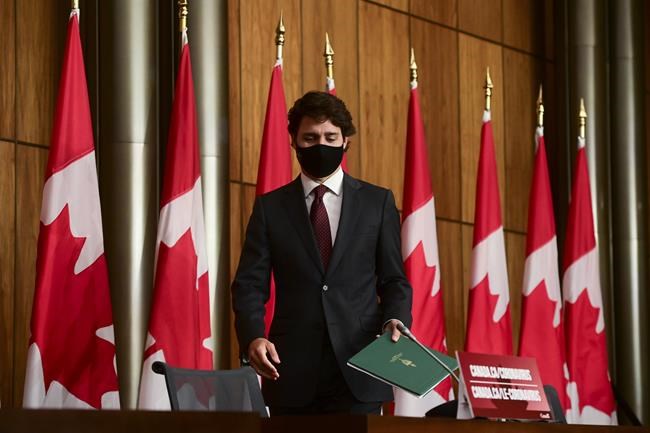
Prime Minister Justin Trudeau arrives to a press conference during the COVID pandemic in Ottawa on Tuesday, Oct. 13, 2020. More federal financial support is on its way to help Indigenous people and communities cope with the ongoing impact of the COVID-19 pandemic. THE CANADIAN PRESS/Sean Kilpatrick

The new funding will support facilities in Indigenous communities in hiring additional staff and offering training for their teams.

The government is also spending $25 million to help Indigenous post-secondary institutions with increased costs related to the pandemic.

“This will help retain staff, adapt courses for online learning and implement public health and safety measures like additional handwashing stations and safe space barriers,” Trudeau said.

He also announced $59 million in funding to improve infrastructure on First Nations to meet COVID-19 health and safety standards.

The new money is on top of more than $2.2 billion the federal government has already allocated to help Indigenous and northern communities get through the health crisis.

Indigenous Services Minister Marc Miller said the announcement brings the government funding for Indigenous communities and organizations during COVID-19 to almost $2.5 billion.

He said the pandemic’s impact has been particularly hard on children and young people.

“We must ensure that they get the necessary support to be able to learn and to thrive in a safe environment,” he said.

Miller said there were 348 active COVID-19 cases among First Nations people living on reserves as of Thursday, adding that the total number of COVID-19 cases has reached 1,360.

Among other things, the government has committed $685 million for the Indigenous Communities Support Fund, which includes funding to address food insecurity, education and other support for children.

It is spending another $650 million to help Indigenous communities respond to the pandemic and for income support.

And it has devoted $122 million to help ensure a safe return to schools on reserves.

This report by The Canadian Press was first published Oct. 30, 2020.

———

This story was produced with the financial assistance of the Facebook and Canadian Press News Fellowship.

Report Error Submit a Tip

More Stories

Netminder no stranger to heavy workload as Jets new No. 1 readies for regular-season start

Ken Wiebe 7 minute read Preview

Netminder no stranger to heavy workload as Jets new No. 1 readies for regular-season start

Ken Wiebe 7 minute read Wednesday, Sep. 30, 2026

Stuart Skinner is quick to admit that he wasn’t always wired this way.

As the Winnipeg Jets new starting goalie prepares for his fifth NHL season, Skinner conceded that the accountability aspect that is now synonymous with his character took some time to build up.

“As I grew up and got older, you go through certain things in life that either build character or make things worse for you. It depends on your choice and your decision,” Skinner said during a recent conversation with the Free Press. “I learned it through trial and error. I learned that, sometimes, it’s hard to get honest with yourself… For me, it’s definitely been a road for me to get to a place like this.

“It definitely is one of my pillars. Accountability is so important because that brings you into a spot of what you’re going to do next. It’s easy to let yourself off the hook. I’m more in the business of putting myself on the hook.”

Read
Wednesday, Sep. 30, 2026

Minimum wage hikes set to begin across five provinces

The Canadian Press 2 minute read Preview

Minimum wage hikes set to begin across five provinces

The Canadian Press 2 minute read Updated: Yesterday at 3:12 PM CDT

The minimum wage is going up in five provinces.

The bumps of between 25 and 40 cents come in Ontario, Prince Edward Island, Nova Scotia, Manitoba and Saskatchewan.

Like other government announcements, Ontario has tied the increase to the rising cost of living.

It's moving its minimum wage up to $17.95 an hour, while P.E.I. is boosting it to $17.30 and Nova Scotia moves it to $17.

Read
Updated: Yesterday at 3:12 PM CDT

Retired guidance counsellor defends explicit 2025 sex-ed presentation to high school football team in disciplinary hearing

Maggie Macintosh 7 minute read Preview

Retired guidance counsellor defends explicit 2025 sex-ed presentation to high school football team in disciplinary hearing

Maggie Macintosh 7 minute read Yesterday at 7:12 PM CDT

Gus Watanabe, a former employee of Oak Park High School in Winnipeg, was the subject of a public disciplinary hearing on Thursday.

Read
Yesterday at 7:12 PM CDT

Jets bench boss Arniel talks rebuilding from last season’s struggles

Mike McIntyre and Ken Wiebe 12 minute read Preview

Jets bench boss Arniel talks rebuilding from last season’s struggles

Mike McIntyre and Ken Wiebe 12 minute read Yesterday at 5:42 PM CDT

Scott Arniel has a lot on his plate these days.

But the head coach of the Winnipeg Jets took some time Thursday to sit down with Free Press hockey writers Mike McIntyre and Ken Wiebe to discuss a number of topics on the eve of a new hockey season. This interview has been condensed and edited for clarity.

Wiebe: What was the evaluation of last season like? What did you personally do in an attempt to improve after going from first-overall to 26th-overall?

I just went back and looked at things and made sure my communication was where it needed to be with my players. Was my communication where it needed to be with my boss, with my general manager (Kevin Cheveldayoff)? How our coaching staff worked. How we handled highs and lows. Things I felt I could have done better.

Read
Yesterday at 5:42 PM CDT

J’accuse!: Kinew uses French to fry interim Tory leader over alleged caucus subterfuge

Chris Kitching and Maggie Macintosh 4 minute read Preview

J’accuse!: Kinew uses French to fry interim Tory leader over alleged caucus subterfuge

Chris Kitching and Maggie Macintosh 4 minute read Yesterday at 5:55 PM CDT

NDP Premier Wab Kinew took a dig at the Progressive Conservatives’ leadership change while facing off with Obby Khan’s short-term replacement for the first time in question period Thursday.

It came after interim Tory leader Konrad Narth accused the New Democrats of failing to implement “stronger” bail reform and enforcement measures as promised.

“Now we see there is less crime in Manitoba than there was when the Progressive Conservatives were in government. What are they doing now? Well, they found knives and chased their old leader out,” Kinew said, speaking in French.

“We don’t even know who’s going to be the PC leader next month… next year? We don’t know. What we know is that we’re working on making communities safer.”

Read
Yesterday at 5:55 PM CDT

Port of Churchill signs agreement with Dutch port

Aaron Epp 2 minute read Preview

Port of Churchill signs agreement with Dutch port

Aaron Epp 2 minute read Tuesday, Sep. 29, 2026

Arctic Gateway Group, operator of the Port of Churchill, has signed an agreement with the Port of Rotterdam in the Netherlands to attract business and strengthen supply chains linking Western Canada and Europe.

The agreement enables the two ports to work together to develop new trade in critical minerals and energy products, connect Canadian producers with European buyers, and identify opportunities to improve the supply chain from Western Canadian resource projects through Churchill and into European markets.

The Port of Rotterdam is Europe’s largest port and home to more than 3,000 businesses across its industrial complex, serving as a major gateway for critical raw materials and energy.

Meanwhile, the Port of Churchill has been identified as a transformative national strategy for Canada and is emerging as a northern trade corridor connecting Western Canada’s resources to global markets.

Read
Tuesday, Sep. 29, 2026