Canadian small businesses rack up $135 billion in debt to survive pandemic: Report

Advertisement

Advertise with us

TORONTO - Canada’s small businesses have collectively taken on $135 billion in debt in an attempt to survive the pandemic, a dizzying amount that could hurt the country's economic recovery, according to a report released Thursday.

Read this article for free:


By clicking the button above, an account will be created and you will begin to receive some of our recommended newsletters. You may opt out of any newsletter by visiting your Email and Communication Preferences page or by clicking "unsubscribe" at the bottom of any email.

or

Already have an account? Log in here »

To continue reading, please subscribe:

Digital Subscription

One year of digital access for only $1.44 a week*

  • Enjoy unlimited reading on winnipegfreepress.com
  • Read the E-Edition, our digital replica newspaper
  • Access News Break, our award-winning app
  • Play interactive puzzles

*Billed as $5.77 plus GST every four weeks. After 52 weeks, price increases to the regular rate of $19.95 plus GST every four weeks. Offer available to new and qualified returning subscribers only. Cancel any time.

To continue reading, please subscribe:

Add Free Press access to your Brandon Sun subscription for only an additional

$1 for the first 4 weeks*

  • Enjoy unlimited reading on winnipegfreepress.com
  • Read the E-Edition, our digital replica newspaper
  • Access News Break, our award-winning app
  • Play interactive puzzles
Start now

*Your next Brandon Sun subscription payment will increase by $1.00 and you will be charged $17.95 plus GST for four weeks. After four weeks, your payment will increase to $24.95 plus GST every four weeks.

Hey there, time traveller!
This article was published 25/02/2021 (2066 days ago), so information in it may no longer be current.

TORONTO – Canada’s small businesses have collectively taken on $135 billion in debt in an attempt to survive the pandemic, a dizzying amount that could hurt the country’s economic recovery, according to a report released Thursday.

The Canadian Federation of Independent Business said the average small business owner has accrued $170,000 in debt, with businesses in the hospitality, recreation and service sectors most indebted.

The debt load has left many small businesses in a precarious financial situation that could lead to a wave of closures, the CFIB warned.

A sign on a shop window indicates the store is closed in Ottawa, Monday March 23, 2020. A new report says Canada’s small businesses now collectively owe more than $135 billion as they struggle to survive the pandemic, a staggering amount experts say could hurt the country's economic recovery.THE CANADIAN PRESS/Adrian Wyld

The longer the COVID-19 pandemic goes on, the more bleak the outlook becomes for some small businesses, said Laura Jones, CFIB’s executive vice-president.

“Over the last six months, the average debt taken on by small businesses to deal with COVID-19 has grown significantly,” she said in a statement.

“While many businesses had previously reopened and were attempting to regain lost sales, the second wave and the restrictions that came with it are putting a massive wrench in an already slow recovery for small businesses.”

The report said more than 70 per cent of business owners across Canada report that they have taken on debt to cope with the impacts of COVID-19.

When drilling down by sector, it becomes apparent that public-facing businesses with a limited ability to conduct work remotely as well as those considered non-essential have taken out loans in greater numbers.

For example, 91 per cent of businesses in the hospitality sector including bars, restaurants and accommodation took on debt, the report said.

In the arts, recreation and information sector, which includes gyms, music venues, performing arts companies and golf courses, 87 per cent of businesses took on debt, the CFIB said.

Among business owners who have taken on debt, three-quarters said it will take them more than a year to repay loans, the report said, while 11 per cent expressed concern that they may not be able to repay their COVID-19 related debt at all.

Meanwhile, 17 per cent of businesses are already actively considering bankruptcy or winding down their business, the CFIB said.

In fact, a staggering one in six small- and medium-sized businesses in Canada – a total of 181,000 businesses – are at risk of closing permanently due to COVID-19, the CFIB said. That’s on top of businesses that have already closed, it added.

“Small businesses need our support through this challenging time,” said Taylor Matchett, a research analyst at CFIB and the lead author of the report.

“We must also keep in mind that businesses are much more fragile now than at the beginning of the pandemic, and every effort should be made to keep businesses open while managing the health implications of the virus.”

The CFIB’s findings are based on an online survey of 3,554 small business owners in February.

This report by The Canadian Press was first published Feb, 25, 2021.

Report Error Submit a Tip

More Stories

Klein, Gillingham trade jabs over megaproject

Malak Abas 6 minute read Preview

Klein, Gillingham trade jabs over megaproject

Malak Abas 6 minute read Yesterday at 9:36 PM CDT

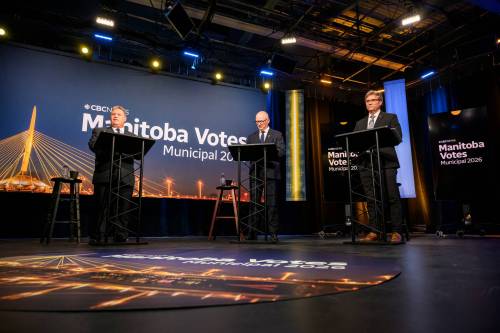
Two of Winnipeg’s mayoral candidates wasted no time trading barbs over who bears responsibility for the skyrocketing cost of overhauling the North End sewage treatment plant, during a televised debate Wednesday.

Scott Gillingham and Kevin Klein pointed the finger at each other for the rising cost of the massive project, which had a cost estimate of $795 million in 2015 and had ballooned to $3.2 billion as of the latest estimate.

“We need to be able to understand how that amount tripled in that short a time,” Klein said at the event held at CBC’s downtown Winnipeg headquarters. He pointed out the first estimate was given when Gillingham was chairman of the city’s finance committee. He questioned what the incumbent did to garner funding for the project.

Gillingham shot back by noting Klein was Manitoba’s environment minister in 2023. He accused his opponent of failing to make a dent on the cost.

Read
Yesterday at 9:36 PM CDT

Is Osborne a street or a road? ‘Stroad’ status fails everyone

Mel Marginet 6 minute read Preview

Is Osborne a street or a road? ‘Stroad’ status fails everyone

Mel Marginet 6 minute read 2:00 AM CDT

Last month, the City of Winnipeg said it would soon begin to study ways to improve pedestrian and cyclist safety along Osborne Street, which runs between two of the city’s densest neighbourhoods, where residents walk and bike for many of their daily activities.

Read
2:00 AM CDT

U of W, former professor sued over alleged sex assault

Erik Pindera 4 minute read Preview

U of W, former professor sued over alleged sex assault

Erik Pindera 4 minute read Yesterday at 2:03 PM CDT

A woman who studied and worked at the University of Winnipeg has filed a lawsuit against the post-secondary institution and her former professor — a convicted sex offender — who she alleges drugged and sexually assaulted her.

Read
Yesterday at 2:03 PM CDT

Mayoral candidates snipe over safety during radio debate

Joyanne Pursaga 6 minute read Preview

Mayoral candidates snipe over safety during radio debate

Joyanne Pursaga 6 minute read Updated: Yesterday at 5:31 PM CDT

Public safety took centre stage during a sometimes fiery mayoral debate Wednesday in which Kevin Klein revealed he would have to raise property taxes to fund his plan to make Winnipeg safer.

The CJOB debate also included candidates Scott Gillingham and Mike Vogiatzakis, who were selected as the top contenders in the race based on polling data.

Klein noted he has promised to strike a task force on public safety and to hire more police, if he’s elected Oct. 28.

“We are 100 police officers short of the very bare minimum of the per capita (number) right now. We have to replace those officers,” said Klein, a former city councillor and Tory cabinet minister.

Read
Updated: Yesterday at 5:31 PM CDT

Exchange welcomes new gallery

Jen Zoratti 3 minute read Preview

Exchange welcomes new gallery

Jen Zoratti 3 minute read Yesterday at 5:49 PM CDT

Co-owned by Laura Porath and Mike Page, Lucent Gallery + Design Studio celebrates its grand opening, Thursday.

Read
Yesterday at 5:49 PM CDT

‘Big win’ kept ag tariffs off table: trade rep

Gabrielle Piché 4 minute read Preview

‘Big win’ kept ag tariffs off table: trade rep

Gabrielle Piché 4 minute read 7:16 PM CDT

Retaliatory tariffs on American agriculture was a possibility earlier this year, according to Manitoba’s U.S. trade representative.

Richard Madan says he banded together with various groups — Manitoba Pork, Keystone Agricultural Producers, cattle representatives — to rally against the move.

“We mobilized quickly,” Madan said during a trip to Winnipeg on Thursday.

Madan said he’d heard tariffs on agriculture were “on the table” upon speaking to Janice Charette, Canada’s chief trade negotiator to the U.S., in Washington.

Read
7:16 PM CDT