Police at nerve center in The Hague share Euro 2020 intel
Advertisement
Read this article for free:
or
Already have an account? Log in here »
To continue reading, please subscribe:

Digital Subscription
One year of digital access for only $205*
- Enjoy unlimited reading on winnipegfreepress.com
- Read the E-Edition, our digital replica newspaper
- Access News Break, our award-winning app
- Play interactive puzzles
*First annual payment billed as $205.00 + GST for one year. This annual subscription will automatically renew at $233.00 + GST every 52 weeks (10% off the regular annual price of $259.35). Offer available to new and qualified returning subscribers only. Cancel any time.
To continue reading, please subscribe:
Add Free Press access to your Brandon Sun subscription for only an additional
$1 for the first 4 weeks*
- Enjoy unlimited reading on winnipegfreepress.com
- Read the E-Edition, our digital replica newspaper
- Access News Break, our award-winning app
- Play interactive puzzles
*Your next Brandon Sun subscription payment will increase by $1.00 and you will be charged $17.95 plus GST for four weeks. After four weeks, your payment will increase to $24.95 plus GST every four weeks.
Read unlimited articles for free today:
or
Already have an account? Log in here »
Hey there, time traveller!
This article was published 10/06/2021 (1944 days ago), so information in it may no longer be current.
THE HAGUE, Netherlands (AP) — Policing a 24-team soccer tournament in 11 cities scattered across 10 countries was always going to be tough even before the coronavirus pandemic compounded the challenges facing law enforcement authorities overseeing the European Championship.
Europol, the European Union police agency, has created a nerve center of about 40 police liaison officers from 22 nations for the tournament, which opens Friday in Rome and ends on July 11 at Wembley Stadium in London.
“The current Euro 2020 championship is of an unprecedented complexity,” Europol executive director Catherine De Bolle said Thursday.
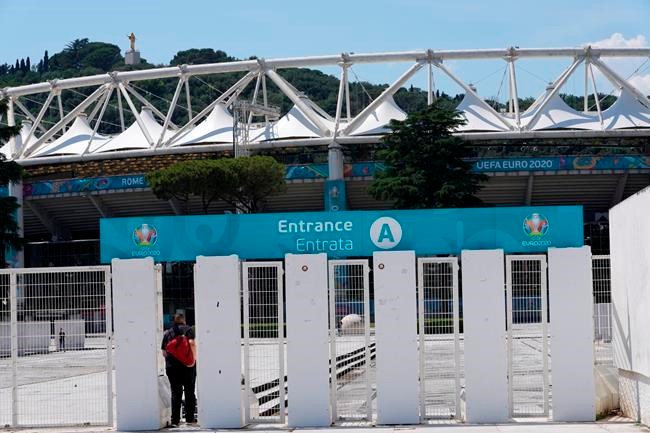
“It is the first ever championship organized by 10 different countries instead of only one or two, as we had seen in past editions,” De Bolle said. “It is also the first large-scale event organized during the COVID-19 pandemic related to sports. And all this, of course, presents important security challenges.”
In Europol’s main meeting room near the North Sea beaches of The Hague, liaison officers are working together to counter any threats that emerge by instantly sharing intelligence.
Their desks are socially distanced and arranged into Euro 2020 groups. For example, Italy, Switzerland, Turkey and Wales are seated together, reflecting the makeup of the tournament’s Group A. The officers will be working in shifts almost around the clock throughout the tournament. Starting at 8 a.m. and finishing only when they’re certain all fans have gotten home safely.
Large screens and televisions are spread around all four walls so they can watch matches and instantly identify trouble. They will be sharing intelligence, including from a network of about 500 “spotters” who track movements of fans.
One side effect of the pandemic is that there will be fewer fans to track because of stadium seating limitations.
But that has not led to law enforcement authorities letting down their guard, especially after hooliganism marred the last European Championship in France, where England and Russia were threatened with expulsion from the tournament following violent clashes in Marseille.
As part of the vigilance, Europol also has set up a task force to tackle threats including cybercrime, terrorism, match-fixing, trafficking counterfeit goods including fake COVID-19 certificates, and other intellectual property crimes, the organization said.
The International Police Cooperation Center at Europol brings together not just EU nations but also those outside the 27-nation bloc, like Russia and Britain.
Adrian Roberts, assistant director of the UK Football Policing Unit, stressed that the Brexit split between Britain and the EU has not hurt intelligence sharing.

“Brexit no has no effect whatsoever on the really important business that we do … with all other countries,” he said.
Roberts and other officials at the official opening of the nerve center said they have no indications of possible fan trouble at the tournament. But he conceded that the pandemic that has largely kept fans from stadiums around the world for much of this season could be limiting police insights.
“I think the risk is larger because of the COVID situation,” he said, “because all of the intelligence that maybe we might have had at an earlier stage by now, it’s all in the unknown.”
___
More AP soccer: https://apnews.com/hub/soccer and https://twitter.com/AP_Sports
Related Articles
Austrians go body surfing on field in Bucharest after rain










Advertisement Advertise With Us
Advertisement Advertise With Us