Poll: Millions in US struggle through life with few to trust

Advertisement

Advertise with us

NEW YORK (AP) — Karen Glidden's loneliness became unbearable during the coronavirus pandemic.

Read this article for free:


or

Already have an account? Log in here »

To continue reading, please subscribe:

Subscribe and receive a limited-edition Free Press branded hat or tote.

Digital Subscription

One year of digital access for only $205*

  • Enjoy unlimited reading on winnipegfreepress.com
  • Read the E-Edition, our digital replica newspaper
  • Access News Break, our award-winning app
  • Play interactive puzzles

*First annual payment billed as $205.00 + GST for one year. This annual subscription will automatically renew at $233.00 + GST every 52 weeks (10% off the regular annual price of $259.35). Offer available to new and qualified returning subscribers only. Cancel any time.

To continue reading, please subscribe:

Add Free Press access to your Brandon Sun subscription for only an additional

$1 for the first 4 weeks*

  • Enjoy unlimited reading on winnipegfreepress.com
  • Read the E-Edition, our digital replica newspaper
  • Access News Break, our award-winning app
  • Play interactive puzzles
Start now

*Your next Brandon Sun subscription payment will increase by $1.00 and you will be charged $17.95 plus GST for four weeks. After four weeks, your payment will increase to $24.95 plus GST every four weeks.

Hey there, time traveller!
This article was published 10/06/2021 (1942 days ago), so information in it may no longer be current.

NEW YORK (AP) — Karen Glidden’s loneliness became unbearable during the coronavirus pandemic.

The 72-year-old widow, who suffers from vision loss and diabetes and lives far from any relatives, barely left her house in Champion, Michigan, this past year, for fear of contracting the virus. Finally vaccinated, she was looking forward to venturing out when her beloved service dog died last month.

It doesn’t help that her circle of trusted friends has dwindled to one neighbor she counts on to help her shop, get to the doctor and hang out.

FILE - In this Feb. 19, 2021, file photo a man watches the sunset from a peak at Papago Park in Phoenix. Millions of Americans are struggling through life with few people they can trust for personal and professional help, a disconnect that raises a key barrier to recovery from the social, emotional and economic fallout of the pandemic. That's according to a new poll from Impact Genome and The Associated Press-NORC Center for Public Affairs Research. (AP Photo/Charlie Riedel, File)

“I feel like I’m in a prison most of the time and once in a while, I get to go out,” said Glidden, whose adult children live in California and Hawaii, where she was born and raised.

She is not alone in her sense of social isolation.

Millions of Americans are struggling through life with few people they can trust for personal and professional help, a disconnect that raises a key barrier to recovery from the social, emotional and economic fallout of the pandemic, according to a new a poll from The Impact Genome Project and The Associated Press-NORC Center for Public Affairs Research.

The poll finds 18% of U.S. adults, or about 46 million people, say they have just one person or nobody they can trust for help in their personal lives, such as emergency child care needs, a ride to the airport or support when they fall sick. And 28% say they have just one person or nobody they can trust to help draft a resume, connect to an employer or navigate workplace challenges.

The isolation is more acute among Black and Hispanic Americans. Thirty-eight percent of Black adults and 35% of Hispanic adults said they had only one or no trusted person to help navigate their work lives, compared with 26% of white adults. In their personal lives, 30% of Hispanic adults and 25% of Black adults said they have one or no trusted people, while 14% of white adults said the same.

Researchers have long debated the idea that the U.S. has suffered from a decline in social capital, or the value derived from personal relationships and civic engagement.

The General Social Survey, a national representative survey conducted by NORC since 1972, suggests that the number of people Americans feel they can trust had declined by the early 2000s, compared with two decades earlier, although there is little consensus about the extent of this isolation or its causes. The rise of social media has added another layer of debate, as experts explore whether it broadens networks or lures people in isolating echo chambers.

The Impact Genome/AP-NORC poll sought to measure how much social capital Americans can count as they try to pick up the pieces of lives fractured by the pandemic. The findings suggest that for many Americans, the pandemic has chipped away at whatever social capital they had going into it.

Americans were more likely to report a decline than an increase in the number of people they could trust over the past year. Just 6% of Americans said their network of trusted people grew, compared with 16% who reported that it shrank. While the majority of Americans said the number of people they could trust stayed the same, nearly 3 in 10 said they asked for less support from family and friends because of COVID-19.

Community bonds have proved to be critical to recovery from calamities such as Superstorm Sandy in 2012, said Jennifer Benz, deputy director of The AP-NORC Center.

But the nature of the pandemic made those bonds difficult or even impossible to maintain. Schools, community centers, churches, synagogues and mosques closed. People couldn’t ask neighbors or grandparents for help with child care or other needs for fear of spreading the virus.

About half of Americans are engaged in civic groups such as religious institutions, schools or community service groups, according to the new poll. And 42% of all adults said they have become less involved with civic groups during the pandemic, compared with just 21% who said they became more engaged.

“Compared to the way social capital can be leveraged in other disasters, the key difference has been that this is a disaster where your civic duty was to be on your own,” Benz said.
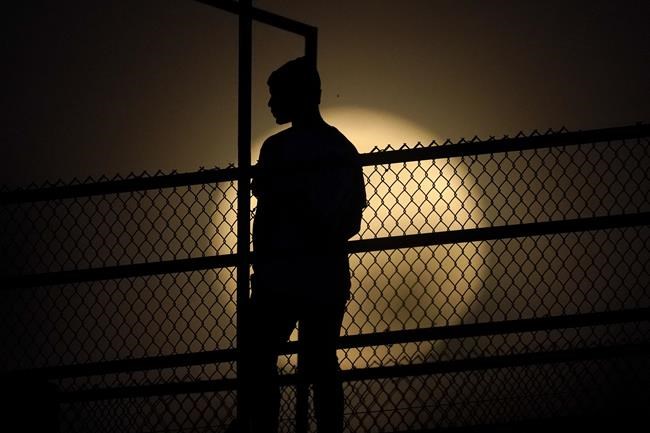
FILE - In this April 26, 2021, file photo a person stands on an observation tower as the moon rises in New Albany, Ind. Millions of Americans are struggling through life with few people they can trust for personal and professional help, a disconnect that raises a key barrier to recovery from the social, emotional and economic fallout of the pandemic. That's according to a new poll from Impact Genome and The Associated Press-NORC Center for Public Affairs Research. (AP Photo/Charlie Riedel, File)

Surveys from the Pew Research Center suggested that relocation increased during the pandemic. While some people moved to be closer to family, more relocated because of job loss or other financial stresses.

Warlin Rosso, 29, has moved often in pursuit of financial stability, often at the cost of his social ties.

He left behind his entire family, including 14 siblings, when he immigrated to the U.S. five years ago from the Dominican Republic. He worked at a warehouse in Chicago for three years, sharing an apartment with a girlfriend. But when that relationship fell apart, he couldn’t afford to move out on his own. In December 2019, he relocated to Jackson, Mississippi, where a childhood friend let him move in.

That friend, Rosso said, remains the only person in Jackson he can trust for help. As the pandemic closed in, Rosso struggled in a city where the Hispanic community is tiny.

Through social media, he found work with a Nicaraguan man who owned a construction business. Later, he found a training program that landed him a job as hospital aide.

His co-workers are friendly, but he feels isolated. Sometimes, he said, patients bluntly ask to be helped by a non-Latino worker. He hopes eventually to get a similar job back in Chicago, where he has friends.

“It’s not always welcoming for Hispanics here,” Rosso said. “Here, I’m alone.”

___

The AP-NORC poll of 2,314 adults was conducted March 25-April 15 using a sample drawn from NORC’s probability-based AmeriSpeak Panel, which is designed to be representative of the U.S. population. The margin of sampling error for all respondents is plus or minus 2.9 percentage points.
Report Error Submit a Tip

More Stories

J’accuse!: Kinew uses French to fry interim Tory leader over alleged caucus subterfuge

Chris Kitching and Maggie Macintosh 4 minute read Preview

J’accuse!: Kinew uses French to fry interim Tory leader over alleged caucus subterfuge

Chris Kitching and Maggie Macintosh 4 minute read Thursday, Oct. 1, 2026

NDP Premier Wab Kinew took a dig at the Progressive Conservatives’ leadership change while facing off with Obby Khan’s short-term replacement for the first time in question period Thursday.

Read
Thursday, Oct. 1, 2026

A day on the campaign trail: Winnipeg's mayor, seeking a second term, does double duty

Malak Abas 12 minute read Preview

A day on the campaign trail: Winnipeg's mayor, seeking a second term, does double duty

Malak Abas 12 minute read Updated: Yesterday at 5:56 PM CDT

In the weeks leading up to the civic election, Scott Gillingham has been performing a juggling act: he’s running to be Winnipeg’s 45th mayor, while still serving as its 44th.

“If someone asks me about the campaign, I’m going to answer them. But I think for most people, I’m the mayor of Winnipeg, even if I’m showing up as a candidate,” Gillingham, 58, says. “I try to do all I can to maintain that distinction.”

The Free Press joined Gillingham on a recent rainy September Saturday on the campaign trail, where he served in both roles during an event-laden day. City council’s final meeting before the Oct. 28 election was days earlier.

In Winnipeg, it’s rare for an incumbent to be defeated. But Gillingham knows his win in 2022 wasn’t exactly a landslide — he won with 27.5 per cent of the vote — and he’s been thinking about his second term ever since.

Read
Updated: Yesterday at 5:56 PM CDT

Blown lead spoils Jets opener

Mike McIntyre 7 minute read Preview

Blown lead spoils Jets opener

Mike McIntyre 7 minute read Yesterday at 11:09 PM CDT

Younger. Faster. Stronger.

They may still be a long ways from a finished product, but it’s safe to say the new-look Winnipeg Jets made a mostly favourable first impression on Friday night in front of a sold-out crowd at Canada Life Centre.

Sure, a 4-3 overtime loss to a hard-nosed Boston Bruins outfit is going to sting a little, especially since the home team was just 98 seconds away from a regulation victory.

But if the Jets can bottle up this kind of energy and effort, they should enjoy plenty of success over the course of the 84-game campaign.

Read
Yesterday at 11:09 PM CDT

Brandonmeat packer thriving on its own

Abiola Odutola 3 minute read Preview

Brandonmeat packer thriving on its own

Abiola Odutola 3 minute read 2:01 AM CDT

BRANDON — Canada Packers has strengthened its business and laid the foundation for future growth during its first year as an independent company, its president says.

The Brandon-based pork producer, separated from Maple Leaf Foods in October 2025, established its own leadership, strategy, systems, culture and identity while continuing operations across its hog production farms and regional hog barns in southern and eastern Manitoba.

The company’s first year was focused on building a successful standalone business while continuing to serve customers, communities and shareholders, president Dennis Organ said.

“Market conditions over the past year have been more challenging than we anticipated when we became a separate entity,” he said in an email. “Despite that, we continued to execute against our priorities, including increasing processing volumes, maintaining disciplined operations and strengthening the business.”

Read
2:01 AM CDT

’Disgusting’ posters being investigated by police

Morgan Modjeski 4 minute read 2:22 PM CDT

The Winnipeg Police Service major crimes unit is investigating what some have labelled offensive and hateful posters on full-display at a Winnipeg home.

One of the people irked by the display is Gracie Garrett. She’s has lived on Ashburn Street in Winnipeg’s Minto neighbourhood for almost ten years. She’s never felt unsafe in the neighbourhood before, but now, a set of posters plastered on a nearby house are making her feel uneasy.

The five signs, posted facing the street prominently on a front window, contain a slur, refer to Nazis as “heroes” and call Muslims, Christians and other groups “evil.”

Learning of the signs Friday, Garrett said she’ll be reporting the posters to police, as she worries they incite and promote violence.

Gordon Bell rings in a century

Maggie Macintosh 13 minute read Preview

Gordon Bell rings in a century

Maggie Macintosh 13 minute read Updated: Yesterday at 8:06 PM CDT

Mischka Valencia had gotten used to the hum of heavy machinery at Gordon Bell High School.

“Ever since I’ve been here, it’s all been under construction,” the Grade 12 student said, standing on the sidelines of the brightly painted revamped outdoor basketball court. “I had no idea this was a court.”

The Filipina teenager landed in Winnipeg several months after the inner-city campus had transformed into a construction site.

It was the fall of 2023 and Mischka’s priorities were fitting in, befriending classmates and learning a third language via first-period French.

Read
Updated: Yesterday at 8:06 PM CDT