Virtual schools saw little disruption, got equal virus aid
Advertisement
Read this article for free:
or
Already have an account? Log in here »
To continue reading, please subscribe:

Digital Subscription
One year of digital access for only $205*
- Enjoy unlimited reading on winnipegfreepress.com
- Read the E-Edition, our digital replica newspaper
- Access News Break, our award-winning app
- Play interactive puzzles
*First annual payment billed as $205.00 + GST for one year. This annual subscription will automatically renew at $233.00 + GST every 52 weeks (10% off the regular annual price of $259.35). Offer available to new and qualified returning subscribers only. Cancel any time.
To continue reading, please subscribe:
Add Free Press access to your Brandon Sun subscription for only an additional
$1 for the first 4 weeks*
- Enjoy unlimited reading on winnipegfreepress.com
- Read the E-Edition, our digital replica newspaper
- Access News Break, our award-winning app
- Play interactive puzzles
*Your next Brandon Sun subscription payment will increase by $1.00 and you will be charged $17.95 plus GST for four weeks. After four weeks, your payment will increase to $24.95 plus GST every four weeks.
Read unlimited articles for free today:
or
Already have an account? Log in here »
Hey there, time traveller!
This article was published 27/08/2021 (1867 days ago), so information in it may no longer be current.
BOSTON (AP) — While many schools scrambled to shift to online classes last year, the nation’s virtual charter schools faced little disruption. For them, online learning was already the norm. Most have few physical classrooms, or none at all.
Yet when Congress sent $190 billion in pandemic aid to schools, virtual charters received just as much as any other school because the same formula applied to all schools, with more money going to those in high-poverty areas, an Associated Press investigation found.
“It’s scandalous that they’re getting that much money,” said Gordon Lafer, an economist at the University of Oregon and school board member in Eugene, Oregon. “There were all kinds of costs that were extraordinary because of COVID, but online schools didn’t have any of them.”
The infusion of federal relief has inflamed a decades-long debate about the role of the nation’s 200-plus fully virtual charter schools, which are publicly funded schools that operate independently or under the umbrella of public school districts. They generally offer classes through online learning platforms provided by private companies.
Leaders of online schools say virtual charters offer a valuable option for students who don’t do well in traditional classrooms. But critics say they drain money from other schools and often lead to poor outcomes for students.
Using data provided by state governments, The Associated Press tracked more than $550 million that went to virtual charters across the country over three rounds of pandemic relief. The analysis, which covered allocations to 76 virtual schools in 10 states, showed that some online charters received among the highest funding rates in their states, getting as much per student as some of the poorest districts.
The federal government has not released nationwide data on the money given to virtual charters. Some states, including Wisconsin and Texas, said allocations for online schools were managed by local districts and not tracked by the state.
Most of the pandemic aid was distributed using the same formula as Title I money, the largest federal funding source for public schools. But some states also used discretionary pools of federal money to send additional help to virtual charters, including in Idaho, Minnesota and Ohio.
Of the 76 virtual schools tracked by the AP, more than a third are operated by the industry’s two largest companies, Stride Inc. and Connections Academy. Others are run by different for-profit companies, while some are run by nonprofits or state or local governments.
Officials at virtual schools say the money was needed to serve a wave of students who transferred from traditional schools during the pandemic. But leaders of some traditional schools wonder why any aid went to virtual charters that were mostly conducting business as usual and did not have to worry about social distancing or sanitizing.
In Philadelphia, the Esperanza Cyber Charter School received $11,300 per student, the highest rate among virtual schools tracked by the AP. That’s compared with $12,300 in Harrisburg public schools, one of Pennsylvania’s poorest districts, and $7,500 in Pittsburgh schools.
Esperanza, operated by a local nonprofit, teaches about 800 students in Philadelphia’s Latino neighborhoods, with more than 90% coming from poverty.
When the pandemic hit last year, Esperanza never halted classes. Teachers started working from home instead of at the school’s single building, but little changed for the student experience, said Jon Marsh, the school’s CEO.
Marsh said he sees both sides of the debate over federal relief. His school’s transition to pandemic teaching was relatively smooth, he said, but there were some new costs. The federal funding helped purchase computers and monitors for teachers, for instance, and new software to help students who are learning English.
Still, Esperanza’s funding was immense for its size. It received nearly $9 million, more than the school spends in a typical year. And so far, it has spent less than half of that sum, leaving school officials wondering how to use the remaining $5 million.
“I would love to have the ability to distribute this money to families in need, but you can’t. That’s not on the list,” Marsh said.
Other states with online schools include Ohio, where virtual charters received $101 million in federal funding, and Oklahoma, where they got $82 million. Smaller amounts went to virtual schools in states including Arizona, California, Idaho and Michigan.
Pennsylvania, long a battleground in the cyber school debate, saw the largest sum, with $235 million going to 11 virtual schools. Those allotments rankled leaders of some traditional schools who said the money was desperately needed in public districts.
“It just doesn’t add up to me when you look at the intent of the legislation,” said Chris Celmer, who until recently served as acting superintendent in Harrisburg, which used its money to buy computers for students and is now improving ventilation across the district’s 12 building. “Those dollars could have been distributed across the other 500 school districts across the state of Pennsylvania.”
Commonwealth Charter Academy, the largest virtual school in Pennsylvania, saw its enrollment double last school year, to nearly 20,000 students.
Commonwealth was awarded about $4,000 per student, totaling more than $60 million. Much of the early funding was used to hire new teachers and buy laptops for students. More recent funding will be used to help students who are behind in reading, said Timothy Eller, a school spokesperson.
“Cyber charter school students are not second-class students,” Eller said. “Just because they attend a cyber charter doesn’t mean they should receive less funding.”
For the online schooling industry, the pandemic has delivered an unprecedented financial boost.
In April 2020, as students flocked to online charters, the financial chief for Stride Inc. told investors that COVID-19 would bring “a lasting tailwind to online education.” Virtual schools, some of which spend millions of dollars a year on advertising, promoted themselves as a better alternative to public schools that were struggling to offer online classes.
Stride’s latest financial reports showed a 48% increase in revenue since last year, with most of it coming from contracts with schools. The company did not respond to a request seeking information about its schools’ federal aid.
The cost of adding new students is typically covered by schools’ state funding, Lafer said, and virtual schools are designed to scale up services at a low cost.

“As far as I can see, the money is 100% pure profit,” said Lafer, who has researched online charter schools.
Recognizing that virtual charters have lower costs, some states routinely fund them at lower rates than traditional schools. Some states applied the same logic when they disbursed discretionary pools of pandemic aid.
In South Carolina, Republican Gov. Henry McMaster gave charter schools $9 million to offset enrollment increases. But while traditional charters received $220 per student, virtual schools were given $116 per student. Separately, McMaster wanted to use $32 million of the federal pandemic aid to provide scholarships for students to attend private schools, but the state Supreme Court blocked the plan.
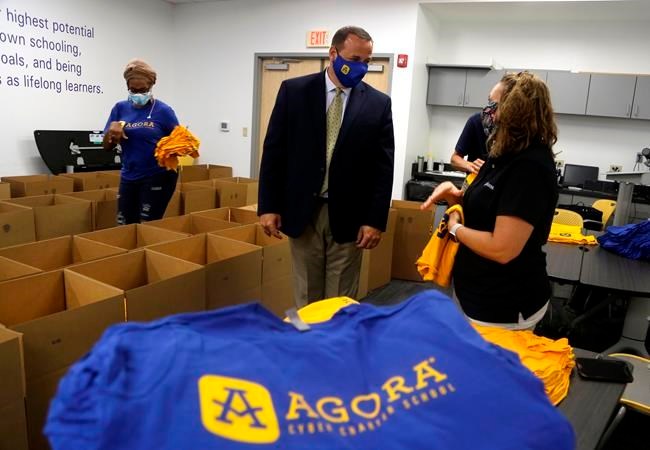
Even some virtual charters are questioning whether they need their full allotments. At Agora Cyber Charter School, a Pennsylvania school affiliated with Stride, officials said they have no plans to use the full $38 million the school was awarded. Agora officials are exploring whether it’s possible to return unused money.
“We’re trying to be very deliberate to make sure that any dollar we take from this is focused on servicing students,” said Richard Jensen, the CEO. “That’s the end game for me.”