Texas bans most abortions, with high court mum on appeal

Advertisement

Advertise with us

The nation's most far-reaching curb on abortions since they were legalized a half-century ago took effect Wednesday in Texas, with the Supreme Court silent on an emergency appeal to put the law on hold.

Read this article for free:


or

Already have an account? Log in here »

To continue reading, please subscribe:

Subscribe and receive a limited-edition Free Press branded hat or tote.

Digital Subscription

One year of digital access for only $205*

  • Enjoy unlimited reading on winnipegfreepress.com
  • Read the E-Edition, our digital replica newspaper
  • Access News Break, our award-winning app
  • Play interactive puzzles

*First annual payment billed as $205.00 + GST for one year. This annual subscription will automatically renew at $233.00 + GST every 52 weeks (10% off the regular annual price of $259.35). Offer available to new and qualified returning subscribers only. Cancel any time.

To continue reading, please subscribe:

Add Free Press access to your Brandon Sun subscription for only an additional

$1 for the first 4 weeks*

  • Enjoy unlimited reading on winnipegfreepress.com
  • Read the E-Edition, our digital replica newspaper
  • Access News Break, our award-winning app
  • Play interactive puzzles
Start now

*Your next Brandon Sun subscription payment will increase by $1.00 and you will be charged $17.95 plus GST for four weeks. After four weeks, your payment will increase to $24.95 plus GST every four weeks.

Hey there, time traveller!
This article was published 01/09/2021 (1858 days ago), so information in it may no longer be current.

The nation’s most far-reaching curb on abortions since they were legalized a half-century ago took effect Wednesday in Texas, with the Supreme Court silent on an emergency appeal to put the law on hold.

If allowed to remain in force, the law, which bans most abortions, would be the strictest against abortion rights in the United States since the high court’s landmark Roe v. Wade decision in 1973.

The Texas law, signed by Republican Gov. Greg Abbott in May, prohibits abortions once medical professionals can detect cardiac activity, usually around six weeks and before most women know they’re pregnant.
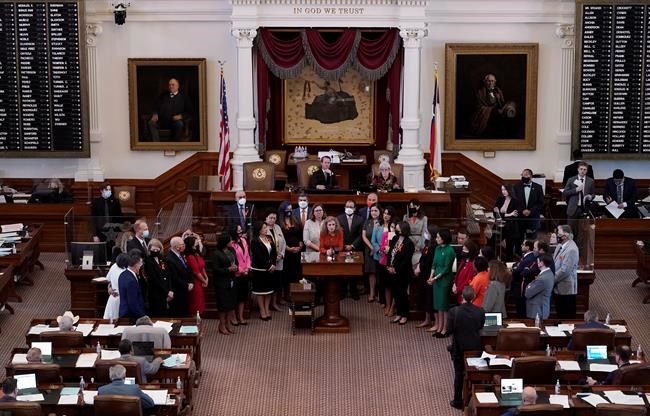
FILE - In this May 5, 2021, file photo, Texas state Rep. Donna Howard, D-Austin, center at lectern, stands with fellow lawmakers in the House Chamber in Austin, Texas, as she opposes a bill introduced that would ban abortions as early as six weeks and allow private citizens to enforce it through civil lawsuits, under a measure given preliminary approval by the Republican-dominated House. Abortion providers in Texas are asking the Supreme Court to prevent enforcement of a state law that would allow private citizens to sue anyone for helping a woman get an abortion after about six weeks of pregnancy. (AP Photo/Eric Gay, File)

It’s part of a broader push by Republicans across the country to impose new restrictions on abortion. At least 12 other states have enacted bans early in pregnancy, but all have been blocked from going into effect.

What makes the Texas law different is its unusual enforcement scheme. Rather than have officials responsible for enforcing the law, private citizens are authorized to sue abortion providers and anyone involved in facilitating abortions. Among other situations, that would include anyone who drives a woman to a clinic to get an abortion. Under the law, anyone who successfully sues another person would be entitled to at least $10,000.

“Starting today, every unborn child with a heartbeat will be protected from the ravages of abortion,” Abbott said in a statement posted on Twitter. “Texas will always defend the right to life.”

But protests were quick.

President Joe Biden said in a statement that the law “blatantly violates the constitutional right established under Roe v. Wade and upheld as precedent for nearly half a century.” He said the law “outrageously” gives private citizens the power “to bring lawsuits against anyone who they believe has helped another person get an abortion.”

Likewise, the American Medical Association said it was deeply disturbed by “this egregious law” and disappointed by the Supreme Court’s inaction.

The law “not only bans virtually all abortions in the state, but it interferes in the patient-physician relationship and places bounties on physicians and health care workers simply for delivering care,” said a statement from Dr. Gerald E. Harmon, the AMA president.

In a phone call with reporters, Marc Hearron, a lawyer for the Center for Reproductive Rights, said the abortion providers his group represents were still hoping to hear from the Supreme Court but “as of now, most abortion is banned in Texas.”

Clinics have said the law would rule out 85% of abortions in Texas and force many clinics to close. Planned Parenthood is among the abortion providers that have stopped scheduling abortions beyond six weeks from conception.
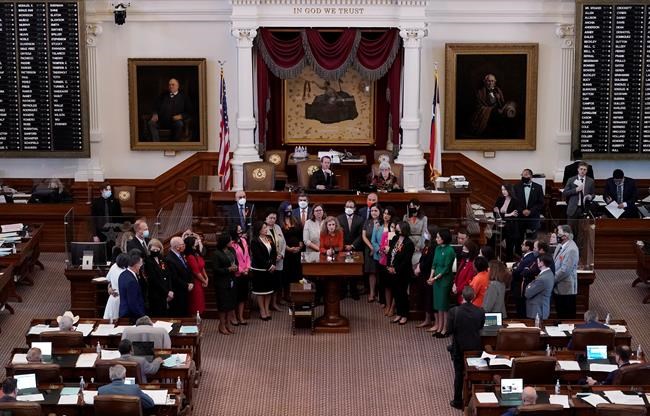
FILE - In this May 5, 2021, file photo, Texas state Rep. Donna Howard, D-Austin, center at lectern, stands with fellow lawmakers in the House Chamber in Austin, Texas, as she opposes a bill introduced that would ban abortions as early as six weeks and allow private citizens to enforce it through civil lawsuits, under a measure given preliminary approval by the Republican-dominated House. A Texas law banning most abortions in the state took effect at midnight on Sept. 1 but the Supreme Court has yet to act on an emergency appeal to put the law on hold. If allowed to remain in force, the law would be the most dramatic restriction on abortion rights in the United States since the high court’s landmark Roe v. Wade decision legalized abortion across the country in 1973. (AP Photo/Eric Gay, File)

Abortion opponents who wrote the law also made it difficult to challenge in court, in part because it’s hard to know whom to sue.

Abortion rights advocates say it will force many women to travel out of state for abortions, if they can afford to do so and also navigate issues including childcare and taking time off work. The Guttmacher Institute, a research organization that supports abortion rights, says if legal abortion care in Texas shuts down, the average one-way driving distance to an abortion clinic for Texans would increase from 12 miles to 248 miles.

Already, abortion clinics beyond the Texas border are feeling the impact. At the Trust Women clinic in Oklahoma City, there had been 80 appointments scheduled over the past two days, more than double the typical number of patients, said Rebecca Tong, co-executive director of the clinic. Two-thirds of those patients were from Texas, another sharp increase, and the earliest opening was now three weeks out.

“Oklahoma has just barely enough clinics for the amount of people here,” Tong said. “If anyone is thinking, ‘Oh, they can just go out of state, it’ll be so easy,’ a lot of clinics in the Midwest and South, we don’t do abortion care five days a week.”

Late into the night Tuesday before the ban took effect clinics in Texas were filled with patients, said Amy Hagstrom Miller, CEO of Whole Women’s Health, which has four abortion clinics in Texas.

Twenty-seven women were still in the waiting room after 10 p.m. at one clinic, leaving doctors crying and scrambling over whether they would see all of them in time, she said. The last abortion at one of her clinics finished at 11:56 p.m. in Fort Worth, where Hagstrom Miller said anti-abortion activists outside shined bright lights in the parking lot after dark looking for wrongdoing, and twice called police.

“This morning I woke up feeling deep sadness. I’m worried. I’m numb,” she said.

The law is part of a hard-right agenda that Texas Republicans muscled through the statehouse this year ahead of the 2022 midterm elections, when Abbott is up for a third term as governor.

Another law taking effect Wednesday ended required firearm training and background checks to carry handguns in public in Texas, and GOP lawmakers on Tuesday approved election changes that will further tighten what are already some of the strictest voting laws in the nation.
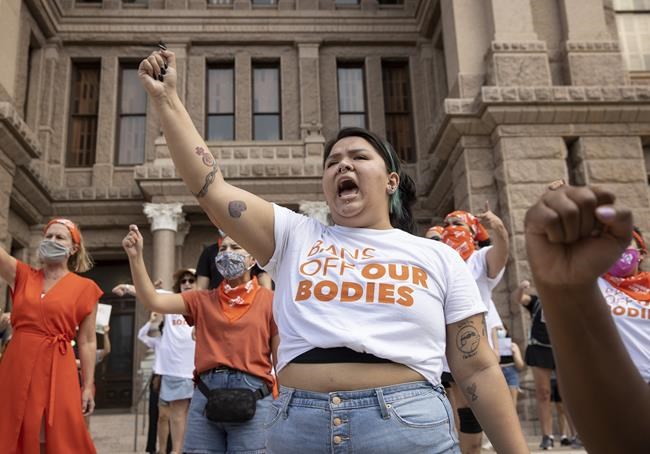
Leen Garza participates in a protest against the six-week abortion ban at the Capitol in Austin, Texas, on Wednesday, Sept. 1, 2021. Dozens of people protested the abortion restriction law that went into effect Wednesday. (Jay Janner/Austin American-Statesman via AP)

Texas has long had some of the nation’s toughest abortion restrictions, including a sweeping law passed in 2013. The Supreme Court eventually struck down that law, but not before more than half of the state’s 40-plus clinics closed.

Lawmakers also are moving forward in an ongoing special session in Texas with proposed new restrictions on medication abortion, a method using pills that accounts for roughly 40% of abortions in the U.S.

Even before the Texas case arrived at the high court the justices had planned to tackle the issue of abortion rights in a major case that will be heard after the court begins hearing arguments again in the fall. That case involves the state of Mississippi, which is asking to be allowed to enforce an abortion ban after 15 weeks of pregnancy.

___

AP writer Paul J. Weber reported from Austin, Texas.

Report Error Submit a Tip

More Stories

Bombers near must-win territory as Als look to punch post-season ticket

Taylor Allen 7 minute read Preview

Bombers near must-win territory as Als look to punch post-season ticket

Taylor Allen 7 minute read Yesterday at 7:35 PM CDT

The Winnipeg Blue Bombers slayed the beast from the East once already this season — but can they do it again?

The Blue and Gold (7-7) will try to pull off another upset when they take on the Montreal Alouettes (11-3) on Saturday (6 p.m.) at Percival Molson Memorial Stadium.

The two teams last met in Winnipeg on Aug. 28 when the Bombers pulled off an unexpected 44-28 victory.

The stakes are much higher this time around. The Als can clinch the East Division with a win, while the Bombers are clinging to the West’s crossover playoff spot by a thread, with the Calgary Stampeders (7-8) hot on their heels.

Read
Yesterday at 7:35 PM CDT

Clock ticks down on destruction of records documenting residential school abuses

Marsha McLeod 13 minute read Preview

Clock ticks down on destruction of records documenting residential school abuses

Marsha McLeod 13 minute read Yesterday at 12:49 PM CDT

In less than a year, a private company is set to destroy the largest cache of records detailing the widespread abuse of Indigenous children at residential schools in Canada.

The destruction, which was ordered by an Ontario court in 2014 and later upheld by the Supreme Court, is set to take place on Sept. 19, 2027.

This countdown is igniting emotional conversations that seek to balance the immense historical value of the records alongside the confidentiality survivors were promised as part of the process of providing detailed testimony about abuses they’d suffered.

The records were created as part of the Indian Residential Schools Settlement Agreement, a class-action settlement stemming from survivors who began suing the federal government in the late 1990s over the harm they’d been subjected to at residential schools.

Read
Yesterday at 12:49 PM CDT

Puzzles Palace

1 minute read Monday, Jul. 27, 2026

To solve our puzzles, please subscribe with this special offer: |

Confidence vote was gamble for MLA, Tories: political expert

Alex Lambert 5 minute read Preview

Confidence vote was gamble for MLA, Tories: political expert

Alex Lambert 5 minute read Thursday, Oct. 1, 2026

BRANDON — A Progressive Conservative MLA’s decision to put forward a confidence motion against the party’s former leader carries a lot of risk for her and the Tories, a political science expert says.

Obby Khan resigned as leader of the PCs on Monday after Jodie Byram (Agassiz) initiated a confidence vote against him the previous week.

The majority of the PC caucus voted in favour of Khan, but he resigned a few days later, citing continued efforts to undermine him by a minority of MLAs.

Brandon University political science Prof. Kelly Saunders said while she doesn’t know what Byram’s motivations were for triggering the vote, such a move carries a lot of risk.

Read
Thursday, Oct. 1, 2026

Gillingham talks trash, pledges big bin boost

Joyanne Pursaga 4 minute read Preview

Gillingham talks trash, pledges big bin boost

Joyanne Pursaga 4 minute read Yesterday at 2:01 AM CDT

Scott Gillingham says he would add hundreds of locked garbage bins downtown to prevent unsightly trash piles if re-elected as mayor.

Read
Yesterday at 2:01 AM CDT

Jets bench boss Arniel talks rebuilding from last season’s struggles

Mike McIntyre and Ken Wiebe 12 minute read Preview

Jets bench boss Arniel talks rebuilding from last season’s struggles

Mike McIntyre and Ken Wiebe 12 minute read Thursday, Oct. 1, 2026

Scott Arniel has a lot on his plate these days.

But the head coach of the Winnipeg Jets took some time Thursday to sit down with Free Press hockey writers Mike McIntyre and Ken Wiebe to discuss a number of topics on the eve of a new hockey season. This interview has been condensed and edited for clarity.

Wiebe: What was the evaluation of last season like? What did you personally do in an attempt to improve after going from first-overall to 26th-overall?

I just went back and looked at things and made sure my communication was where it needed to be with my players. Was my communication where it needed to be with my boss, with my general manager (Kevin Cheveldayoff)? How our coaching staff worked. How we handled highs and lows. Things I felt I could have done better.

Read
Thursday, Oct. 1, 2026