‘Blatant attack’: Panel of UN experts assails ‘regressive’ Texas abortion law
Advertisement
Read this article for free:
or
Already have an account? Log in here »
To continue reading, please subscribe:

Digital Subscription
One year of digital access for only $205*
- Enjoy unlimited reading on winnipegfreepress.com
- Read the E-Edition, our digital replica newspaper
- Access News Break, our award-winning app
- Play interactive puzzles
*First annual payment billed as $205.00 + GST for one year. This annual subscription will automatically renew at $233.00 + GST every 52 weeks (10% off the regular annual price of $259.35). Offer available to new and qualified returning subscribers only. Cancel any time.
To continue reading, please subscribe:
Add Free Press access to your Brandon Sun subscription for only an additional
$1 for the first 4 weeks*
- Enjoy unlimited reading on winnipegfreepress.com
- Read the E-Edition, our digital replica newspaper
- Access News Break, our award-winning app
- Play interactive puzzles
*Your next Brandon Sun subscription payment will increase by $1.00 and you will be charged $17.95 plus GST for four weeks. After four weeks, your payment will increase to $24.95 plus GST every four weeks.
Read unlimited articles for free today:
or
Already have an account? Log in here »
Hey there, time traveller!
This article was published 14/09/2021 (1828 days ago), so information in it may no longer be current.
WASHINGTON – A “regressive” abortion ban in Texas has left the United States in violation of international law, and the Supreme Court — the ultimate guardian of the landmark 1973 ruling that makes it legal — is complicit, a United Nations expert panel declared Tuesday.
President Joe Biden’s administration has vowed to challenge the law in court, and Democrats are already aggressively fundraising on the issue, nervously eyeing their tenuous hold on Congress as the 2022 midterm elections loom large.
With Canada in the throes of a federal campaign that features a resurgent Conservative party and the spectacle of U.S.-style anti-vaccination rallies, some fear the long-term erosion of abortion rights north of the border as well.
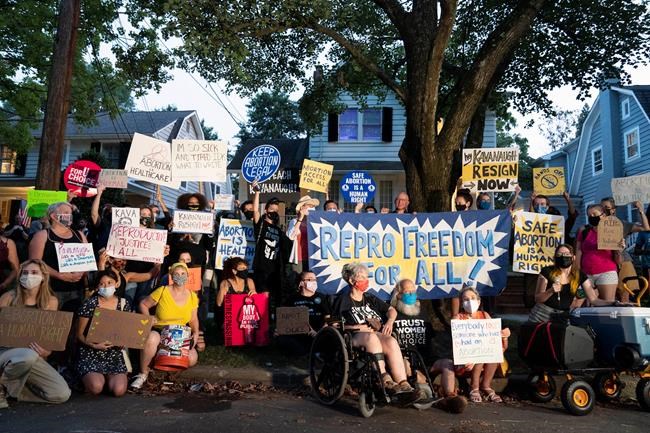
“I kind of wonder what it means in terms of the public getting used to the idea of abortion restrictions, and that’s really scary,” said Joyce Arthur, executive director of the Abortion Rights Coalition of Canada.
The Texas law, which took effect Sept. 1, bans abortions after embryonic heart activity is detected, which is typically at the six-week mark. That’s too little time for many women to even realize they are pregnant, critics say.
It also avoids constitutional issues by expanding the ability of virtually anyone to file a civil suit against abortion providers, doctors or anyone else who “aids or abets” a patient seeking to get the procedure after the legal threshold.
Just minutes before the law was scheduled to take effect Sept. 1, the Supreme Court quietly voted 5-4 against blocking it, conjuring fears that Roe v. Wade, the 1973 ruling that established the constitutional right to an abortion, could be hanging in the balance.
The UN panel, an independent group of special rapporteurs and leaders of working groups operating with the support of the Office of the High Commissioner for Human Rights, accused Texas of circumventing the U.S. Constitution.
The law also disproportionately targets women who can’t afford to travel outside the state, a proportion of the Texas population that is dominated by people of colour, the experts said in a statement.
The law “deputizes” ordinary citizens by offering financial incentives to enforce it in the civil courts — what the panel called a clear violation of human rights that will foster stigma and fear among women, and risk inciting violence against anyone who tries to help them.
“With the passage of the Texas law, the United States stands in violation of international law,” the panel said in a statement.
A number of other U.S. states, including Georgia, Mississippi, Kentucky and Ohio, have also passed similar so-called “heartbeat” laws, but they remain in legal limbo as a result of legal challenges.
Florida Gov. Ron DeSantis, an avowed opponent of abortion rights, has also mused about following the Texas lead, but officials in that state have since tried to distance his administration from the idea of financial incentives.
What happens in the U.S. can have a major impact on what happens elsewhere in the world, said Melissa Upreti, a panel member and the chair of the UN Working Group on Discrimination Against Women and Girls.
“We see this as a serious retrogression in the United States,” Upreti said in an interview.
“What has happened in the United States is not good for other countries. And it is a concern that others might now feel emboldened because I think those who are opposed to women’s abortion rights are seeing this as a major victory.”
Conservative Leader Erin O’Toole, whose party has long been a lightning rod for the abortion debate, tried to ground himself against a campaign shock from the outset of the campaign, declaring himself to be pro-choice.
O’Toole has also said he would not block members of his Conservative caucus from proposing their own private member’s bills to restrict abortion, and would allow them to vote their conscience on such legislation.
Arthur, for one, said she’s not overly concerned about a similar challenge to abortion rights in Canada, “a very different place than the U.S.”
But like many Canadians following the campaign, she’s noticed some decidedly American flourishes, notably the legions of protesters showing up at hospitals and Liberal rallies to denounce Prime Minister Justin Trudeau’s plan to impose mandatory COVID-19 vaccination rules for travellers.
Trudeau — who was pelted with gravel at one campaign stop — and NDP Leader Jagmeet Singh have both proposed tougher criminal penalties for anyone blocking access to hospitals, vaccine clinics, testing centres, pharmacies and abortion clinics, or otherwise intimidating or harassing health-care workers.
“This behaviour of going to all of Trudeau’s campaign stops and yelling and screaming obscenities at him and throwing rocks — I mean, that’s just disgusting,” Arthur said.

“I do have hope and faith that the progressives in the world are still overall a majority of people, hopefully, and there’s still lots of good things going on in the world.”
Both Arthur and Upreti pointed to the example of Mexico, where that country’s Supreme Court delivered a sweeping decision last week that declared it unconstitutional to punish abortion.
“At the end of the day, it really depends on what people themselves choose to be inspired by or influenced by,” Upreti said, citing Canada as a model for its defence of human rights and gender equality around the world.
“One would hope that in Canada, people would be more inspired by those things, rather than retrogression south of the border.”
This report by The Canadian Press was first published Sept. 14, 2021.
Related Articles
Liberals win 4th mandate as NDP vote collapses and Singh announces he will resign












Advertisement Advertise With Us
Advertisement Advertise With Us