Report: At least 59,000 meat workers caught COVID, 269 died

Advertisement

Advertise with us

OMAHA, Neb. (AP) — At least 59,000 meatpacking workers caught COVID-19 and 269 workers died when the virus tore through the industry last year, which is significantly more than previously thought, according to a new U.S. House report released Wednesday.

Read this article for free:


or

Already have an account? Log in here »

To continue reading, please subscribe:

Subscribe and receive a limited-edition Free Press branded hat or tote.

Digital Subscription

One year of digital access for only $205*

  • Enjoy unlimited reading on winnipegfreepress.com
  • Read the E-Edition, our digital replica newspaper
  • Access News Break, our award-winning app
  • Play interactive puzzles

*First annual payment billed as $205.00 + GST for one year. This annual subscription will automatically renew at $233.00 + GST every 52 weeks (10% off the regular annual price of $259.35). Offer available to new and qualified returning subscribers only. Cancel any time.

To continue reading, please subscribe:

Add Free Press access to your Brandon Sun subscription for only an additional

$1 for the first 4 weeks*

  • Enjoy unlimited reading on winnipegfreepress.com
  • Read the E-Edition, our digital replica newspaper
  • Access News Break, our award-winning app
  • Play interactive puzzles
Start now

*Your next Brandon Sun subscription payment will increase by $1.00 and you will be charged $17.95 plus GST for four weeks. After four weeks, your payment will increase to $24.95 plus GST every four weeks.

Hey there, time traveller!
This article was published 27/10/2021 (1803 days ago), so information in it may no longer be current.

OMAHA, Neb. (AP) — At least 59,000 meatpacking workers caught COVID-19 and 269 workers died when the virus tore through the industry last year, which is significantly more than previously thought, according to a new U.S. House report released Wednesday.

The meatpacking industry was one of the early epicenters of the coronavirus pandemic, with workers standing shoulder-to-shoulder along production lines. The U.S. House Select Subcommittee on the Coronavirus Crisis, which examined internal documents from five of the biggest meatpacking companies, said companies could have done more to protect their workers.

The new estimate of infections in the industry is nearly three times higher than the 22,400 that the United Food and Commercial Workers Union has said were infected or exposed. And the true number could be even higher because the companies’ data didn’t generally include coronavirus cases confirmed by outside testing or self reported by employees.
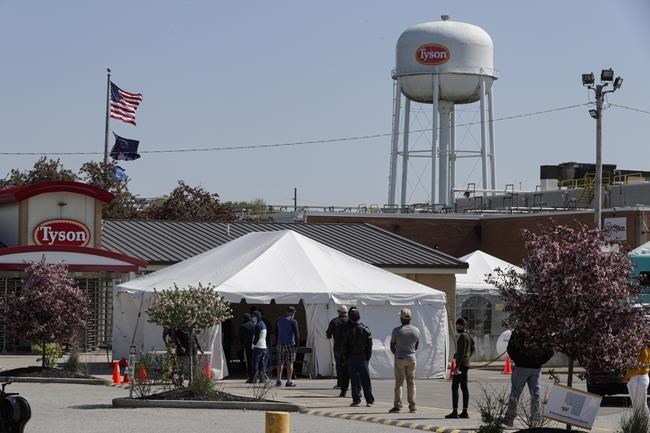
FILE - In this May 7, 2020, file photo workers wait in line to enter the Tyson Foods pork processing plant in Logansport, Ind. At least 59,000 meatpacking workers became ill with COVID-19 and 269 workers died when the virus tore through the industry last year, which is significantly more than previously thought, according to a new U.S. House report released Wednesday, Oct. 27, 2021. (AP Photo/Michael Conroy, File)

At the height of the outbreaks in the spring of 2020, U.S. meatpacking production fell to about 60% of normal as several major plants were forced to temporarily close for deep cleaning and safety upgrades or operated at slower speeds because of worker shortages. The report said companies were slow to take protective steps such as distributing protective equipment and installing barriers between work stations.

“Instead of addressing the clear indications that workers were contracting the coronavirus at alarming rates due to conditions in meatpacking facilities, meatpacking companies prioritized profits and production over worker safety, continuing to employ practices that led to crowded facilities in which the virus spread easily,” the report said.

Martin Rosas, who represents a UFCW chapter based in Kansas with over 17,000 members in three states, said the union pressed companies for better protections.

“The harsh reality is that many of the companies were slow to act in the early days of the outbreak, and whatever progress that was achieved was due to the union demanding action,” Rosas said.

The report is based on documents from JBS, Tyson Foods, Smithfield Foods, Cargill and National Beef. Together they control over 80% of the beef market and over 60% of the pork market nationwide.

The North American Meat Institute trade group defended the industry’s response to the pandemic. And Cargill, Tyson, Smithfield and JBS released statements Wednesday saying they worked aggressively to meet federal health and safety standards and took additional measures to protect their employees, such as conducting widespread testing and urging employees to get vaccinated.

“The health and safety of our team members always comes first and our response since the onset of the pandemic has demonstrated that commitment, with an investment of more than $760 million to date. We have taken aggressive action to keep the virus out of our facilities and adopted hundreds of safety measures that often outpaced federal guidance and industry standards,” JBS spokeswoman Nikki Richardson said.

The companies expressed regret at the toll the virus has taken.

“Even one illness or loss of life to COVID-19 is one too many, which is why we’ve taken progressive action from the start of the pandemic to protect the health and safety of our workers,” Tyson spokesman Gary Mickelson said.
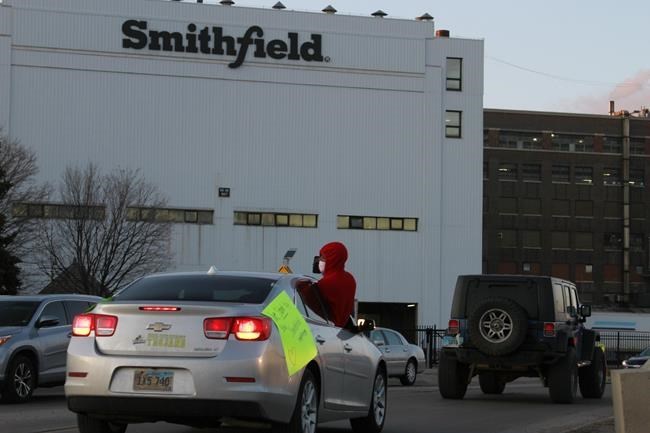
FILE - In this April 9, 2020 file photo employees and family members protest outside a Smithfield Foods processing plant in Sioux Falls, S.D. At least 59,000 meatpacking workers became ill with COVID-19 and 269 workers died when the virus tore through the industry last year, which is significantly more than previously thought, according to a new U.S. House report released Wednesday, Oct. 27, 2021. (AP Photo/Stephen Groves File)

The report said infection rates were especially high at some meatpacking plants between the spring of 2020 and early 2021. At a JBS plant in Hyrum, Utah, 54% of the workforce contracted the virus. Nearly 50% of workers at a Tyson plant in Amarillo, Texas, were infected. And 44% of employees at National Beef’s plant in Tama, Iowa, caught COVID-19.

The report said internal documents show Smithfield aggressively pushed back against government safety recommendations after experts from the Centers for Disease Control and Prevention inspected its pork plant in Sioux Falls, South Dakota, after a major outbreak. A few days earlier, Smithfield’s CEO told the CEO of National Beef in an email that “Employees are afraid to come to work.”

Maryland Rep. Jamie Raskin said the Occupational Safety and Health Administration needs to do more to protect meatpacking workers.

“Some of these companies are treating the workers in the plants not much better than the animals that go through them,” Raskin said.

Debbie Berkowitz, with Georgetown University’s Kalmanovitz Initiative for Labor and the Working Poor, said the industry was slow to respond and federal regulators didn’t force companies to act.

“When the pandemic hit, of course it was going to hit meatpacking plants really hard and really fast,” said Berkowitz, a former OSHA official who testified Wednesday. “What was the industry’s response — not to protect workers and mitigate the spread of COVID-19, not to separate workers 6 feet apart, which was the earlier guidance that came out in late February — but to just keep on going.”
Report Error Submit a Tip

More Stories

Creative powerhouse Perry Rosemond never lost Winnipeg roots

Ben Waldman 7 minute read Preview

Creative powerhouse Perry Rosemond never lost Winnipeg roots

Ben Waldman 7 minute read Yesterday at 6:00 AM CDT

He created King of Kensington, directed the troops in the Royal Canadian Air Farce, and his creative eye was behind the lens for television shows starring Johnny Cash, Tom Jones, Mr. Dress-Up and the Friendly Giant.

He also wrote and developed the Canadian version of Sesame Street during his time as the head of school and preschool programming for CBC in Toronto, and directed a televised special in 2002 for Winnipeg sketch comedy troupe Royal Liechtenstein Theatre Company.

But before his name featured in the credits of some of the most iconic and influential pieces of the Cancon canon, Perry Rosemond was an only child living in a crammed, multi-generational home in Winnipeg’s North End, racing each day to beat the morning bell next door at William Whyte School.

In memoirs that have yet to be published, the late television producer recalled his childhood. “(T)here were 14 of us in the house at 193 Andrews St., and it wasn’t that big of a house,” he writes.

Read
Yesterday at 6:00 AM CDT

’Disgusting’ posters being investigated by police

Morgan Modjeski 4 minute read Yesterday at 2:22 PM CDT

The Winnipeg Police Service major crimes unit is investigating what some have labelled offensive and hateful posters on full-display at a Winnipeg home.

One of the people irked by the display is Gracie Garrett. She’s has lived on Ashburn Street in Winnipeg’s Minto neighbourhood for almost ten years. She’s never felt unsafe in the neighbourhood before, but now, a set of posters plastered on a nearby house are making her feel uneasy.

The five signs, posted facing the street prominently on a front window, contain a slur, refer to Nazis as “heroes” and call Muslims, Christians and other groups “evil.”

Learning of the signs Friday, Garrett said she’ll be reporting the posters to police, as she worries they incite and promote violence.

Today’s horoscope

Georgia Nicols 4 minute read Preview

Today’s horoscope

Georgia Nicols 4 minute read 2:00 AM CDT

MOON ALERT: Caution! Avoid shopping (except food and gas) and important decisions until after 6:30 p.m. today. After that, the moon moves from Cancer into Leo.

ARIES (March 21-April 19)

Don’t expect much co-operation from partners, spouses and close friends. This is why you might feel cut off from others or a bit lonely. There’s the sense a gulf exists between you and everyone else. But this is temporary. Courage!

TAURUS (April 20-May 20)

Read
2:00 AM CDT

Manitoba’s own Summer Howell takes on biggest role yet as Stephen King’s telekinetic teen Carrie

Randall King 7 minute read Preview

Manitoba’s own Summer Howell takes on biggest role yet as Stephen King’s telekinetic teen Carrie

Randall King 7 minute read Friday, Oct. 2, 2026

From the tender age of eight, actress Summer Howell has made her presence known in a series of horror films shot in her home province of Manitoba.

Her first film was Curse of Chucky (2013), director Don Mancini’s continuation of the venerable killer doll series he started (as a screenwriter) in 1988 with Child’s Play.

“Even then, it was obvious she was very talented, intelligent and delightful,” Mancini said of Howell.

Though she has worked in other genres, Howell gravitated to horror repeatedly, with credits in Shawn Linden’s harrowing Hunter Hunter (2020) and the 2023 possession thriller All Fun and Games. Earlier this year, she shot the horror film Sundown in Winnipeg with director Rebekah McKendry, which premièred last week at Beyond Fest in Los Angeles and is headed for a streaming berth on Shudder.

Read
Friday, Oct. 2, 2026

Puzzles Palace

1 minute read Monday, Jul. 27, 2026

To solve our puzzles, please subscribe with this special offer: |

Winnipeggers witness unveiling of Japanese Canadian monument in B.C.

Morgan Modjeski 6 minute read Preview

Winnipeggers witness unveiling of Japanese Canadian monument in B.C.

Morgan Modjeski 6 minute read Yesterday at 8:39 PM CDT

As Miki Stewart gathered with her family at the Japanese Cultural Association of Manitoba on Saturday afternoon, she was thinking of her parents, Yoshimaru and Yoshi Abe.

Both Stewart, 80, and her sister Yumi Falk, 81, alongside an older brother, were born in the Tashme internment camp in British Columbia. They were among more than 2,600 Japanese Canadians who were forcefully removed and interred at the camp following the bombing of Pearl Harbour and Canada’s declaration of war on Japan in 1941.

“They didn’t talk much about how they suffered,” Stewart said of her parents. “But they did.”

She was amongst a group of more than 150 people who gathered at the association’s McPhillips headquarters on Saturday afternoon to watch the unveiling of the Japanese Canadian Monument in Victoria B.C.

Read
Yesterday at 8:39 PM CDT