UN: Wildfires getting worse globally, governments unprepared

Advertisement

Advertise with us

BILLINGS, Mont. (AP) — A warming planet and changes to land use patterns mean more wildfires will scorch large parts of the globe in coming decades, causing spikes in unhealthy smoke pollution and other problems that governments are ill prepared to confront, according to a U.N. report released Wednesday.

Read this article for free:


or

Already have an account? Log in here »

To continue reading, please subscribe:

Subscribe and receive a limited-edition Free Press branded hat or tote.

Digital Subscription

One year of digital access for only $205*

  • Enjoy unlimited reading on winnipegfreepress.com
  • Read the E-Edition, our digital replica newspaper
  • Access News Break, our award-winning app
  • Play interactive puzzles

*First annual payment billed as $205.00 + GST for one year. This annual subscription will automatically renew at $233.00 + GST every 52 weeks (10% off the regular annual price of $259.35). Offer available to new and qualified returning subscribers only. Cancel any time.

To continue reading, please subscribe:

Add Free Press access to your Brandon Sun subscription for only an additional

$1 for the first 4 weeks*

  • Enjoy unlimited reading on winnipegfreepress.com
  • Read the E-Edition, our digital replica newspaper
  • Access News Break, our award-winning app
  • Play interactive puzzles
Start now

*Your next Brandon Sun subscription payment will increase by $1.00 and you will be charged $17.95 plus GST for four weeks. After four weeks, your payment will increase to $24.95 plus GST every four weeks.

Hey there, time traveller!
This article was published 23/02/2022 (1683 days ago), so information in it may no longer be current.

BILLINGS, Mont. (AP) — A warming planet and changes to land use patterns mean more wildfires will scorch large parts of the globe in coming decades, causing spikes in unhealthy smoke pollution and other problems that governments are ill prepared to confront, according to a U.N. report released Wednesday.

The Western U.S., northern Siberia, central India, and eastern Australia already are seeing more blazes, and the likelihood of catastrophic wildfires globally could increase by a third by 2050 and more than 50% by the turn of the century, according to the report from the United Nations Environment Program.

Areas once considered safe from major fires won’t be immune, including the Arctic, which the report said was “very likely to experience a significant increase in burning.”
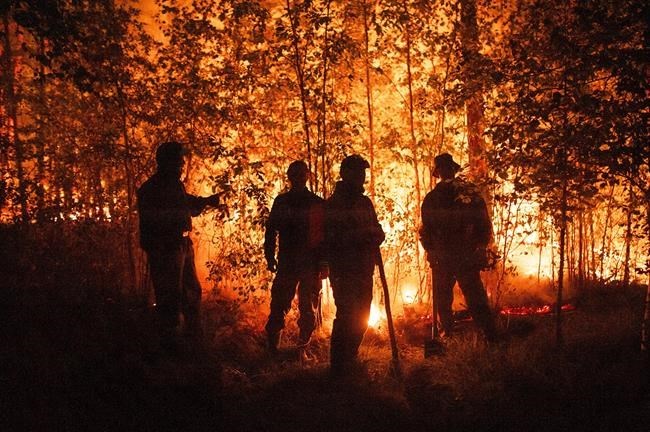
FILE -Firefighters work at the scene of forest fire near Kyuyorelyakh village at Gorny Ulus area, west of Yakutsk, in Russia Thursday, Aug. 5, 2021. A warming planet and land use changes mean more wildfires will scorch large parts of the globe in coming decades. That's according to a UN report released Wednesday, Feb. 23, 2022 that says many governments are ill-prepared to address the problem. (AP Photo/Ivan Nikiforov, File)

Tropical forests in Indonesia and the southern Amazon of South America also are likely to see increased wildfires, the report concluded.

“Uncontrollable and devastating wildfires are becoming an expected part of the seasonal calendars in many parts of the world,” said Andrew Sullivan, with the Commonwealth Scientific and Industrial Research Organisation in Australia, one of the report’s authors.

The report describes a worsening cycle: Climate change brings more drought and higher temperatures that make it easy for fires to start and spread, and in turn those blazes release more climate-changing carbon into the atmosphere as they burn through forests and peatland.

Some areas including parts of Africa are seeing decreasing wildfires, in part because more land is being devoted to agriculture, said report co-author Glynis Humphrey from the University of Cape Town.

But U.N. researchers said many nations continue to spend too much time and money fighting fires and not enough trying to prevent them. Land use changes can make the fires worse, such as logging that leaves behind debris that can easily burn and forests that are intentionally ignited to clear land for farming, the report said.

Poor communities are often hit hardest by fires, which can degrade water quality, destroy crops and reduce land available to grow food.

“It impacts people’s jobs and the economic situation that people are in,” Humphrey said. “It’s integral that fire be in the same category of disaster management as floods and droughts. It’s absolutely essential.”

In the United States, officials recently unveiled a $50 billion effort to reduce fire risks over the next decade by more aggressively thinning forests around “hot spots” where nature and neighborhoods collide. Only some of that work has funding so far — about $3 billion over five years under the recently passed federal infrastructure bill, according to officials in President Joe Biden’s administration.

Critics of the administration’s plan say it continues to put too much emphasis on fighting some fires that can be useful to clear out underbrush when the flames remain relatively small and don’t threaten houses.

The U.N. researchers also called for more awareness of the dangers from wildfire smoke inhalation, which can affect tens of millions of people annuall y as plumes from major wildfires drift thousands of miles across international borders.

Report Error Submit a Tip

More Stories

Clock ticks down on destruction of records documenting residential school abuses

Marsha McLeod 13 minute read Preview

Clock ticks down on destruction of records documenting residential school abuses

Marsha McLeod 13 minute read Yesterday at 12:49 PM CDT

In less than a year, a private company is set to destroy the largest cache of records detailing the widespread abuse of Indigenous children at residential schools in Canada.

The destruction, which was ordered by an Ontario court in 2014 and later upheld by the Supreme Court, is set to take place on Sept. 19, 2027.

This countdown is igniting emotional conversations that seek to balance the immense historical value of the records alongside the confidentiality survivors were promised as part of the process of providing detailed testimony about abuses they’d suffered.

The records were created as part of the Indian Residential Schools Settlement Agreement, a class-action settlement stemming from survivors who began suing the federal government in the late 1990s over the harm they’d been subjected to at residential schools.

Read
Yesterday at 12:49 PM CDT

Volunteer pop-up library axed from Manitoba Youth Centre

Matthew Frank 4 minute read Preview

Volunteer pop-up library axed from Manitoba Youth Centre

Matthew Frank 4 minute read 2:01 AM CDT

Manitoba Corrections has cancelled a pop-up library program at the Manitoba Youth Centre, leaving inmates without librarian services and fewer options to borrow certain books.

The Prison Libraries Committee, part of the non-profit Manitoba Library Association, operated and funded the volunteer program since 2024 before it was shut down by the province last month. The group previously partnered with the province to offer the service because the facility has no dedicated library of its own.

“It is concerning that community members who are incarcerated, especially youth, are losing out on meaningful programming, access to information and rehabilitation efforts, which are offered at no cost to (Manitoba) Corrections. We urge Manitoba Justice to promote more library services and programming, not less,” said a Sept. 24 letter from the non-profit addressed to the justice minister.

Ashley Huot, chair of the Prison Libraries Committee, said she was puzzled when she received an email last month from Manitoba Corrections stating that the pop-up library was no longer needed.

Read
2:01 AM CDT

Letters, Oct. 3

7 minute read 2:01 AM CDT

A morning in the life …

My very first lesson does not start when I walk into that lecture hall, oh no — it starts long before. It begins when I walk to my car, check the estimated arrival time to the University of Manitoba and hope that Winnipeg traffic agrees with it.

A drive that appears completely manageable changes almost immediately when I’m greeted by a tsunami of orange pylons and a line of cars that appears to go on forever. Traffic moves by the inch, lanes magically disappear and the detour I took yesterday now has a detour of its own. These factors make me do a calculation that I have become all too familiar with. How late can I arrive and still find parking, run to my class across campus and get to class with enough time left to make it worth it?

I have grown used to people saying, “Why not just leave earlier?” I do. But when I’m already leaving for my 8:30 a.m. class at 7 a.m., there’s only so much I can do. This drive that some would think is relaxing is one that feels like an assignment that I didn’t know I had to complete and is due at 8:30 a.m.

Brandonmeat packer thriving on its own

Abiola Odutola 3 minute read Preview

Brandonmeat packer thriving on its own

Abiola Odutola 3 minute read 2:01 AM CDT

BRANDON — Canada Packers has strengthened its business and laid the foundation for future growth during its first year as an independent company, its president says.

The Brandon-based pork producer, separated from Maple Leaf Foods in October 2025, established its own leadership, strategy, systems, culture and identity while continuing operations across its hog production farms and regional hog barns in southern and eastern Manitoba.

The company’s first year was focused on building a successful standalone business while continuing to serve customers, communities and shareholders, president Dennis Organ said.

“Market conditions over the past year have been more challenging than we anticipated when we became a separate entity,” he said in an email. “Despite that, we continued to execute against our priorities, including increasing processing volumes, maintaining disciplined operations and strengthening the business.”

Read
2:01 AM CDT

Sisters relieved hospital takes accountability after mother’s death

Scott Billeck 5 minute read Preview

Sisters relieved hospital takes accountability after mother’s death

Scott Billeck 5 minute read Thursday, Oct. 1, 2026

Eight months after losing their mother, two Winnipeg sisters say an internal hospital review has finally given them something they had been seeking since her death: accountability.

Chelsea Mann and Samantha Burns said St. Boniface Hospital officials acknowledged mistakes were made in the care of their mother, Judy Burns, during a recent meeting to discuss the findings of a critical incident review into her death.

The acknowledgement marked a significant departure from an earlier meeting with hospital officials, when they felt their concerns were largely dismissed.

Burns, 68, died on Jan. 21, three days after being admitted, after experiencing rectal bleeding.

Read
Thursday, Oct. 1, 2026

A spiritual vision will help anchor a health civic outlook

John Longhurst 5 minute read 2:01 AM CDT

We have an election coming up. With that in mind, the Free Press asked some of their columnists to write about the challenges ahead and how the city can become better.

For Tom Brodbeck, the main challenge is finances — and how candidates will pay for their many promises for fixing roads, improving public safety and making transit better.

Rebecca Chambers said that the concerns of inner-city residents need to be taken seriously by those who aspire to work at city hall.

Niigaan Sinclair said the most pressing issue in Winnipeg isn’t construction projects, light-rail transit, public safety, taxes or social services. For him, it’s the city’s relationship with Indigenous people.