UN: War in Ukraine to hurt poor nations importing grain

Advertisement

Advertise with us

ROME (AP) — Poorer countries in northern Africa, Asia and the Middle East that depend heavily on wheat imports risk suffering significant food insecurity because of Russia's war in Ukraine, and the conflict is poised to drive up already soaring food prices in much of the world, the U.N. food agency warned Friday.

Read this article for free:


or

Already have an account? Log in here »

To continue reading, please subscribe:

Subscribe and receive a limited-edition Free Press branded hat or tote.

Digital Subscription

One year of digital access for only $205*

  • Enjoy unlimited reading on winnipegfreepress.com
  • Read the E-Edition, our digital replica newspaper
  • Access News Break, our award-winning app
  • Play interactive puzzles

*First annual payment billed as $205.00 + GST for one year. This annual subscription will automatically renew at $233.00 + GST every 52 weeks (10% off the regular annual price of $259.35). Offer available to new and qualified returning subscribers only. Cancel any time.

To continue reading, please subscribe:

Add Free Press access to your Brandon Sun subscription for only an additional

$1 for the first 4 weeks*

  • Enjoy unlimited reading on winnipegfreepress.com
  • Read the E-Edition, our digital replica newspaper
  • Access News Break, our award-winning app
  • Play interactive puzzles
Start now

*Your next Brandon Sun subscription payment will increase by $1.00 and you will be charged $17.95 plus GST for four weeks. After four weeks, your payment will increase to $24.95 plus GST every four weeks.

Hey there, time traveller!
This article was published 11/03/2022 (1669 days ago), so information in it may no longer be current.

ROME (AP) — Poorer countries in northern Africa, Asia and the Middle East that depend heavily on wheat imports risk suffering significant food insecurity because of Russia’s war in Ukraine, and the conflict is poised to drive up already soaring food prices in much of the world, the U.N. food agency warned Friday.

Ukraine and Russia, which is under heavy economic sanctions for invading its neighbor two weeks ago, account for one-third of global grain exports.

With the conflict’s intensity and duration uncertain, “the likely disruptions to agricultural activities of these two major exporters of staple commodities could seriously escalate food insecurity globally, when international food and input prices are already high and vulnerable,” said Qu Dongyu, director-general of the Rome-based Food and Agriculture Organization.
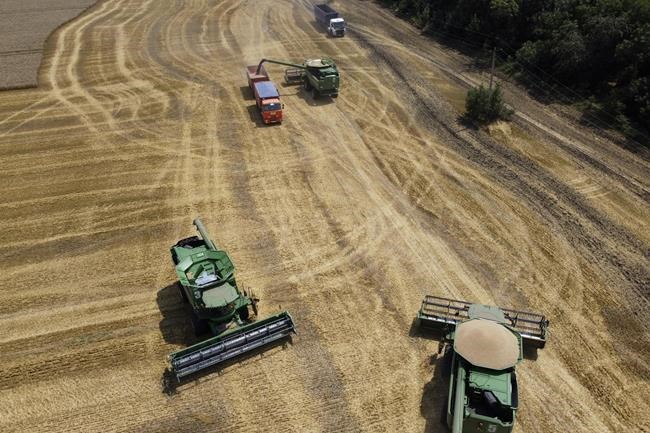
FILE - Farmers harvest with their combines in a wheat field near the village Tbilisskaya, Russia, July 21, 2021. The Russian tanks and missiles besieging Ukraine also are threatening the food supply and livelihoods of people in Europe, Africa and Asia who rely on the vast, fertile farmlands known as the “breadbasket of the world.” Russia and Ukraine combine for about a third of the world’s wheat and barley exports and provide large amounts of corn and cooking oils. (AP Photo/Vitaly Timkiv, File)

The U.N. agency, known as FAO, also noted that Russia is the lead producer of fertilizer, and a key fertilizer component — urea — has jumped more than threefold in price in the last 12 months.

There’s also the uncertainty over whether Ukraine’s wheat ready in June can be harvested as “massive population displacement has reduced the number of agricultural laborers and workers. Accessing agricultural fields would be difficult,” Qu noted.

Ukraine’s ports on the Black Sea are shuttered, and its government this week banned the export of wheat, oats, millet, buckwheat and some other food products to prevent a crisis in its own country.

The ban does not apply to its major global exports of corn and sunflower oil. It and Russia together supply 52% of the world’s sunflower oil exports. They also account for 19% of the world’s barley supply, 14% of wheat and 4% of corn.

“It is still unclear whether (other) exporters would be able to fill this gap,” Qu said, warning that wheat inventories are already running low in Canada.

The United States, Argentina and other wheat-producing nations are likely to limit exports as governments seek to ensure domestic supply, he said.

Adding to the pressure, countries that depend on Russian and Ukrainian wheat are likely to increase imports. Egypt, Turkey, Bangladesh and Iran buy 60% of their wheat from Russia and Ukraine. Also heavily reliant are Lebanon, Tunisia, Yemen, Libya and Pakistan.

In Libya, where civil war has ground on for years, the latest price increases for food staples have people worried.

Salah Alabar, a 37-year-old father of two, said bread and flour have increased by roughly 40% in his Benghazi neighborhood. Sunflower oil is 25% higher.

“This poses a challenge to families with minimum wages and even the middle-class families as expenses increase across the board,” he said.

The U.N. agency said its simulations suggest that “the global number of undernourished people could increase by 8 to 13 million” in 2022-2023, particularly in Asia, sub-Saharan Africa, the Middle East and North Africa.

Potential for unrest could rise with the prices.
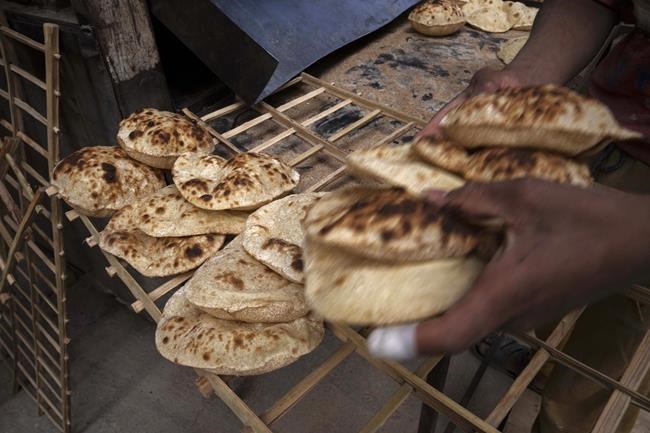
FILE - A worker collects Egyptian traditional 'baladi' flatbread, at a bakery, in el-Sharabia, Shubra district, Cairo, Egypt, Wednesday, March 2, 2022. Ukraine's government banned the export of wheat, oats and other food staples on Wednesday, March 9, 2022 as authorities try to make sure they can feed people while Russia's invasion intensifies.(AP Photo/Nariman El-Mofty, File)

Mohammed Jassim, who owns a small bakery in Baghdad, said there was real concern in Iraq, where dozens of people held demonstrations in the past week over skyrocketing food prices.

“I am a consumer who buys staples for my business, and I have seen an increase of about 20% in the price of sugar and wheat,” he said. “If this keeps up, then I will be forced to raise my prices, and ultimately, the average citizen will be the one to pay for it.”

With shortfalls in grain and sunflower seed exports by Ukraine and Russia, “worryingly, the resulting global supply gap could push up international food and feed prices by 8 to 22% above their already elevated levels,” the FAO’s report warned.

Its figures show food prices reached an all-time high in February.

The COVID-19 pandemic already had a major impact on global food security. Last year, global prices of wheat and barley rose 31%, and rapeseed and sunflower oil prices jumped by more than 60%. Wheat prices have surged more than 50% since a week before the invasion.

In Italy, supermarkets in Tuscany and Sardinia are limiting sales of sunflower seed oil to two containers per customer, Italian state TV said. Spanish supermarkets also are rationing it.

Italian importers of the seed for processing into oil say their supply has already dried up.

___

Associated Press reporters Qassim Abdul-Zahra contributed from Baghdad, Iraq, and Rami Musa contributed from Benghazi, Libya.

Report Error Submit a Tip

More Stories

Mayoral hopefuls trade accusations

Maggie Macintosh 4 minute read Preview

Mayoral hopefuls trade accusations

Maggie Macintosh 4 minute read Yesterday at 7:51 PM CDT

Two mayoral hopefuls traded accusations about meddling in each other’s campaigns as the incumbent rallied supporters for his re-election bid on the eve of advanced polls opening across Winnipeg.

A social media post made by Mike Vogiatzakis, one of 12 nominees in the Oct. 28 race for the top job at city hall, caught the attention of rivals Sunday.

The funeral director took to Facebook midday to criticize Kevin Klein — a competitor he said he thought of “as a friend” until the former Tory cabinet minister made a U-turn after pledging to back the Vogiatzakis campaign.

“Good speaker? Yes. Good looking guy? Sure. Someone I trust now? Absolutely not,” he wrote in a lengthy post.

Read
Yesterday at 7:51 PM CDT

The election of our discontent: City at a crumbling crossroads, grumbling residents say in poll

Matthew Frank 7 minute read Preview

The election of our discontent: City at a crumbling crossroads, grumbling residents say in poll

Matthew Frank 7 minute read Updated: 3:16 PM CDT

There’s an undercurrent of unhappiness running through the Winnipeg electorate as the municipal election day approaches.

One-half of Winnipeggers believe the city is heading in the wrong direction, according to a new Abacus Data poll, with nearly one-third unsure if Winnipeg is regressing or progressing.

Only 21 per cent of residents believe the city is on the right track, the Free Press-commissioned poll found.

That discontentment extends to how the city spends its tax dollars, with four in 10 Winnipeggers believing they receive poor value for what they pay in property taxes.

Read
Updated: 3:16 PM CDT

Living the dream

Ken Wiebe 7 minute read Preview

Living the dream

Ken Wiebe 7 minute read Saturday, Oct. 3, 2026

DETROIT – As Tyrel Bauer took a left turn out of the tunnel from the Winnipeg Jets dressing room and into the stands, he was met with a hearty round of applause from the 25 friends and family members who had made the trek from various points around North America.

Bauer had just realized a childhood dream and the significance of the moment was not lost on some of his biggest supporters.

“It was a special walk, for sure. A special walk,” Bauer said on Saturday afternoon before the Jets departed for a two-game road trip that begins on Sunday in Detroit against the Red Wings. “Those people who came – and many more that weren’t there and were cheering on from afar – they’ve always been there.

“I wanted that for my family, maybe even more than I wanted it for me. They’ve been through thick and thin. I’ve stressed mom out quite a bit over the years doing my job. That meant a lot for them and I’m really happy they could be there for it.”

Read
Saturday, Oct. 3, 2026

Brandon meat packer thriving on its own

Abiola Odutola 3 minute read Preview

Brandon meat packer thriving on its own

Abiola Odutola 3 minute read Saturday, Oct. 3, 2026

BRANDON — Canada Packers has strengthened its business and laid the foundation for future growth during its first year as an independent company, its president says.

The Brandon-based pork producer, separated from Maple Leaf Foods in October 2025, established its own leadership, strategy, systems, culture and identity while continuing operations across its hog production farms and regional hog barns in southern and eastern Manitoba.

The company’s first year was focused on building a successful standalone business while continuing to serve customers, communities and shareholders, president Dennis Organ said.

“Market conditions over the past year have been more challenging than we anticipated when we became a separate entity,” he said in an email. “Despite that, we continued to execute against our priorities, including increasing processing volumes, maintaining disciplined operations and strengthening the business.”

Read
Saturday, Oct. 3, 2026

Thank Manitoba’s teachers by investing in students

Lillian Klausen 5 minute read 2:00 AM CDT

Manitoba’s students are settling into a new school year. Whether you graduated in 1986 or 2006, today’s classrooms look very different from the ones you remember.

Students reflect the changing makeup of our communities — differences in social, emotional, physical and cognitive abilities and socioeconomic stresses are all increasingly present and adding to the complexity of our classrooms.

Meeting these differing individual needs is no easy feat. It requires manageable class sizes, school counsellors, social workers, specialized resource teachers and investment in the systems that can help students thrive. But when those supports aren’t available, students’ needs don’t disappear. Increasingly, it falls to classroom teachers to try to fill the gaps.

When I started working as a teacher more than 30 years ago, we had budgets for resources when we needed them. Today, the needs of students have diversified and increased, but the funding for our public schools is failing to meet them.

Lemonade stand brings in hundreds for West Broadway Youth Outreach

AV Kitching 9 minute read Preview

Lemonade stand brings in hundreds for West Broadway Youth Outreach

AV Kitching 9 minute read 6:00 AM CDT

Like most 12-year-olds, there’s nothing Ruby Barkley enjoys more than a tall glass of lemonade. So when she decided to set up a lemonade stand, Ruby’s Sips + Sweets, in her neighbourhood last month, her mom was only too happy to say yes.

Especially since Ruby had decided she was going to donate proceeds of the sales to West Broadway Youth Outreach (WBYO), a non-profit organization providing recreational and life-skills programming for children aged four and up.

Ruby had set up lemonade stands in the past and was accustomed to serving up glasses from a pitchers of drink she’d already pre-made, but this time round she chose to do something different.

“We got a muddler press and I hand-pressed the lemons and then added flavours. It’s a whole process. It’s hand squeezed right before your eyes and anybody can watch it. I loved doing it,” she says.

Read
6:00 AM CDT