US-backed group gets lifesaving meds to Ukrainians amid war
Advertisement
Read this article for free:
or
Already have an account? Log in here »
To continue reading, please subscribe:

Digital Subscription
One year of digital access for only $205*
- Enjoy unlimited reading on winnipegfreepress.com
- Read the E-Edition, our digital replica newspaper
- Access News Break, our award-winning app
- Play interactive puzzles
*First annual payment billed as $205.00 + GST for one year. This annual subscription will automatically renew at $233.00 + GST every 52 weeks (10% off the regular annual price of $259.35). Offer available to new and qualified returning subscribers only. Cancel any time.
To continue reading, please subscribe:
Add Free Press access to your Brandon Sun subscription for only an additional
$1 for the first 4 weeks*
- Enjoy unlimited reading on winnipegfreepress.com
- Read the E-Edition, our digital replica newspaper
- Access News Break, our award-winning app
- Play interactive puzzles
*Your next Brandon Sun subscription payment will increase by $1.00 and you will be charged $17.95 plus GST for four weeks. After four weeks, your payment will increase to $24.95 plus GST every four weeks.
Read unlimited articles for free today:
or
Already have an account? Log in here »
Hey there, time traveller!
This article was published 27/03/2022 (1655 days ago), so information in it may no longer be current.
WASHINGTON (AP) — Thousands of patients in Ukraine are receiving lifesaving medicines to treat HIV and opioid addiction through a U.S.-funded group still operating despite the Russian invasion. Supplies are running short and making deliveries is a complicated calculus with unpredictable risks.
Officials say the quiet work of the Alliance for Public Health shows how American assistance is reaching individuals in the besieged nation, on a different wavelength from U.S. diplomatic and military support for the Ukrainian government.
The Ukraine-based humanitarian organization has operated for more than 20 years. It has received millions of dollars from the U.S. Agency for International Development as well as the Centers for Disease Control and Prevention, and other federal programs to counter HIV globally.
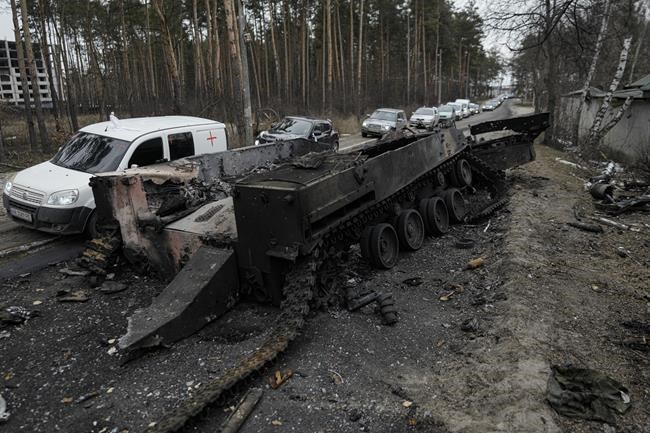
Executive director Andriy Klepikov said shutting down was not an option during the invasion. Ukraine has one of the most serious HIV epidemics in Western Europe, and patients need their medications daily.
He said his group made a “risk management plan” to continue its work if fighting broke out. But it did not envision the scale of the onslaught unleashed by Russian forces, and that has forced the group to adapt.
In areas of Ukraine that have escaped the worst, the organization is still able to deliver medications via postal and parcel services. For refugees who have left the country, caseworkers are making connections with aid groups that can restock medications. In places under attack but still in Ukrainian control, medical vans are bringing in supplies via convoys. The group has even been able to get some deliveries into Russian-controlled areas, with the help of intermediaries. It also is distributing medicines for tuberculosis.
Asked how long it can keep going, Klepikov responded:
“We Ukrainians are quite resilient. I am not the best soldier. But in the area of medicine, humanitarian work, public health, human rights __ that’s my area, and I will do the maximum possible.” He was interviewed by telephone several times recently.
“We are still serving thousands of people” with medications, Klepikov said. “It’s more than five thousand.”
The group’s fleet of medical vans has been pressed into service to transport injured civilians to hospitals that can treat complex cases, and to deliver essential supplies for daily living.
U.S. officials say they have been impressed with the attitude of the Ukrainians, which evokes the tenacity of Britons during the London Blitz in World War II.
“Going into the war, I think we assumed the services would probably not be working anymore, and we completely understood,” said Ryan Keating, a CDC epidemiologist overseeing AIDS prevention and treatment assistance for Ukraine. But “in most cases throughout the country our partners have continued to work every day.”
Keating tells of a nurse at a clinic in one hard-hit city, who when the air raid siren sounded, scooped up the HIV medicines first and then hustled to the bomb shelter. Health care staff continued to communicate with clients from the bomb shelter.
For the Alliance, every day turns into a test. The group has lost contact with clients in Mariupol, which has a large population of HIV patients. That coastal city has been relentlessly pummeled by the Russians, and reports indicate much of it is reduced to rubble. An Alliance medical van was destroyed during a bombardment, Klepikov said.
Normal patterns of communication between clients and their caseworkers and clinicians have been severely disrupted. A clinic or office may be closed. Patients may have moved to safer areas. Messaging apps and online forums have filled some of the gaps, much as telehealth became the fallback in the United States during the first wave of the coronavirus pandemic.
A website supported by the Alliance has become a place for patients to seek counseling for the trauma of war. According to one of the group’s periodic situation reports, the top concerns of patients are acute stress, strong anxiety mixed with sadness, fear of death, guilt after evacuating to a safer area, and guilt about not doing enough.
“The importance of this work increases substantially in the context of war,” said Klepikov, who holds a doctorate in philosophy.
The U.S. has a long-standing relationship with the Ukrainian group through a program called the President’s Emergency Plan for AIDS Relief.
Efforts are underway to restock Ukraine’s supply of medicines, said Dr. Ezra Barzilay, CDC’s country director for Ukraine. Antiretroviral drugs are used to treat HIV, and medicines such as buprenorphine and methadone are used for opioid addiction. Two Ukrainian factories that made drugs to treat opioid addiction have been attacked.
HIV and opioid addiction are related medical problems because the virus that causes AIDS can be transmitted by infected needles used to inject drugs. The Alliance estimates that 100,000 Ukrainians living with HIV are in cities and districts impacted by the Russian invasion. At the time the war started, more than 17,000 patients with opioid addiction were receiving treatment.
“Having the drugs in country doesn’t necessarily make it work,” Barzilay said. “You could have thousands of pills in one city and the city next door may not have access. They’re moving drugs by car from location to location.”
Program director Klepikov said he remembers a long-ago event with the U.S. ambassador to kick off American support for his organization. “I’m worried that what we’ve achieved in 21 years can be destroyed in days because of the Russian aggression in Ukraine.”
President Joe Biden’s health secretary, Xavier Becerra, said the Health and Human Services Department is coordinating with the State Department to deliver medical supplies to Ukraine, and is preparing to help resettle Ukrainian refugees. “We want to be there,” Becerra told The Associated Press. “At HHS, we have a role to play as well.”
Related Articles
Zelenskyy briefs Trudeau amid talks with Russia

Advertisement Advertise With Us
Advertisement Advertise With Us