Feds move forward on menstrual equity in budget, advocates want it done ‘right’

Advertisement

Advertise with us

OTTAWA - Over six months since the Liberals committed to creating a menstrual equity fund, the federal government has proposed the pilot project in its 2022 budget.

Read this article for free:


or

Already have an account? Log in here »

To continue reading, please subscribe:

Subscribe and receive a limited-edition Free Press branded hat or tote.

Digital Subscription

One year of digital access for only $205*

  • Enjoy unlimited reading on winnipegfreepress.com
  • Read the E-Edition, our digital replica newspaper
  • Access News Break, our award-winning app
  • Play interactive puzzles

*First annual payment billed as $205.00 + GST for one year. This annual subscription will automatically renew at $233.00 + GST every 52 weeks (10% off the regular annual price of $259.35). Offer available to new and qualified returning subscribers only. Cancel any time.

To continue reading, please subscribe:

Add Free Press access to your Brandon Sun subscription for only an additional

$1 for the first 4 weeks*

  • Enjoy unlimited reading on winnipegfreepress.com
  • Read the E-Edition, our digital replica newspaper
  • Access News Break, our award-winning app
  • Play interactive puzzles
Start now

*Your next Brandon Sun subscription payment will increase by $1.00 and you will be charged $17.95 plus GST for four weeks. After four weeks, your payment will increase to $24.95 plus GST every four weeks.

Hey there, time traveller!
This article was published 08/04/2022 (1639 days ago), so information in it may no longer be current.

OTTAWA – Over six months since the Liberals committed to creating a menstrual equity fund, the federal government has proposed the pilot project in its 2022 budget.

Starting in 2022, the government would give $25 million over two years to create a national pilot that helps make menstrual products available to Canadians.

Women and Gender Equality Canada will be in charge of creating the project.
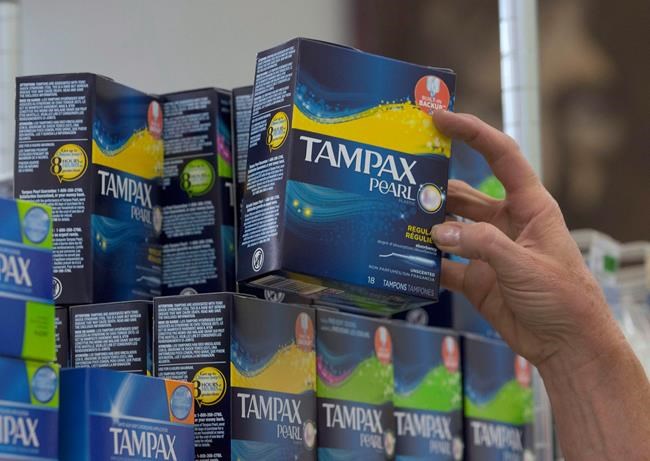
Tammy Compton restocks tampons at Compton's Market, Wednesday, June 22, 2016, in Sacramento, Calif. Advocates say that government should make menstrual products freely available for those who need them. NDP MP Leah Gazan, critic for women and gender equality, says they should be treated as an essential hygiene product, like toilet paper. (AP Photo/Rich Pedroncelli)

Kevin Hiebert, director of business development at Changing the Flow, said the groups directly affected by lack of access should lead the discussion on how to get menstrual equity right.

This would mean reaching out to people who are racialized, gender nonconforming, disabled and experience other forms of marginalization, Hiebert said.

“Go to where they are and say, ‘What does solving period poverty look like to you?'” he said.

Bhanvi Sachdeva, youth advocate for Plan International Canada, said this work should be sure to meet the needs of those groups, while also keeping the climate in mind.

This means moving away from single-use period products to reusable ones, Sachdeva said.

Palwashah Ali, advocacy co-chair for Bleed The North, said she’s noticed similar government programs are often gendered and hit the bare minimum standard for equity.

“There’s a diverse array of individuals with different gender identities, with different experiences, who go through menstruation,” said Ali.

The mandate letter for Women and Gender Equality Minister Marci Ien tasked her with creating a fund so that non-profits and shelters could make products freely available to “vulnerable women.”

The budget did away with the gendered reference and instead said the fund would help “Canadians in need.”

NDP MP Leah Gazan, critic for women and gender equality, said Monday that these products should be treated as an essential hygiene product, like toilet paper.

“It’s about dignity, and ensuring people have what they need to live in dignity, and that includes menstrual hygiene products, especially for those who can’t afford it,” Gazan said.

MP Karen Vecchio, the Conservative critic for women and gender equality, said Tuesday that she does not support a subsidy for menstrual products, and would want to approach the problem differently.

“Is that a subsidy so that we’re still paying $10 for a box of tampons, or are we going to try to start doing something different?” Vecchio said.

Vecchio said she would want to look further at the root causes that explain why menstrual products get priced so high, whether it be due to tariffs or markups along the supply chain.

“People are making money off of people who need these products. I don’t think it’s a government fix,” she said.

Ien said on March 22 in the House of Commons that she is consulting with organizations about menstrual equity to inform their work.

Riyadh Nazerally, a spokesperson in Ien’s office, said in a statement Wednesday that the minister and her team have started consulting with educational institutions, businesses, not-for-profits and other government departments.

When asked if Ien would be creating a formalized consultation process, Nazerally did not directly answer but said they will continue holding consultations “to make menstrual equity a reality.”

“Supporting people that menstruate is long overdue and is part of our government’s plan to build a more equitable Canada,” he said.

The Liberal government created a public consultation process on providing menstrual products in federally regulated workplaces that came to a close in September 2021.

Hiebert of Changing the Flow said consultations would be worth doing if they’re meant to find out what people using the fund would need, and to use those findings to better meet those needs.

“Unless that’s happening … it’s not necessary. Broadly speaking, what needs to be done is known,” he said.

Gabrielle Trépanier, another advocacy co-chair with Bleed The North, said she thinks there is absolutely a need for a full consultation, to make sure the program is successful for every type of person it is trying to reach.

The information that circulates on menstruation does not always highlight all people who experience it, Trépanier said.

“Oftentimes we have folks like Indigenous folks or people who have menstrual disabilities who get missed in these programs, because there isn’t that lengthy consultation,” she said.

This report by The Canadian Press was first published April 8, 2022.

—

This story was produced with the financial assistance of the Meta and Canadian Press News Fellowship.

Report Error Submit a Tip

More Stories

Mayoral candidate Vogiatzakis criticized for living outside Winnipeg

Malak Abas 4 minute read Preview

Mayoral candidate Vogiatzakis criticized for living outside Winnipeg

Malak Abas 4 minute read Updated: Yesterday at 6:03 PM CDT

A mayoral hopeful took heat from other candidates Friday for living outside Winnipeg while running in the civic election.

Mike Vogiatzakis’s primary residence is in the Rural Municipality of St. Andrews, about 25 kilometres north of Winnipeg — a community with its own mayor and councillors.

But the funeral director said he owns a home in Winnipeg where he divides his time, and he would move to the city full-time if elected mayor.

“It doesn’t matter where a person lives. Why are we dividing St. Andrews and Manitoba and Winnipeg? I’ve met the criteria to run for mayor,” Vogiatzakis said Friday morning.

Read
Updated: Yesterday at 6:03 PM CDT

Jets bench boss Arniel talks rebuilding from last season’s struggles

Mike McIntyre and Ken Wiebe 12 minute read Preview

Jets bench boss Arniel talks rebuilding from last season’s struggles

Mike McIntyre and Ken Wiebe 12 minute read Thursday, Oct. 1, 2026

Scott Arniel has a lot on his plate these days.

But the head coach of the Winnipeg Jets took some time Thursday to sit down with Free Press hockey writers Mike McIntyre and Ken Wiebe to discuss a number of topics on the eve of a new hockey season. This interview has been condensed and edited for clarity.

Wiebe: What was the evaluation of last season like? What did you personally do in an attempt to improve after going from first-overall to 26th-overall?

I just went back and looked at things and made sure my communication was where it needed to be with my players. Was my communication where it needed to be with my boss, with my general manager (Kevin Cheveldayoff)? How our coaching staff worked. How we handled highs and lows. Things I felt I could have done better.

Read
Thursday, Oct. 1, 2026

Gordon Bell rings in a century

Maggie Macintosh 13 minute read Preview

Gordon Bell rings in a century

Maggie Macintosh 13 minute read Updated: Yesterday at 8:06 PM CDT

Mischka Valencia had gotten used to the hum of heavy machinery at Gordon Bell High School.

“Ever since I’ve been here, it’s all been under construction,” the Grade 12 student said, standing on the sidelines of the brightly painted revamped outdoor basketball court. “I had no idea this was a court.”

The Filipina teenager landed in Winnipeg several months after the inner-city campus had transformed into a construction site.

It was the fall of 2023 and Mischka’s priorities were fitting in, befriending classmates and learning a third language via first-period French.

Read
Updated: Yesterday at 8:06 PM CDT

A spiritual vision will help anchor a health civic outlook

John Longhurst 5 minute read 2:01 AM CDT

We have an election coming up. With that in mind, the Free Press asked some of their columnists to write about the challenges ahead and how the city can become better.

For Tom Brodbeck, the main challenge is finances — and how candidates will pay for their many promises for fixing roads, improving public safety and making transit better.

Rebecca Chambers said that the concerns of inner-city residents need to be taken seriously by those who aspire to work at city hall.

Niigaan Sinclair said the most pressing issue in Winnipeg isn’t construction projects, light-rail transit, public safety, taxes or social services. For him, it’s the city’s relationship with Indigenous people.

Brandonmeat packer thriving on its own

Abiola Odutola 3 minute read Preview

Brandonmeat packer thriving on its own

Abiola Odutola 3 minute read 2:01 AM CDT

BRANDON — Canada Packers has strengthened its business and laid the foundation for future growth during its first year as an independent company, its president says.

The Brandon-based pork producer, separated from Maple Leaf Foods in October 2025, established its own leadership, strategy, systems, culture and identity while continuing operations across its hog production farms and regional hog barns in southern and eastern Manitoba.

The company’s first year was focused on building a successful standalone business while continuing to serve customers, communities and shareholders, president Dennis Organ said.

“Market conditions over the past year have been more challenging than we anticipated when we became a separate entity,” he said in an email. “Despite that, we continued to execute against our priorities, including increasing processing volumes, maintaining disciplined operations and strengthening the business.”

Read
2:01 AM CDT

Health minister warns $1.2 billion in annual federal funding set to expire in March

Scott Billeck 4 minute read Preview

Health minister warns $1.2 billion in annual federal funding set to expire in March

Scott Billeck 4 minute read Thursday, Oct. 1, 2026

Manitoba’s health minister is warning of possible cuts to health care with $1.2 billion in annual funding from Ottawa set to expire next year.

“We’re very concerned that what would be the largest cut to health care in a generation is right in front of us,” Health Minister Uzoma Asagwara said Thursday at the Manitoba legislature. “It means that services that Manitobans depend on will be in jeopardy and be at risk.

“Any reductions, any cuts from Canada, will have direct impacts on the health outcomes of Manitobans.”

Asagwara, who serves as the provincial and territorial health minister lead, chaired a virtual meeting Tuesday with provincial and territorial health ministers to discuss federal funding for health care, mental health care and substance use services, which is scheduled to expire March 31, 2027.

Read
Thursday, Oct. 1, 2026