At this week’s Summit of the Americas, Canada has stake in U.S. border challenges
Advertisement
Read this article for free:
or
Already have an account? Log in here »
To continue reading, please subscribe:

Digital Subscription
One year of digital access for only $205*
- Enjoy unlimited reading on winnipegfreepress.com
- Read the E-Edition, our digital replica newspaper
- Access News Break, our award-winning app
- Play interactive puzzles
*First annual payment billed as $205.00 + GST for one year. This annual subscription will automatically renew at $233.00 + GST every 52 weeks (10% off the regular annual price of $259.35). Offer available to new and qualified returning subscribers only. Cancel any time.
To continue reading, please subscribe:
Add Free Press access to your Brandon Sun subscription for only an additional
$1 for the first 4 weeks*
- Enjoy unlimited reading on winnipegfreepress.com
- Read the E-Edition, our digital replica newspaper
- Access News Break, our award-winning app
- Play interactive puzzles
*Your next Brandon Sun subscription payment will increase by $1.00 and you will be charged $17.95 plus GST for four weeks. After four weeks, your payment will increase to $24.95 plus GST every four weeks.
Read unlimited articles for free today:
or
Already have an account? Log in here »
Hey there, time traveller!
This article was published 06/06/2022 (1580 days ago), so information in it may no longer be current.
WASHINGTON – If foreign policy was purely a matter of geography, one might assume Canada would be free to go check out the buffet at this week’s Summit of the Americas once the discussion turns, as it surely will, to the migratory tide flooding the U.S.-Mexico border.
But at the dawn of a turbulent new geopolitical era, evidence is mounting that America’s southern frontier — along with the political and economic challenges and opportunities it represents — is closer in many ways than most Canadians might realize.
And if President Joe Biden hopes to realize his vision of a comprehensive, holistic solution to the economic and social ills that imperil the Western Hemisphere, experts say he’ll need Canada to be an integral part of that conversation.
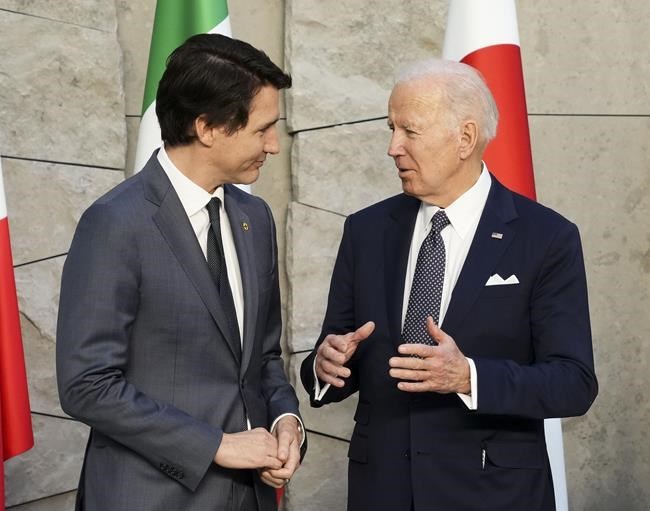
“Canada has an enormous amount to contribute, because Canada is the country in the Americas that has come closest to getting immigration right,” said Andrew Selee, president of the Migration Policy Institute, a non-partisan think tank based in Washington D.C.
“There’s a lot that the rest of the Americas, including the United States, could be learning from Canada.”
The idea behind the summit in Los Angeles, which Prime Minister Justin Trudeau will attend beginning Wednesday, is to find a way to address some of the underlying political, economic and social causes of northward migration in the first place.
Not everyone will be there: the White House left Venezuela, Nicaragua and Cuba off the guest list due to their dubious records on human rights and disregard for democratic values. Mexican President Andrés Manuel López Obrador vowed to skip the summit in protest.
Trudeau demurred Monday when asked about the decision. Chilean President Gabriel Boric, however, who happened to be in Ottawa for meetings with the prime minister, did not.
“We think it’s an error, a mistake, and we’re going to say that during the summit,” Boric said in Spanish. “However, we will never stop raising our voice to defend human rights and condemn political prisoners, and show our concern about the migratory crisis.”
En route, Trudeau will stop Tuesday in Colorado Springs, Colo., where he and Defence Minister Anita Anand will meet with commanders and military officials from Norad, the joint-command continental defence system that’s awaiting a long-needed upgrade.
He’ll be joined in California by Environment Minister Steven Guilbeault and Foreign Affairs Minister Mélanie Joly, who is scheduled to meet with U.S. Secretary of State Antony Blinken and Mexican counterpart Marcelo Ebrard.
As a cornerstone of Canada’s economic growth, federal immigration policy strikes a delicate balance between economic, humanitarian and labour-policy priorities, all the while preserving public buy-in to keep the ever-present political dangers at bay, Selee said.
Those dangers, weaponized to great effect by Donald Trump, now loom larger than ever in North America, where the former president’s isolationist, build-the-wall rhetoric has proven so potent that it’s become standard Republican doctrine.
And while the migration challenges at Canada’s southern border pale in comparison to those that confront the U.S. along the Rio Grande Valley, they are there — and they share a connection.
Despite the more than 2,300 kilometres separating Canada from Mexico’s northern frontier, U.S. customs officials as far north as Maine have in recent months encountered dozens of people who entered the country from the south.
It’s likely many were headed to spots like Roxham Road, a popular destination for those looking to make a refugee claim in Canada without being returned to the U.S., which is what automatically happens when they show up at an official entry point.
“It would not be surprising if there are people coming from or through Latin America that really want to get to Canada in the end,” Selee said.
“Canada has just enough people who come from elsewhere in the Americas that it could become a much more attractive destination over time, particularly if the U.S. is a less hospitable environment.”
It’s been 28 years since the U.S. hosted the inaugural Summit of the Americas in 1994, “and we’re obviously living in different times,” said Juan Gonzalez, the National Security Council’s senior director for the Western Hemisphere.
For starters, Russia has invaded Ukraine, the lasting impact of an ongoing two-year pandemic continues to reverberate, inflation is testing new records and many people on this side of the planet are “really starting to question the value of democracy,” Gonzalez said.
Biden will propose what Gonzalez called a strategy of shared responsibility and economic support for those countries most impacted by the flow of migration. It will also include a multilateral declaration “of unity and resolve” to bring the crisis under control.
Leaders of “source, transit or destination countries” will seek consensus on how to tackle a problem “that is actually impacting all the countries in the Americas,” he said.
“We need to work together to address it in a way that treats migrants with dignity, invests in creating opportunities that would dissuade migrants from leaving their homes in the first place, and provide the protections that migrants deserve.”
The U.S. Border Patrol calls it “push and pull” — the myriad factors that spur people around the world to abandon one country in favour of another, often as clandestinely as possible. Those motivations were muted during the COVID-19 pandemic, but no longer.
Police intercepted nearly 10,000 people entering Canada between official entry points during the first four months of the year, compared with just 3,944 during the same period of 2019. And last month alone, U.S. Customs and Border Protection reported 9,157 encounters at or near the Canada-U.S. border — seven times the 1,250 apprehensions in April 2021.
Late last month, two Honduran nationals appeared in court in Montana to face human smuggling charges after they allegedly led a group of migrants into the country by walking across the Canada-U.S. border.
Two U.S. citizens are also facing similar charges in a pair of separate cases — one last month that saw a group of Indian nationals rescued while trying to cross a river that separates Ontario from New York state, and one in Minnesota linked to the January deaths of a family of four from India who died of exposure in frigid conditions in Manitoba.

Agents in Maine have also recently encountered carloads of illegal migrants, including five Romanian nationals who entered from Canada. Two other separate incidents involved a total of 22 people, 14 from Mexico and seven from Ecuador, who entered the U.S. via the southern border.
“There are a number of push-and-pull factors … that make people want to leave their country or come to another country for one reason or another,” said William Maddocks, the chief U.S. Border Patrol agent for Houlton Sector, which encompasses Maine.
Human smugglers are always keen to exploit that desire, he added. “Where these people see an opportunity for making a profit, that becomes their business. Any time we change the laws, there will be people who seek to exploit those changes.”
Other summit priorities will include helping countries bring COVID-19 under control, forging new ties on climate and energy initiatives, confronting food insecurity and leveraging existing trade agreements to better ensure more people are able to reap the benefits.
This report by The Canadian Press was first published June 6, 2022.
Related Articles
Trudeau, Anand meet Norad brass at mountain HQ
Advertisement Advertise With Us
Advertisement Advertise With Us