AP exposes the Tuskegee Syphilis Study: The 50th Anniversary

Advertisement

Advertise with us

WASHINGTON (AP) — EDITOR’S NOTE — On July 25, 1972, Jean Heller, a reporter on The Associated Press investigative team, then called the Special Assignment Team, broke news that rocked the nation. Based on documents leaked by Peter Buxtun, a whistleblower at the U.S. Public Health Service, the then 29-year-old journalist and the only woman on the team, reported that the federal government let hundreds of Black men in rural Alabama go untreated for syphilis for 40 years in order to study the impact of the disease on the human body. Most of the men were denied access to penicillin, even when it became widely available as a cure. A public outcry ensued, and nearly four months later, the “Tuskegee Study of Untreated Syphilis in the Negro Male” came to an end. The investigation would have far-reaching implications: The men in the study filed a lawsuit that resulted in a $10 million settlement, Congress passed laws governing how subjects in research studies were treated, and more than two decades later President Bill Clinton formally apologized for the study, calling it “shameful.”

Read this article for free:


or

Already have an account? Log in here »

To continue reading, please subscribe:

Subscribe and receive a limited-edition Free Press branded hat or tote.

Digital Subscription

One year of digital access for only $205*

  • Enjoy unlimited reading on winnipegfreepress.com
  • Read the E-Edition, our digital replica newspaper
  • Access News Break, our award-winning app
  • Play interactive puzzles

*First annual payment billed as $205.00 + GST for one year. This annual subscription will automatically renew at $233.00 + GST every 52 weeks (10% off the regular annual price of $259.35). Offer available to new and qualified returning subscribers only. Cancel any time.

To continue reading, please subscribe:

Add Free Press access to your Brandon Sun subscription for only an additional

$1 for the first 4 weeks*

  • Enjoy unlimited reading on winnipegfreepress.com
  • Read the E-Edition, our digital replica newspaper
  • Access News Break, our award-winning app
  • Play interactive puzzles
Start now

*Your next Brandon Sun subscription payment will increase by $1.00 and you will be charged $17.95 plus GST for four weeks. After four weeks, your payment will increase to $24.95 plus GST every four weeks.

Hey there, time traveller!
This article was published 25/07/2022 (1533 days ago), so information in it may no longer be current.

WASHINGTON (AP) — EDITOR’S NOTE — On July 25, 1972, Jean Heller, a reporter on The Associated Press investigative team, then called the Special Assignment Team, broke news that rocked the nation. Based on documents leaked by Peter Buxtun, a whistleblower at the U.S. Public Health Service, the then 29-year-old journalist and the only woman on the team, reported that the federal government let hundreds of Black men in rural Alabama go untreated for syphilis for 40 years in order to study the impact of the disease on the human body. Most of the men were denied access to penicillin, even when it became widely available as a cure. A public outcry ensued, and nearly four months later, the “Tuskegee Study of Untreated Syphilis in the Negro Male” came to an end. The investigation would have far-reaching implications: The men in the study filed a lawsuit that resulted in a $10 million settlement, Congress passed laws governing how subjects in research studies were treated, and more than two decades later President Bill Clinton formally apologized for the study, calling it “shameful.”

Today, the effects of the study still linger — it is often blamed for the unwillingness of some African Americans to participate in medical research.

In observance of the 50th anniversary of Heller’s groundbreaking investigation, the AP is republishing the original report and a recent interview with her and others on how the story came together.
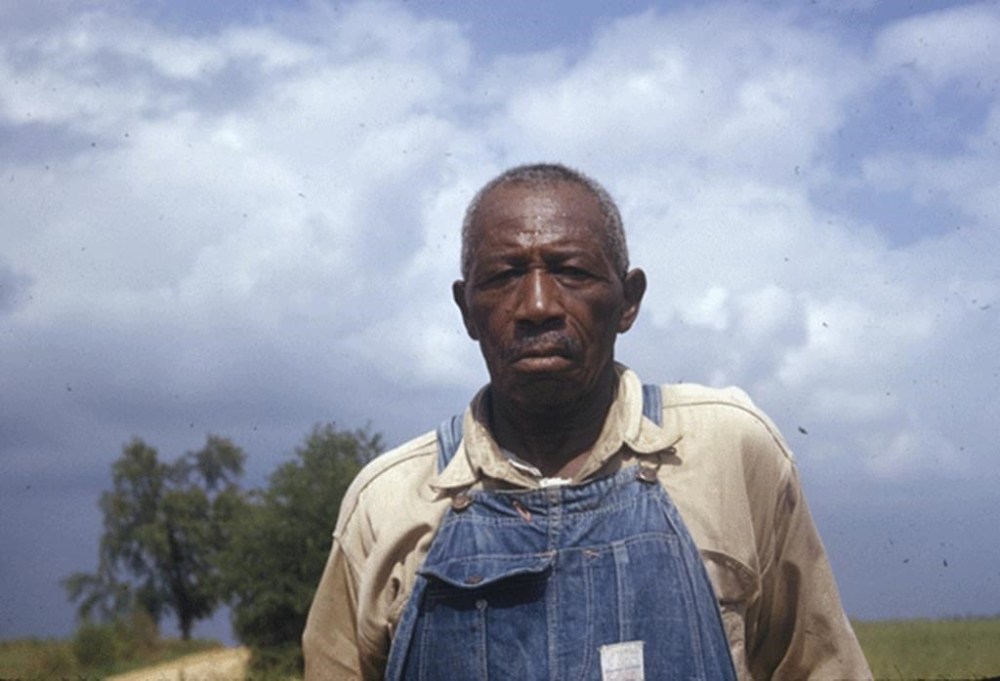
This 1950's photo made available by the National Archives shows a man included in a syphilis study in Alabama. For 40 years starting in 1932, medical workers in the segregated South withheld treatment for Black men who were unaware they had syphilis, so doctors could track the ravages of the illness and dissect their bodies afterward. (National Archives via AP)

___

For 40 years the U.S. Public Health Service has conducted a study in which human guinea pigs, denied proper medical treatment, have died of syphilis and its side effects.

The study was conducted to determine from autopsies what the disease does to the human body.

PHS officials responsible for initiating the experiment have long since retired. Current PHS officials, who say they have serious doubts about the morality of the study, also say that it is too late to treat syphilis in any of the study’s surviving participants.

But PHS doctors say they are rendering whatever other medical services they can now give to the survivors while the study of the disease’s effects continues.
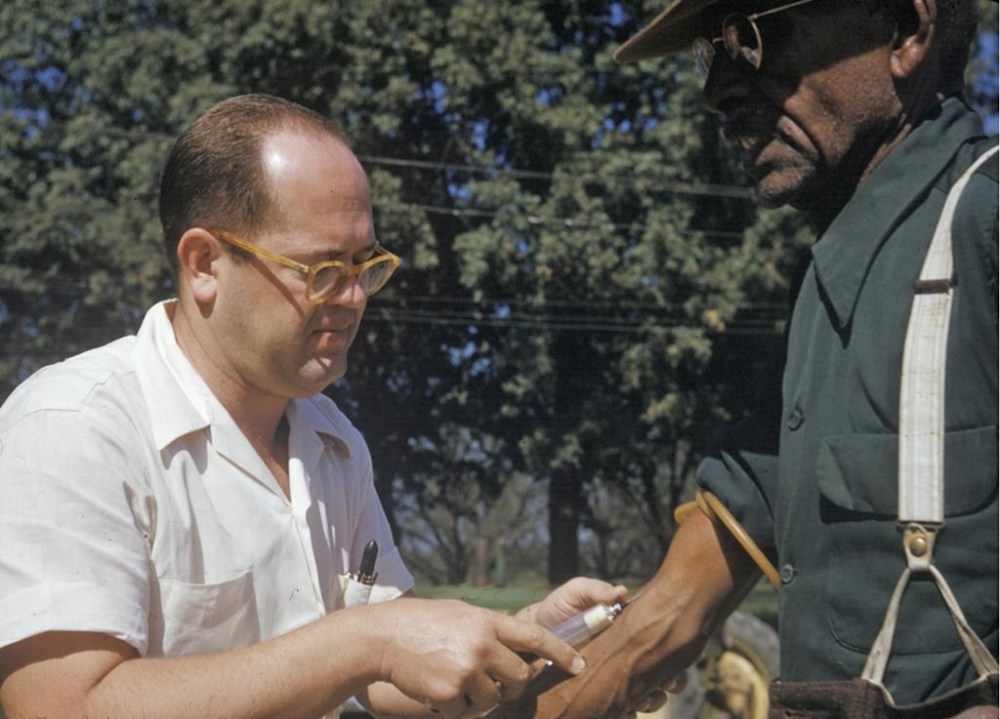
FILE - In this 1950's photo released by the National Archives, a man included in a syphilis study has blood drawn by a doctor in Tuskegee, Ala. For 40 years starting in 1932, medical workers in the segregated South withheld treatment for Black men who were unaware they had syphilis, so doctors could track the ravages of the illness and dissect their bodies afterward. Finally exposed in 1972, the study ended and the men sued, resulting in a $9 million settlement. (National Archives via AP)

The experiment, called the Tuskegee Study began in 1932 with about 600 black men mostly poor and uneducated, from Tuskegee, Ala., an area that had the highest syphilis rate in the nation at the time.

One-third of the group was free of syphilis; two-thirds showed evidence of the disease. In the syphilitic group, half were given the best treatment known at the time, but the other half, about 200 men, received no treatment at all for syphilis, PHS officials say.

As incentives to enter the program, the men were promised free transportation to and from hospitals, free hot lunches, free medicine for any disease other than syphilis and free burial after autopsies were performed.

The Tuskegee Study began 10 years before penicillin was discovered to be a cure for syphilis and 15 years before the drug became widely available. Yet, even after penicillin became common, and while its use probably could have helped or saved a number of the experiment subjects, the drug was denied them, Dr. J.D. Millar says.

He is chief of the venereal disease branch of the PHS’s Center for Disease Control in Atlanta and is now in charge of what remains of the Tuskegee Study. Dr. Millar said in an interview that he has serious doubts about the program.
Lillie Tyson Head holds a photograph of her late parents, Freddie Lee and Johnnie Mae Neal Tyson, at her home in Wirtz, Va., on Saturday, July 23, 2022. Freddie Tyson was part of the infamous
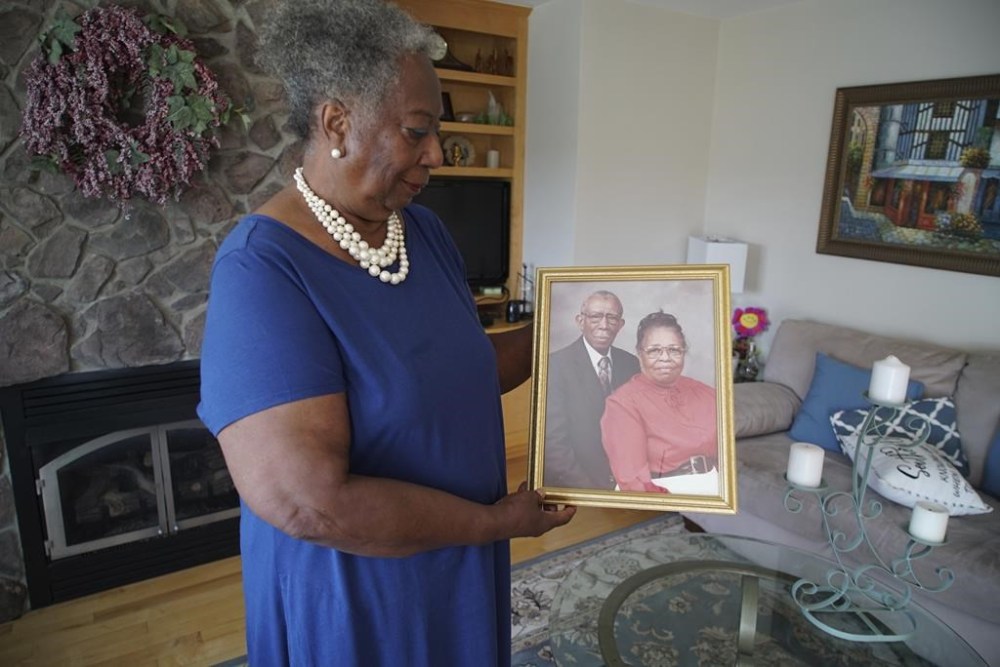
Lillie Tyson Head holds a photograph of her late parents, Freddie Lee and Johnnie Mae Neal Tyson, at her home in Wirtz, Va., on Saturday, July 23, 2022. Freddie Tyson was part of the infamous "Tuskegee Study," in which hundreds of Black men in Alabama went untreated for syphilis for decades so federal government researchers could record the disease's affects on the body. Head says her mother was later tested, and did not have the disease. (AP Photo/Allen G. Breed)

“I think a definite serious moral problem existed when the study was undertaken, a more serious moral problem was overlooked in the post-war years when penicillin became available but was not given to these men and a moral problem still exists,” Dr. Millar said.

“But the study began when attitudes were much different on treatment and experimentation. At this point in time, with our current knowledge of treatment and the disease and the revolutionary change in approach to human experimentation, I don’t believe the program would be undertaken,” he said.

Syphilis, a highly contagious infection spread by sexual contact, can cause if untreated, bone and dental deformations, deafness, blindness, heart disease and central nervous system deterioration.

No figures were available on when the last death occurred in the program. And one official said that apparently no conscious effort was made to halt the program after it got under way.

A 1969 CDC study of 276 treated and untreated syphilitics who participated in the Tuskegee Study showed that seven had died as a direct result of syphilis. Another 154 died of heart disease.

This 1950's photo made available by the National Archives shows a man included in a syphilis study in Alabama. For 40 years starting in 1932, medical workers in the segregated South withheld treatment for Black men who were unaware they had syphilis, so doctors could track the ravages of the illness and dissect their bodies afterward. (National Archives via AP)

CDC officials say they cannot determine at this late date how many of the heart disease deaths were caused by syphilis or how many additional deaths could be linked to the disease.

However, several years ago an American Medical Association study determined that untreated syphilis reduces life expectancy by 17 per cent in black men between the ages of 25 and 50, a precise description of the Tuskegee Study subjects.

Don Prince, another official in the venereal disease branch of CDC, said the Tuskegee Study had contributed some knowledge about syphilis, particularly that the morbidity and mortality rate among untreated syphilitics were not as high as previously believed.

Like Dr. Millar, Prince said he thought the study should have been halted with penicillin treatment for participants after World War II.

“I don’t know why the decision was made in 1946 not to stop the program,” Prince said. “I was unpleasantly surprised when I first came here and found out about it. It really puzzles me.”

FILE - In this 1950's photo released by the National Archives, a man included in a syphilis study has blood drawn by a doctor in Tuskegee, Ala. For 40 years starting in 1932, medical workers in the segregated South withheld treatment for Black men who were unaware they had syphilis, so doctors could track the ravages of the illness and dissect their bodies afterward. Finally exposed in 1972, the study ended and the men sued, resulting in a $9 million settlement. (National Archives via AP)

At the beginning of 1972, according to CDC data, 74 of the untreated syphilitics were still living. All of them, Dr. Millar said, were men who did not suffer any potentially fatal side effects from their bouts with the disease.

Some of them received penicillin and antibiotics in past years for other aliments, Prince said, but none has ever received treatment for syphilis. Now, both men agree, it’s too late

Recent reviews of the Tuskegee Study by the CDC indicate that treatment now for survivors is medically questionable, Dr. Millar said. Their average age is 74 and massive penicillin therapy, with possible ill side effects, is deemed too great a risk to individuals, particularly for those whose syphilis is now dormant.

However, Dr. Millar, added there was a point in time when survivors could have been treated with at least some measure of success.

“The most critical moral issue about this experiment arises in the post-war era, the years after the end of World War II when penicillin became widely available.

Lillie Tyson Head holds a photograph of her late parents, Freddie Lee and Johnnie Mae Neal Tyson, at her home in Wirtz, Va., on Saturday, July 23, 2022. Freddie Tyson was part of the infamous
Lillie Tyson Head holds a photograph of her late parents, Freddie Lee and Johnnie Mae Neal Tyson, at her home in Wirtz, Va., on Saturday, July 23, 2022. Freddie Tyson was part of the infamous "Tuskegee Study," in which hundreds of Black men in Alabama went untreated for syphilis for decades so federal government researchers could record the disease's affects on the body. Head says her mother was later tested, and did not have the disease. (AP Photo/Allen G. Breed)

“I know some were treated with penicillin for other diseases and then dropped from the program because the drug had some positive effect on the primary disease (syphilis). Looking at it now, one cannot see any reason they could not have been treated at that time.”


This 1950's photo made available by the National Archives shows a man included in a syphilis study in Alabama. For 40 years starting in 1932, medical workers in the segregated South withheld treatment for Black men who were unaware they had syphilis, so doctors could track the ravages of the illness and dissect their bodies afterward. (National Archives via AP)
FILE - In this 1950's photo released by the National Archives, a man included in a syphilis study has blood drawn by a doctor in Tuskegee, Ala. For 40 years starting in 1932, medical workers in the segregated South withheld treatment for Black men who were unaware they had syphilis, so doctors could track the ravages of the illness and dissect their bodies afterward. Finally exposed in 1972, the study ended and the men sued, resulting in a $9 million settlement. (National Archives via AP)
Lillie Tyson Head holds a photograph of her late parents, Freddie Lee and Johnnie Mae Neal Tyson, at her home in Wirtz, Va., on Saturday, July 23, 2022. Freddie Tyson was part of the infamous
Lillie Tyson Head holds a photograph of her late parents, Freddie Lee and Johnnie Mae Neal Tyson, at her home in Wirtz, Va., on Saturday, July 23, 2022. Freddie Tyson was part of the infamous "Tuskegee Study," in which hundreds of Black men in Alabama went untreated for syphilis for decades so federal government researchers could record the disease's affects on the body. Head says her mother was later tested, and did not have the disease. (AP Photo/Allen G. Breed)
This 1950's photo made available by the National Archives shows a man included in a syphilis study in Alabama. For 40 years starting in 1932, medical workers in the segregated South withheld treatment for Black men who were unaware they had syphilis, so doctors could track the ravages of the illness and dissect their bodies afterward. (National Archives via AP)
FILE - In this 1950's photo released by the National Archives, a man included in a syphilis study has blood drawn by a doctor in Tuskegee, Ala. For 40 years starting in 1932, medical workers in the segregated South withheld treatment for Black men who were unaware they had syphilis, so doctors could track the ravages of the illness and dissect their bodies afterward. Finally exposed in 1972, the study ended and the men sued, resulting in a $9 million settlement. (National Archives via AP)
Lillie Tyson Head holds a photograph of her late parents, Freddie Lee and Johnnie Mae Neal Tyson, at her home in Wirtz, Va., on Saturday, July 23, 2022. Freddie Tyson was part of the infamous
Lillie Tyson Head holds a photograph of her late parents, Freddie Lee and Johnnie Mae Neal Tyson, at her home in Wirtz, Va., on Saturday, July 23, 2022. Freddie Tyson was part of the infamous "Tuskegee Study," in which hundreds of Black men in Alabama went untreated for syphilis for decades so federal government researchers could record the disease's affects on the body. Head says her mother was later tested, and did not have the disease. (AP Photo/Allen G. Breed)
This 1950's photo made available by the National Archives shows a man included in a syphilis study in Alabama. For 40 years starting in 1932, medical workers in the segregated South withheld treatment for Black men who were unaware they had syphilis, so doctors could track the ravages of the illness and dissect their bodies afterward. (National Archives via AP)
FILE - In this 1950's photo released by the National Archives, a man included in a syphilis study has blood drawn by a doctor in Tuskegee, Ala. For 40 years starting in 1932, medical workers in the segregated South withheld treatment for Black men who were unaware they had syphilis, so doctors could track the ravages of the illness and dissect their bodies afterward. Finally exposed in 1972, the study ended and the men sued, resulting in a $9 million settlement. (National Archives via AP)
Lillie Tyson Head holds a photograph of her late parents, Freddie Lee and Johnnie Mae Neal Tyson, at her home in Wirtz, Va., on Saturday, July 23, 2022. Freddie Tyson was part of the infamous
Lillie Tyson Head holds a photograph of her late parents, Freddie Lee and Johnnie Mae Neal Tyson, at her home in Wirtz, Va., on Saturday, July 23, 2022. Freddie Tyson was part of the infamous "Tuskegee Study," in which hundreds of Black men in Alabama went untreated for syphilis for decades so federal government researchers could record the disease's affects on the body. Head says her mother was later tested, and did not have the disease. (AP Photo/Allen G. Breed)
Report Error Submit a Tip

More Stories

‘Amazing honour’: Winnipeg distribution centre continues award-winning ways for McKesson Canada

Aaron Epp 6 minute read Preview

‘Amazing honour’: Winnipeg distribution centre continues award-winning ways for McKesson Canada

Aaron Epp 6 minute read 6:00 AM CDT

After a three-year absence, the trophy is back in Winnipeg.

Last week, McKesson Canada named its 120,000-square-foot pharmaceutical distribution centre in the northwest part of the Manitoba capital its Distribution Centre of the Year. The award recognizes the facility’s role in helping essential medications reach communities across the province and some of Canada’s remote regions.

This is the fourth time the Winnipeg facility has earned the company-wide award since it opened five years ago. McKesson previously honoured the centre in 2021, 2022 and 2023. The recognition comes with a trophy, as well as a banner that was hung from the rafters on Thursday.

More than 100 employees work across the centre’s day-and-night operations, processing between 80,000 and 100,000 medication units daily. Last year, the centre distributed more than 21 million medication units while maintaining more than 99 per cent accuracy.

Read
6:00 AM CDT

Province looks to seize notorious drug den

Erik Pindera 5 minute read Preview

Province looks to seize notorious drug den

Erik Pindera 5 minute read Saturday, Oct. 3, 2026

Provincial justice officials are trying to seize a Dominion Street drug den that has been the source of trouble in the West End for years.

The owner of 982 Dominion St., 45-year-old Robert Edward Johnson, was most recently arrested in June along with several others after a lengthy Winnipeg Police investigation into thefts and illicit drug sales connected to the house.

“The residence has a reputation within the neighbourhood as being a location where individuals habitually attend for the purpose of purchasing and/or consuming controlled substances,” reads a statement of claim filed by the province’s director of civil forfeiture in the Court of King’s Bench last week.

“For several years, the residence has been associated with criminal activity, violence, and disorder, resulting in numerous police attendances and complaints from members of the surrounding community.”

Read
Saturday, Oct. 3, 2026

Hydro Québec faces issue we should avoid

Editorial 4 minute read Preview

Hydro Québec faces issue we should avoid

Editorial 4 minute read 2:01 AM CDT

You might be tempted to call it a canary in an electric power generation coal mine.

Read
2:01 AM CDT

Connor powers Jets past Red Wings for first win of season

Ken Wiebe 8 minute read Preview

Connor powers Jets past Red Wings for first win of season

Ken Wiebe 8 minute read Updated: 6:11 AM CDT

DETROIT — Kyle Connor is on a mission.

Whether it’s the baby bump from the birth of his second child or his constant mission to elevate his game and find new ways to score, the Winnipeg Jets left-winger is flying out of the gate and seemingly notching goals at will.

After scoring in the season opener for an NHL record ninth consecutive time, Connor delivered a pair of goals and added an assist in his home state to lead the Jets to a 3-2 victory over the Detroit Red Wings on Sunday afternoon at Little Caesars Arena.

“The sheer amount of volume that he gets and how he gets himself in a good spot, he’s able to get that release off from anywhere,” said Jets forward Cole Perfetti. “His first one was just all skill. What a finish that was and then his second one, just reading the play so well. (Coming) off the pads like that, kind of in front of him and he put it in a small little window top shelf that no goalie could ever save. He doesn’t panic when he gets into those spots, obviously.

Read
Updated: 6:11 AM CDT

Mayoral hopefuls trade accusations

Maggie Macintosh 4 minute read Preview

Mayoral hopefuls trade accusations

Maggie Macintosh 4 minute read Yesterday at 7:51 PM CDT

Two mayoral hopefuls traded accusations about meddling in each other’s campaigns as the incumbent rallied supporters for his re-election bid on the eve of advanced polls opening across Winnipeg.

A social media post made by Mike Vogiatzakis, one of 12 nominees in the Oct. 28 race for the top job at city hall, caught the attention of rivals Sunday.

The funeral director took to Facebook midday to criticize Kevin Klein — a competitor he said he thought of “as a friend” until the former Tory cabinet minister made a U-turn after pledging to back the Vogiatzakis campaign.

“Good speaker? Yes. Good looking guy? Sure. Someone I trust now? Absolutely not,” he wrote in a lengthy post.

Read
Yesterday at 7:51 PM CDT

Six high school hockey programs ceased operations following new Hockey Manitoba policy

Joshua Frey-Sam 7 minute read Preview

Six high school hockey programs ceased operations following new Hockey Manitoba policy

Joshua Frey-Sam 7 minute read Friday, Oct. 2, 2026

She lived the best of both worlds.

For the last three years, the 17-year-old wore a sweater for two different hockey programs — her high school team and AAA club in the Manitoba Female Hockey League — and was preparing to flourish in both colours again this winter.

Recently, however, the blue-liner was disappointed to learn she is no longer eligible to play her Grade 12 season with her school owing to a new policy imposed by Hockey Manitoba that bans players from participating in the Manitoba Women’s High School Hockey League if they are rostered on a U18 AAA team.

The rule applies to all athletes who play for both Winnipeg-based and rural AAA teams.

Read
Friday, Oct. 2, 2026