International partners had concern about Canada’s ‘ability to handle’ convoy protests
Advertisement
Read this article for free:
or
Already have an account? Log in here »
To continue reading, please subscribe:

Digital Subscription
One year of digital access for only $205*
- Enjoy unlimited reading on winnipegfreepress.com
- Read the E-Edition, our digital replica newspaper
- Access News Break, our award-winning app
- Play interactive puzzles
*First annual payment billed as $205.00 + GST for one year. This annual subscription will automatically renew at $233.00 + GST every 52 weeks (10% off the regular annual price of $259.35). Offer available to new and qualified returning subscribers only. Cancel any time.
To continue reading, please subscribe:
Add Free Press access to your Brandon Sun subscription for only an additional
$1 for the first 4 weeks*
- Enjoy unlimited reading on winnipegfreepress.com
- Read the E-Edition, our digital replica newspaper
- Access News Break, our award-winning app
- Play interactive puzzles
*Your next Brandon Sun subscription payment will increase by $1.00 and you will be charged $17.95 plus GST for four weeks. After four weeks, your payment will increase to $24.95 plus GST every four weeks.
Read unlimited articles for free today:
or
Already have an account? Log in here »
Hey there, time traveller!
This article was published 12/08/2022 (1486 days ago), so information in it may no longer be current.
OTTAWA – Two days before the Emergencies Act was invoked last February to quell anti-government convoy protests, Prime Minister Justin Trudeau warned cabinet ministers that international partners were concerned Canada wasn’t able to control the situation.
The warning is contained in heavily redacted summaries of three meetings of the government’s incident response group and one meeting of the full cabinet, which were released through the Federal Court as part of a challenge of the government’s use of the act.
Trudeau’s comments on Feb. 12 came the day after he spoke with U.S. President Joe Biden. According to the White House, Biden expressed concerns about the impact of blockades at border crossings, including the Ambassador Bridge in Windsor, Ont., on U.S. companies and workers.
“The prime minister promised quick action in enforcing the law and the president thanked him for the steps he and other Canadian authorities are taking,” the White House said on Feb. 11.
At the time, Trudeau was speaking to a number of world leaders about the buildup of Russian military forces near the border with Ukraine. In the first 12 days of February, he spoke with leaders from the EU, Norway, Poland, Japan, Germany and Ukraine. Readouts from the Prime Minister’s Office for those meetings do not mention the ongoing protests.
But that was top of mind for cabinet, the documents show. The weekend before invoking the Emergencies Act, the government was busy weighing the consequences of using the legislation while also assessing other tools.
By Saturday, Feb. 12, protesters were using social media to co-ordinate, beginning “slow roll” protests, and involving children in their actions by bringing them to blockades to prevent police activity and engaging schools in walkouts, the documents say.
The meeting minutes show cabinet and senior government, military and RCMP officials were told there was the possibility of engagement with the protest leaders, and even a potential “breakthrough” in clearing the protest in Ottawa.
But the same briefings warned ministers the protesters in the capital were becoming increasingly hostile to police, and were showing a “significant escalation in boldness.”
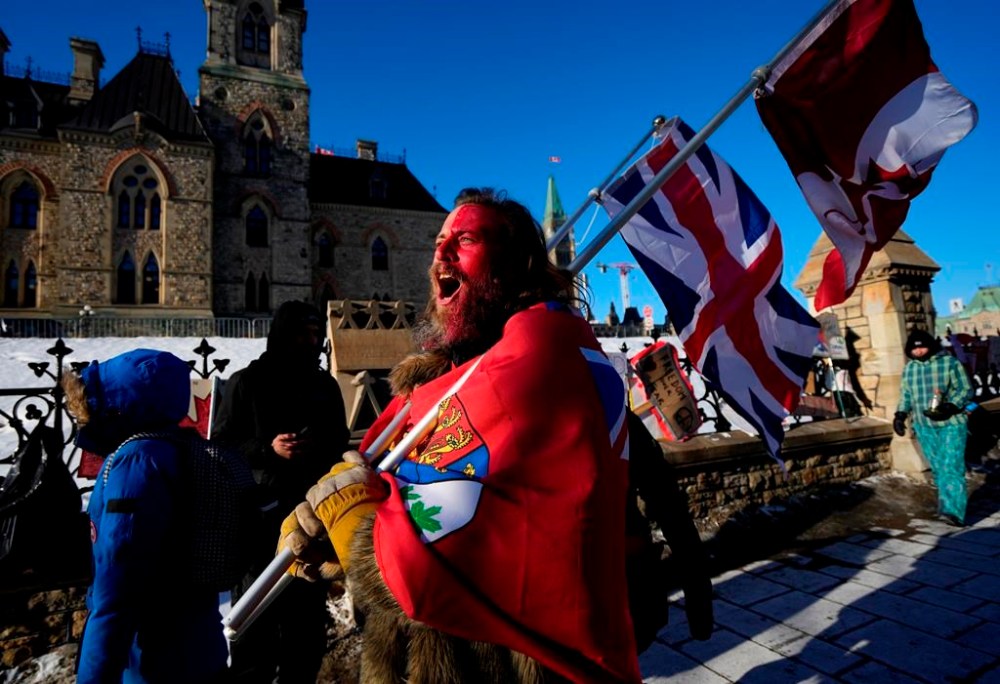
Ottawa police released a statement Feb. 12 saying there were more than 4,000 people in the downtown area and there had been “aggressive, illegal behaviour.” The Ottawa Police Service, Ontario Provincial Police and RCMP then established an enhanced Integrated Command Centre to co-ordinate.
Behind the scenes, RCMP Commissioner Brenda Lucki told the federal incident group that there were challenges working with the other forces, citing concerns with communication and with Ottawa police chief Peter Sloly — who resigned the following week.
Meanwhile, police enforcement began Saturday at the Ambassador Bridge after an attempt by the Ontario government to negotiate with protesters failed, the documents say, but it stalled as the number of protesters swelled to more than 500.
Public Safety Minister Marco Mendicino told his colleagues there seemed to be two distinct movements involved: a “relatively harmless and happy” faction with a “strong relationship to faith communities,” and a more concerning group “of harder extremists trying to undermine government institutions and law enforcement.”
He also noted there were reports of ex-military members advising and instructing the blockade leaders, the documents say.
Transport Minister Omar Alghabra was working to secure tow trucks and drivers. The federal government has said that tow companies were unwilling to move the big rigs choking Ottawa’s downtown streets, and invoking the Emergencies Act gave police powers to compel them to help.
It was Sunday that federal officials were told there was a “potential for a breakthrough in Ottawa.”
According to Keith Wilson, lawyer for the “Freedom Convoy” group, that breakthrough was a deal he had been working to negotiate with city officials. Tamara Lich, one of the protest leaders, and Ottawa Mayor Jim Watson exchanged letters on Feb. 12, discussing an arrangement that would see the truckers move their vehicles outside the residential areas.
“Many of the citizens and businesses in Ottawa have been cheering us on but we are also disturbing others. That was never our intent,” Lich wrote to Watson.
The group printed flyers explaining that they planned to reposition trucks beginning Monday, “so we don’t give the prime minister the excuse he desperately wants to use force and seize our trucks.”
“The block captains started going truck to truck and handing these documents out saying, ‘We need to de-escalate,'” Wilson said in an interview.
But the protest was not a unified group.
On Sunday evening, Feb. 13, prominent protester Pat King said on social media that there was no deal, and suggested counter-protesters were spreading misinformation. He told demonstrators not to move.
Some vehicles began moving on Feb. 14, Wilson said, clearing two blocks.

But he said several misunderstandings and miscommunications in the “chaotic environment” slowed what was already likely to be a multi-day effort to move truckers onto Wellington Street and the Sir John A MacDonald Parkway.
“We thought we had communication challenges,” Wilson said. “Oh my God, did the police ever have terrible communications. So we go to move trucks, and then the police wouldn’t let us move.”
That afternoon, Trudeau announced the decision to invoke the Emergencies Act.
By Feb. 19, following days of warnings from police for protesters to leave, an operation involving hundreds of officers began clearing vehicles and people from Ottawa’s downtown core.
This report by The Canadian Press was first published Aug. 12, 2022.
Related Articles
Public hearings in Emergencies Act inquiry to start in September
Advertisement Advertise With Us
Advertisement Advertise With Us