Provincial governments not jumping to act on tighter alcohol warning guidelines
Advertisement
Read this article for free:
or
Already have an account? Log in here »
To continue reading, please subscribe:

Digital Subscription
One year of digital access for only $205*
- Enjoy unlimited reading on winnipegfreepress.com
- Read the E-Edition, our digital replica newspaper
- Access News Break, our award-winning app
- Play interactive puzzles
*First annual payment billed as $205.00 + GST for one year. This annual subscription will automatically renew at $233.00 + GST every 52 weeks (10% off the regular annual price of $259.35). Offer available to new and qualified returning subscribers only. Cancel any time.
To continue reading, please subscribe:
Add Free Press access to your Brandon Sun subscription for only an additional
$1 for the first 4 weeks*
- Enjoy unlimited reading on winnipegfreepress.com
- Read the E-Edition, our digital replica newspaper
- Access News Break, our award-winning app
- Play interactive puzzles
*Your next Brandon Sun subscription payment will increase by $1.00 and you will be charged $17.95 plus GST for four weeks. After four weeks, your payment will increase to $24.95 plus GST every four weeks.
Read unlimited articles for free today:
or
Already have an account? Log in here »
Hey there, time traveller!
This article was published 27/01/2023 (1343 days ago), so information in it may no longer be current.
HALIFAX – Politicians in charge of provincial and territorial liquor laws aren’t hurrying to adopt or promote newly updated guidelines that advise a steep drop in Canadian drinking habits.
Across Canada, the responsible ministers declined interview requests from The Canadian Press. In written responses, they didn’t commit to changing marketing methods for alcohol and noted they’re awaiting Ottawa’s lead on whether to slap warning labels on products.
In some cases, such as Nunavut and British Columbia, governments say they’re actively reviewing the guidelines. Two provinces — New Brunswick and Nova Scotia — as well as the Northwest Territories said their health departments are developing plans to incorporate the new advice. The Northwest Territories Health Department said it intends to “share the new guidelines broadly.”

The guidance prepared by the Canadian Centre on Substance Use and Addiction for Health Canada and released on Jan. 17 represents a major shift from its 2011 advice that having two drinks a day was considered low risk. The updated report says there is a moderate risk of harm for those who consume between three and six standard drinks a week, and it increases for every additional drink.
Kevin Shield, a professor at University of Toronto’s school of public health, notes about two-thirds of Canadians who drink are consuming in the guideline’s riskier ranges, according to the most recent Statistics Canada survey.
Shield — who studies methods used by governments to reduce harms caused by alcohol — said in an interview Wednesday that liquor agencies aren’t currently giving consumers a good sense of the long-term health risks of alcohol. The typical messages, he said, are: “Don’t drink and drive, don’t drink while pregnant and please enjoy responsibly,” with only the Northwest Territories including labels warning of health impacts.
Some governments have been loosening marketing restrictions. For example, in its 2019 budget, Ontario’s Progressive Conservatives called for earlier serving hours for bars and restaurants, alcohol in municipal parks and advertising of free alcohol by casinos.
The province’s Finance Department said in an emailed response it’s “aware” of the CCSA update but didn’t comment on whether the province’s liquor corporation, the LCBO, will alter its policies. The LCBO website contains a link to the updated guidelines, but finding it requires surfing through three other topics before reaching a link written in small type at the bottom of a page.
Tim Stockwell, the former head of the Canadian Institute for Substance Use Research at the University of Victoria, said the reality is the issue isn’t a political priority.
“They’re thinking about the economy, and tourism and the vitality of nightlife in their cities. The last thing on policymakers’ minds is whether this commodity we’re so familiar with is doing any harm,” he said in an interview Tuesday.
The liquor corporations continue to be key sources of revenue to their provinces, with the B.C. agency providing close to $1.2 billion in the last fiscal year, Ontario’s LCBO providing about $2.4 billion and Quebec’s SAQ reporting a $1.35-billion profit.
A spokesman for Quebec’s finance minister said the province isn’t considering any changes to the provincial liquor corporation’s current practices. “We trust citizens to make the best decisions for their health, in light of the latest knowledge on the subject,” spokeswoman Claudia Loupret said.
In Nova Scotia, Finance Minister Allan MacMaster said liquor education materials “do not yet” reflect the new guidance. Beverley Ware, a spokeswoman for the province’s liquor corporation, said the Department of Health “plans to develop materials to inform Nova Scotians of the new guidance on alcohol and health,” and the liquor retailer is in favour of sharing this information with its customers.
A spokesman for New Brunswick’s Health Department said it supports the updated guidelines and is working on a communication plan to help New Brunswickers understand them.
Siobhan Coady, the finance minister in Newfoundland and Labrador, provided an email saying her officials are “always mindful of new research,” noting the province was already examining whether to introduce policies that limit liquor consumption — including raising the minimum price for drinks sold in bars.
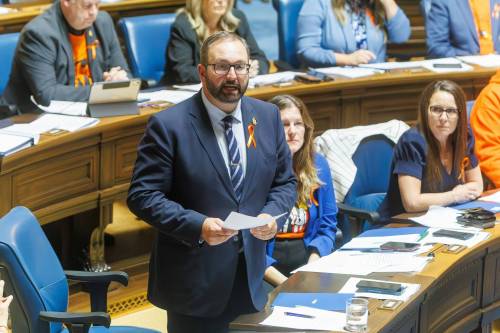
Manitoba’s government didn’t comment on how it will incorporate the guidelines into its liquor marketing, but noted its liquor corporation has a “DrinkSense” website that encourages responsible consumption.
Meanwhile, none of the provinces reached by The Canadian Press indicated they are considering directly implementing the call for health warning labels, though the Northwest Territories does already have a label mentioning the risk to pregnant women and drivers, and noting alcohol “may cause health problems.”
Nunavut’s Finance Department said in an email it is reviewing its alcohol regulations, including possible warning label requirements, and will “note the findings” of the CCSA in its review.
David Morris, a spokesman for the Saskatchewan liquor authority, said the province’s retail liquor system will be fully private later this year and there are no plans to change the way private retailers in the province sell or market alcoholic beverages.

A spokesperson for British Columbia’s Ministry of Mental Health and Addictions said the province will be reviewing the CCSA guidelines and “have more to say in the weeks ahead.”
Manitoba, Saskatchewan, Nova Scotia and Yukon said it’s up to Ottawa to take the lead on creating warning labels that discuss the risks of cancer, heart disease and stroke. Carolyn Bennett, the federal minister of mental health and addictions, was unavailable for an interview, and her office said she’s reviewing the CCSA’s advice.
Dan Malleck, a professor of health sciences at Brock University who has been critical of the CCSA guidelines, said the provinces are right to be reluctant about adopting the updated guidelines. “I think any reasonable government should ignore the guidelines completely,” he said in an email. “It’s poor research, ideologically driven, and based upon spurious connections with health harms.”
This report by The Canadian Press was first published Jan. 27, 2023.
— With files from Allison Jones, Steve Lambert, Terri Theodore, Kelly Malone, Colette Derworiz, Hina Alam, Sidhartha Banerjee and Emily Blake.