As South bans abortion, thousands turn to Illinois clinics
Advertisement
Read this article for free:
or
Already have an account? Log in here »
To continue reading, please subscribe:

Digital Subscription
One year of digital access for only $205*
- Enjoy unlimited reading on winnipegfreepress.com
- Read the E-Edition, our digital replica newspaper
- Access News Break, our award-winning app
- Play interactive puzzles
*First annual payment billed as $205.00 + GST for one year. This annual subscription will automatically renew at $233.00 + GST every 52 weeks (10% off the regular annual price of $259.35). Offer available to new and qualified returning subscribers only. Cancel any time.
To continue reading, please subscribe:
Add Free Press access to your Brandon Sun subscription for only an additional
$1 for the first 4 weeks*
- Enjoy unlimited reading on winnipegfreepress.com
- Read the E-Edition, our digital replica newspaper
- Access News Break, our award-winning app
- Play interactive puzzles
*Your next Brandon Sun subscription payment will increase by $1.00 and you will be charged $17.95 plus GST for four weeks. After four weeks, your payment will increase to $24.95 plus GST every four weeks.
Read unlimited articles for free today:
or
Already have an account? Log in here »
Hey there, time traveller!
This article was published 25/03/2023 (1295 days ago), so information in it may no longer be current.
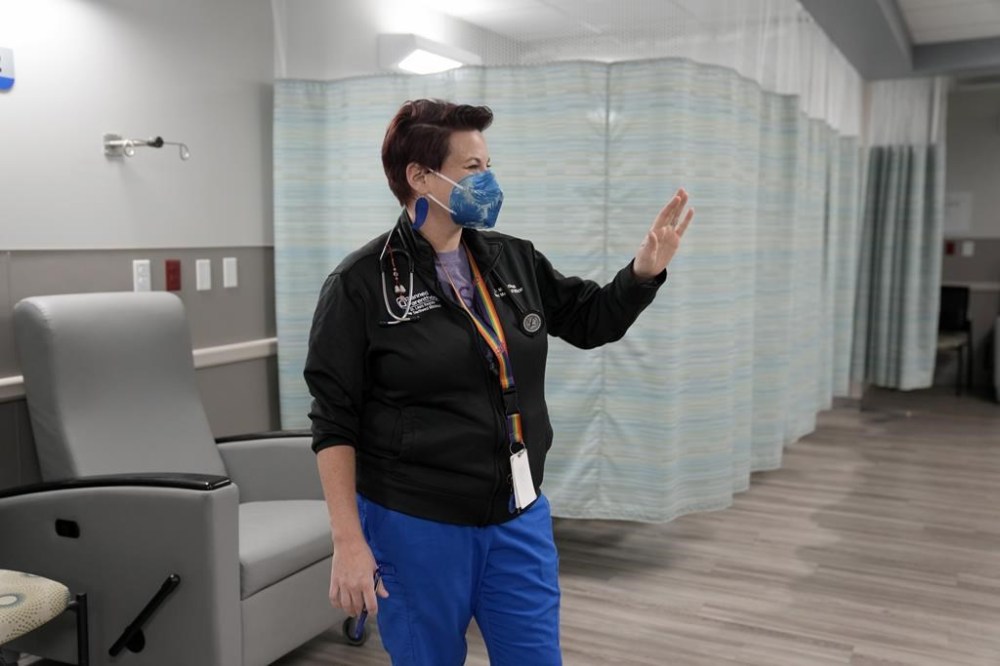
FAIRVIEW HEIGHTS, Ill. (AP) — Dr. Colleen McNicholas is fresh off performing two abortions when a ringing phone quickly stops her.
“Oh, ugh,” she said, eyes widened, before she darted off to another room.
Just the day before, 58 women had abortions at the Fairview Heights’ Planned Parenthood clinic, 15 miles east of St. Louis. But the new day is still stacked with appointments; as many as 100 abortion and family planning patients might walk through the doors.
Every day is busy now.
Hundreds of women travel each week to the southern tip of Illinois to secure an abortion, something that is no longer available to millions living in a 1,800 mile stretch of 11 Southern states that have mostly banned pregnancy terminations since the Supreme Court stripped away constitutional protections for women to end pregnancies.
But another barrier awaits them once they reach the clinic in one of the country’s most abortion-friendly states. Anti-abortion advocates in neon hazard vests frantically try to wave passersby down at the gates, hoping to talk them out of what they are about to do.
The clinic’s waitlist for abortions has only grown from two days to nearly three weeks after the Supreme Court ruling last June — even after staffers started working 10-hour shifts and they opened the clinic on Saturdays.
“With every piece of litigation, with every new constitutional amendment, with every new abortion restriction in a state that has some access, we are on this teeter-totter of what can we do here to make more space for the people who are going to be fleeing their home state?” McNicholas said.
With 10,000 abortion patients expected this year at the clinic, there’s talk of opening on Sundays. Staff developed an emergency plan that would convert some patient rooms, normally reserved for birth control consultations or vasectomies, to make more room for abortions. A recreational vehicle has been retooled into a mobile clinic that can travel along the state line for doctors to provide abortions.
That still won’t be enough to keep up, McNicholas predicted.
She’s eyeing a proposed six-week abortion ban in Florida which could send even more women from the South seeking abortions up north. And she’s closely watching how a Texas judge will rule on a case that seeks to keep the abortion pill mifepristone off the market.
“Any additional decision has the potential to really change demand again,” she said. “It’s like crisis management every day of the year.”
Months before Roe v. Wade was overturned, Planned Parenthood and the nearby Hope Clinic had already been grappling with a surge of patients from Oklahoma, Arkansas, Texas and elsewhere after Gov. Greg Abbott, R-Texas, signed a bill into law that effectively shut down several abortion clinics in his state and led to long waiting lists in neighboring states’ facilities. Together, the clinics launched a new regional logistics center in January 2022 dedicated to helping out-of-state patients book hotels, flights, gas money, bus rides or rental cars to either facility.
Just six months later, on June 24, the Supreme Court ruled that abortion was not a constitutionally protected right. Within hours, states such as Louisiana, Mississippi, Tennessee and Texas began enacting trigger laws that banned abortions.
Now, about 70 women call the center every day for help getting to an abortion clinic in southern Illinois, said Kawanna Shannon, the director of patient access at the Planned Parenthood clinic. When they reach the line, a navigator first goes over what they can pay toward their abortion. There are other details: How will the patient get to the area? Does she have money for food while she stays there? Will she need child care?
When someone cannot afford to pay for hotels, bus tickets or plane rides, the center books the travel for the patient and works with more than 30 nonprofit groups around the country that solicit funds for abortion access to fund the trip.
The work doesn’t end there.
A staffer is available around-the-clock to answer desperate calls from patients who run into travel issues. Workers raced to arrange a ride to the airport in the middle of the night for one patient to flee her abusive partner. They troubleshoot when a car breaks down on the trip to southern Illinois. They navigated canceled flights during a crushing winter travel season to make sure one woman made it back to her family on Christmas day after an abortion.
“It’s not going to slow down,” Shannon said. “We are really taking care of the entire Southern region. All the (patients) in the South are really coming to southern Illinois because we’re the closest. Almost all of them need some type of help – be it travel, be it procedure costs.”
Two hours south of the Planned Parenthood clinic, two new abortion clinics opened in Carbondale, Illinois, late last year to give women living in banned states a closer option.
After reading the Supreme Court’s leaked draft opinion last May, Andrea Gallegos, the director of the Alamo Clinic, said she hopped on Google and started looking for liberal-leaning cities in rural, southern Illinois.
“Illinois was just a state that really stood out in this sea of states that would more than likely ban abortion,” Gallegos said. “It seemed like a good choice to try and get over there.”
The Alamo Clinic relocated to the area from Oklahoma last November.
Three doctors in a rotation travel from Montana, Tennessee or Texas weekly to perform about 30 abortions daily at the clinic, which will terminate a pregnancy before 18 weeks. Gallegos says fewer than 5% of patients who come to the clinic are from Illinois.
Most patients coming to the Fairview Heights clinic are no longer from the region, either. During the final six months of last year, the clinic saw 2,042 abortion patients from outside of Missouri or Illinois — up from just 314 the six months before.
Women are now seeking abortions later in their pregnancies at the Planned Parenthood clinic, which offers the procedure through 26 weeks. About one-quarter of patients need a second trimester abortion, McNicholas said.
But the hardest change to deal with has been the steady increase in children who are coming to the clinic, hoping to end a pregnancy that was the result of a rape or abuse.
“What you use to see was maybe one or two 10-and 11-year-olds a year,” she said. “Now you’re seeing a couple a month because they’re coming from all over the country. Just sitting with that knowledge that this many people are experiencing so much trauma … There are times where it’s really hard.”
___
The Associated Press receives support from the Robert Wood Johnson Foundation for public health reporting. The AP is solely responsible for all content.
Related Articles
Some US states stock abortion medications after court ruling
Advertisement Advertise With Us
Advertisement Advertise With Us