The latest ‘boogeyman’
There’s always a new food item to blame, but healthy eating goes beyond notions of good and evil

Advertisement
Read this article for free:
or
Already have an account? Log in here »
To continue reading, please subscribe:

Digital Subscription
One year of digital access for only $205*
- Enjoy unlimited reading on winnipegfreepress.com
- Read the E-Edition, our digital replica newspaper
- Access News Break, our award-winning app
- Play interactive puzzles
*First annual payment billed as $205.00 + GST for one year. This annual subscription will automatically renew at $233.00 + GST every 52 weeks (10% off the regular annual price of $259.35). Offer available to new and qualified returning subscribers only. Cancel any time.
To continue reading, please subscribe:
Add Free Press access to your Brandon Sun subscription for only an additional
$1 for the first 4 weeks*
- Enjoy unlimited reading on winnipegfreepress.com
- Read the E-Edition, our digital replica newspaper
- Access News Break, our award-winning app
- Play interactive puzzles
*Your next Brandon Sun subscription payment will increase by $1.00 and you will be charged $17.95 plus GST for four weeks. After four weeks, your payment will increase to $24.95 plus GST every four weeks.
Read unlimited articles for free today:
or
Already have an account? Log in here »
Hey there, time traveller!
This article was published 29/07/2023 (1141 days ago), so information in it may no longer be current.
Everywhere I look online people say “seed oils” will destroy your health. But what does the research really say?
And how do you know who — and what — to believe when you read an article on the internet?
Fear sells. When you make fear-based comments and claims, people notice. And “seed oils cause obesity, inflammation, cancer and will kill you if you eat them” is that exact kind of nonsense.
Time magazine
It’s just the latest in a long line of “nutritional boogeymen” since the obesity epidemic came into full swing in the early 1980s.
At first, the boogeyman was saturated fat and cholesterol.
In 1984, Time magazine went with a cover featuring frowny-face sunny-side-up eggs and bacon under the headline Cholesterol: And Now the Bad News, and everyone ditched bacon and eggs for a while. Fat was making us fat and clogging our arteries, or so we were told.
But of course, over time we realized it made little impact either way.
The next nutritional boogeyman was sugar, and eventually all carbs. After all, eating less fat didn’t work, so the answer must be sugar, right? We’re eating too many carbs, which is causing our insulin to spike, and insulin is a “storage hormone.” (This theory is called the insulin hypothesis, and it’s had plenty of holes poked in it in recent years, by the way.)
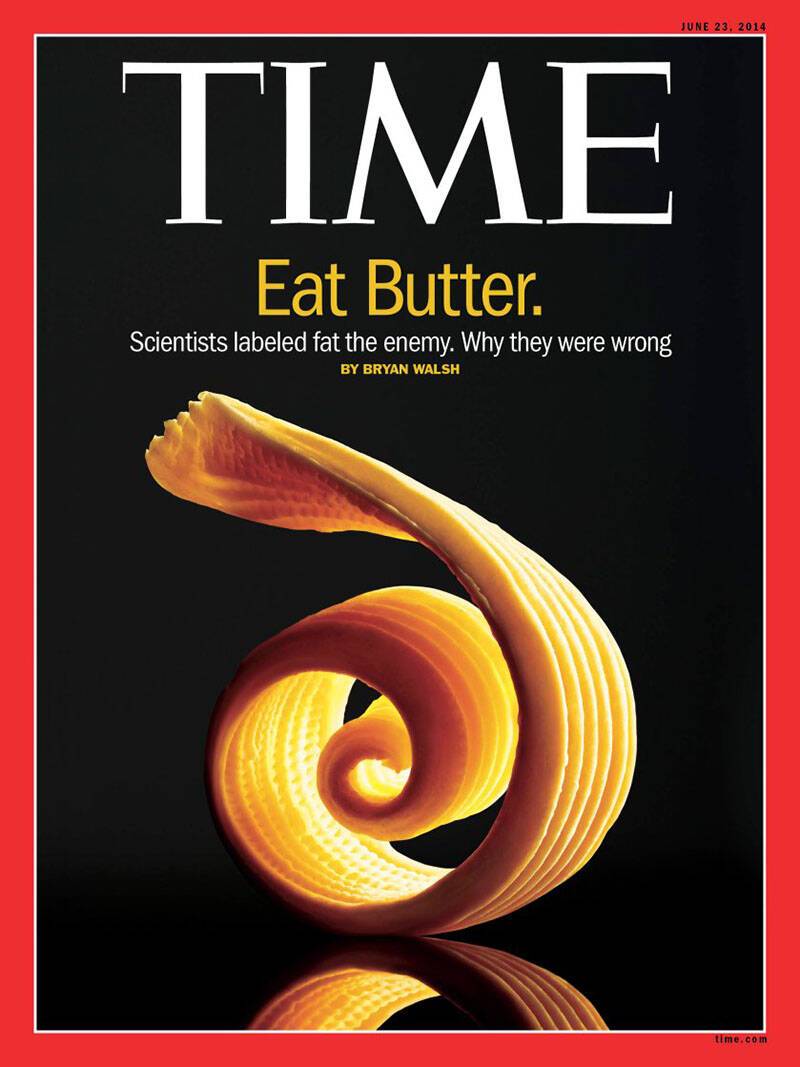
So, Time magazine went in the other direction, and came out with another cholesterol-related cover in 2014. This time, the headline Eat Butter: Scientists labeled fat the enemy. Why they were wrong ran above a photograph of an artistically sculpted curl of butter.
And like clockwork, all the food companies said, “shoot, nobody wants to buy our low-fat products any longer! We need to make low-carb products, because carbs are bad!”
And our grocery store shelves were bombarded with low-carb cookies, gluten-free cakes and Atkins-approved muffins.
And of course… it didn’t work (yet again). And since obesity rates are still rising, we need another boogeyman.
Sugar consumption has plummeted in the United States over the last decade but our weight and waistlines have expanded at the same rates as before.
Clearly, we haven’t pinpointed the proper boogeyman, right?
Now enter seed oils. Common seed oils include canola oil, sunflower oil and safflower oil.
Sometimes, chemical solvents are used to extract the oils as well. This association with “chemicals” is what makes seed oils a prime target to scare people away. People see the words “chemicals” and “processed” (which seed oils are), and the appeal to logical fallacy is difficult to overcome (just like with “artificial” sweeteners).
Seed oils are also high in Omega-6 fatty acids, which scares people, since the Omega-3 to Omega-6 fatty acid ratio needs to be kept in check.
The biggest reason seed oils have been deemed “bad” is because of their association with processed and fried foods.
Processed foods are created to taste delicious. It’s tough to lose weight if you’re regularly eating junk food like cakes, candy and potato chips. But you already knew that, right? You were never supposed to eat most of your foods from a bag or a box with a barcode. But unfortunately, our world is set up to do just that.
The question remains, is it about the seed oils themselves, or is it the excess calories that come along with eating processed foods?
Even before I started coaching others, I didn’t want to know the nitty-gritty scientific facts behind protocols. I just wanted to know what mattered to the average person so I could make it work in layman’s terms. Give me the Cliff’s Notes — that was my motto — and that’s what I do for my clients as well.
Because of this, I need to know who to trust, especially in the world of nutrition, which many people treat like religion.
Back in the early 2000s when I was learning how to get fit myself, I came across some dubious information, and took it as gospel.
I fell hook, line and sinker into the “carbs are bad” rhetoric that was running wild online. I went “keto” before it was even a thing.
Did I lose weight? Yep, I sure did, but I also lost muscle, my libido (not cool for a 20-something guy, lol), and kept getting sick (some of that surely would’ve happened with a crash diet higher in carbs, as well).
I was obsessive about not eating carbs and I was positive that eating them made you fat. Because that’s exactly what “everyone said” online. Sound familiar? This is the exact same thing people are saying about seed oils right now.
It wasn’t until I sought out trustworthy sources of information that I started to realize I was falling for the fads.
I spent that next year some 18 years ago taking the PN1 course on nutrition, going back to university for night classes, and I hired a coach of my own. I had to find unbiased practitioners and follow their lead.
What is an “unbiased practitioner?” It’s a coach or figure who uses nuance when they speak. They never spout absolutes such as “if you eat this one thing, it will destroy your health.”
If you listen to “Carnivore Carl” from Twitter, who sells “Carnivore coaching,” of course Carnivore Carl will tell you things that fit his narrative.
Every year, as the temperatures rose, so did the number on the scale. Then one fateful summer in my mid 20s, I decided to break free from this cycle and just commit to the basics. I found if I had these foundational five habits in my arsenal — and I applied them near daily — I could mix in fun and still focus on fitness.
Habit 1: H2O to the rescue
I chugged down not one, not two, but a glorious three litres of water every day. It helped wash away the cravings and kept me energized all summer long.
Habit 2: Calorie control caper
I must admit, I had some “triggers” that led to ice cream, barbecues — you name it! But I embraced the awareness that tracking my portions provided me. I enjoyed those indulgences mindfully, while making sure my overall intake played nice with my goals.
Habit 3: Power of protein
Ah, the high-protein diet. It was like having a trusty sidekick to keep me strong and satisfied. I swapped those empty-calorie snacks for protein-packed powerhouses that fuelled my days and helped me build some muscle.
Habit 4: Pumping iron

Speaking of muscles, that fateful summer had a new attraction: strength training! I waved goodbye to hours on the treadmill and hit the weights with gusto.
Habit 5: Walking wonderland
Ah, the joy of walking! I made it my mission to clock in those magical 8,000-10,000 steps every day. Walking became my escape, my time to recharge, and an opportunity to get out while the weather was good.
My approach has evolved over the years, but these foundational five habits are the framework. I promise you it makes things a whole lot more enjoyable and sustainable if you choose to do the same.
Mitch Calvert is a Winnipeg-based fitness coach who has helped more than 1,500 people transform their bodies and lives over the past decade. Visit mitchcalvert.com to grab a free meal plan and calorie calculator or email him to get direct coaching.
Our newsroom depends on a growing audience of readers to power our journalism. If you are not a paid reader, please consider becoming a subscriber.
Our newsroom depends on its audience of readers to power our journalism. Thank you for your support.
Our newsroom depends on a growing audience of readers to power our journalism. If you are not a paid reader, please consider becoming a subscriber.
Our newsroom depends on its audience of readers to power our journalism. Thank you for your support.
Advertisement Advertise With Us
Advertisement Advertise With Us