Patients need doctors who look like them. Can medicine diversify without affirmative action?
Advertisement
Read this article for free:
or
Already have an account? Log in here »
To continue reading, please subscribe:

Digital Subscription
One year of digital access for only $205*
- Enjoy unlimited reading on winnipegfreepress.com
- Read the E-Edition, our digital replica newspaper
- Access News Break, our award-winning app
- Play interactive puzzles
*First annual payment billed as $205.00 + GST for one year. This annual subscription will automatically renew at $233.00 + GST every 52 weeks (10% off the regular annual price of $259.35). Offer available to new and qualified returning subscribers only. Cancel any time.
To continue reading, please subscribe:
Add Free Press access to your Brandon Sun subscription for only an additional
$1 for the first 4 weeks*
- Enjoy unlimited reading on winnipegfreepress.com
- Read the E-Edition, our digital replica newspaper
- Access News Break, our award-winning app
- Play interactive puzzles
*Your next Brandon Sun subscription payment will increase by $1.00 and you will be charged $17.95 plus GST for four weeks. After four weeks, your payment will increase to $24.95 plus GST every four weeks.
Read unlimited articles for free today:
or
Already have an account? Log in here »
Hey there, time traveller!
This article was published 10/09/2023 (1125 days ago), so information in it may no longer be current.
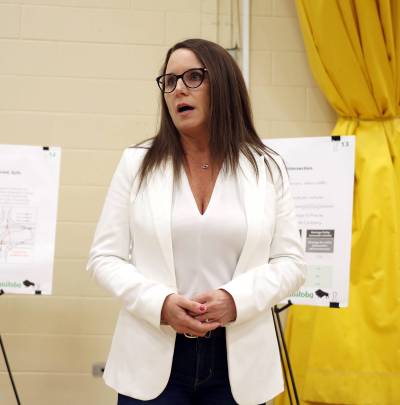
DETROIT (AP) — Dr. Starling Tolliver knew she wanted to become a doctor. Yet, as a Black girl growing up in Akron, Ohio, it was a dream that felt out of reach.
She rarely saw doctors who looked like her. As a child, she experienced severe hair loss, and struggled to find a dermatologist who could help.
Tolliver made a pact with two childhood best friends to become doctors who would care for Black and underserved communities like their own. Now 30, she is in her final year of dermatology residency at Wayne State University in Detroit.

She plans to spend her career caring for the body’s largest organ, where differences in melanin give humans the skin colors underpinning the construct of race. In dermatology, only 3% of U.S. doctors are Black.
Despite her success, the girls’ pact remains unfulfilled. While her friend Charmaine became a nurse, Maria, who wanted to become a pediatrician, was killed in their hometown at the age of 19.
Her friend’s death only strengthened her resolve.
“I’m going to continue to go on this path of medicine,” Tolliver said. “Not only for myself, but for Maria, and to potentially help others in the future from similar backgrounds as mine know that they can do it as well.”
But more than two months after the Supreme Court struck down affirmative action in college admissions, concerns have arisen that a path into medicine may become much harder for students of color. Heightening the alarm: the medical field’s reckoning with longstanding health inequities.
Black Americans represent 13% of the U.S. population, yet just 6% of U.S. physicians are Black. Increasing representation among doctors is one solution experts believe could help disrupt health inequities.
The disparities stretch from birth to death, often beginning before Black babies take their first breath, a recent Associated Press series showed. Over and over, patients said their concerns were brushed aside or ignored, in part because of unchecked bias and racism within the medical system and a lack of representative care.
A UCLA study found the percentage of Black doctors had increased just 4% from 1900 to 2018.
But the affirmative action ruling dealt a “serious blow” to the medical field’s goals of improving that figure, the American Medical Association said, by prohibiting medical schools from considering race among many factors in admissions. The ruling, the AMA said, “will reverse gains made in the battle against health inequities.”
The consequences could affect Black health for generations to come, said Dr. Uché Blackstock, a New York emergency room physician and author of “LEGACY: A Black Physician Reckons with Racism in Medicine.”
“It’s really about holding these larger organizations, institutions accountable and saying: ‘Right now, we’re in a crisis — a crisis of humanity,’” Blackstock said.
With affirmative action off the table at predominantly white institutions, historically Black colleges and universities may see an increase in applications, said Dr. Valerie Montgomery Rice, president and CEO of Morehouse School of Medicine in Atlanta.
The college, which typically has 115 openings for new medical students, receives between 7,000 and 9,000 applications per year, a number Rice said she believes will increase in light of the Supreme Court ruling. HBCUs have long served as a direct pipeline of Black doctors.
Experts say diversity is especially needed within specialty medicine. In dermatology, just 65 of the 796 applicants for residencies in 2020 were Black, data from the Association of American Medical Colleges shows. Only 39 were Latino.
For a field focusing on the skin, the unequal access among patients of color is stark: Patients of color are half as likely as white patients to see a dermatologist for the same conditions.
The consequences can be devastating.
“The skin is a window to the rest of your health,” said Dr. Ginette Okoye, professor and chair of dermatology at Howard University, who is a programming lead for the American Academy of Dermatology’s Pathways program.
“If you have kidney disease, if you have cancer, sometimes those clues show up on the skin first. We are able to preemptively diagnose cancer sometimes just by the way a specific rash shows up on the skin,” Okoye said. “That’s pretty impactful.”
Black men are more likely to die of melanoma, compared with men of other races, according to a study co-authored last month by dermatologist Dr. Ashley Wysong in the Journal of the American Academy of Dermatology. They also are more likely to be diagnosed at a later stage, when the condition is more difficult to treat. Melanoma is the most invasive and serious form of skin cancer.
The reasons for the different cancer rates are unclear, and more research is needed to understand in particular how economic and social conditions impact the cancer rates, Wysong said. The study found survival rates in men with melanoma were highest among white men, 75%, while the survival rates were lowest among Black men at only 52%.
“As medical professionals, any time we see disparities in care or outcomes of any kind, we have to look at the systems in which we are delivering care and we have to look at ways that we are falling short,” Wysong said.
Without affirmative action as a tool, career programs focused on engaging people of color could grow in importance.
For instance, the Pathways initiative engages students from Black, Latino and Indigenous communities from high school through medical school.
The program starts with building interest in dermatology as a career and continues to scholarships, workshops and mentorship programs. The goal: Increase the number of underrepresented dermatology residents from about 100 in 2022 to 250 by 2027, and grow the share of dermatology faculty who are members of color by 2%.
Tolliver credits her success in becoming a dermatologist in part to a scholarship she received through Ohio State University’s Young Scholars Program, which helps talented, first-generation Ohio students with financial need. The scholarship helped pave the way for medical school, but her involvement in the Pathways residency program also was central.
Azariah Providence, a 17-year-old rising high school senior who lives in the U.S. Virgin Islands, participated in the high school Pathways program last month. She wants to become a dermatologist because of her own scalp psoriasis diagnosis, which is a skin disease causing a rash with itchy, scaly patches.
Her condition hampered her self-esteem as a 9-year-old girl. The dermatologist she saw, one of very few on the island, prescribed medication causing Providence’s skin to burn and her hair to fall out.
“It was a difficult experience because as a little girl, your hair is very important to you,” Providence recalled. “After going through that, I wanted to help little girls who have similar conditions that I have. I want to be that person for them that I didn’t have when I was younger.”
Providence, who would be a first-generation medical student, said the program exposed her to college students and doctors of color, something she had never before seen.

“I think it’s important for more Black people to get into the field of dermatology for the simple reason that some conditions may appear differently on Black skin,” Providence said. “I want to enter the field so that people who look like me can have their skin understood and fully studied so that when they come to get diagnosed, it’s a correct diagnosis and they could get the correct treatment.”
Dermatology also is working to diversify its textbooks to help improve the spectrum of skin colors so doctors can be better equipped to diagnose and provide equitable care, said Dr. Adam Friedman, chair of dermatology at George Washington School of Medicine and Health Sciences in Washington, D.C.
But targeted programs to diversify the pipeline of talent are crucial for the future of medicine, Friedman said.
As Tolliver prepares to leave residency, she hopes to be one of the people pushing for better outcomes, especially for Black women.
“Our patients are looking for us, and that kind of pushed forward my love for this field,” Tolliver said. “And that really has been my goal ongoing from when I was a little girl: for Black women to see the beauty of themselves, within themselves.”