Hydration education
The continuing fight to drink up

Advertisement
Read this article for free:
or
Already have an account? Log in here »
To continue reading, please subscribe:

Digital Subscription
One year of digital access for only $205*
- Enjoy unlimited reading on winnipegfreepress.com
- Read the E-Edition, our digital replica newspaper
- Access News Break, our award-winning app
- Play interactive puzzles
*First annual payment billed as $205.00 + GST for one year. This annual subscription will automatically renew at $233.00 + GST every 52 weeks (10% off the regular annual price of $259.35). Offer available to new and qualified returning subscribers only. Cancel any time.
To continue reading, please subscribe:
Add Free Press access to your Brandon Sun subscription for only an additional
$1 for the first 4 weeks*
- Enjoy unlimited reading on winnipegfreepress.com
- Read the E-Edition, our digital replica newspaper
- Access News Break, our award-winning app
- Play interactive puzzles
*Your next Brandon Sun subscription payment will increase by $1.00 and you will be charged $17.95 plus GST for four weeks. After four weeks, your payment will increase to $24.95 plus GST every four weeks.
Read unlimited articles for free today:
or
Already have an account? Log in here »
Hey there, time traveller!
This article was published 30/09/2023 (1085 days ago), so information in it may no longer be current.
Several times a day, my smartwatch buzzes, asking me if I “want to add to my hydration log.”
Want is a strong word. I never want to add to my hydration log, mostly because I have nothing to add.
I, like many people, struggle with my water intake. Not because I hate water the way some people do; I just have problems drinking when I’m not actively thirsty … but by then it’s already too late. I feel like that’s the one scared-straight fact about dehydration we all universally retained: if you feel thirsty, you’re already dehydrated.

Apple TV+
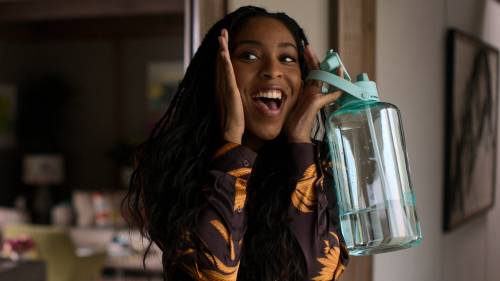
Jessica Williams’ character in Shrinking is a certified hydration babe.
Which, like… yes? That’s why I’m thirsty? Isn’t this a feature, not a bug?
I have zero memory of drinking plain water growing up. This is a pretty ubiquitous, cross-generational experience for those whose birth years begin with a 19; apparently Seinfeld even did a bit about it at last Friday’s show at Canada Life Centre. For me, a child of the late 1980s and ’90s, hydration came in the following forms: juice boxes, milk (sometimes chocolate), pop, powdered iced tea and Kool-Aid. Maybe a quick snort from a gum-encrusted water fountain in the hallway at school on the way back from a shift dodging balls in the gym.
An aside: did anyone else play Dr. Dodgeball? For the deprived uninitiated, it’s dodgeball, but with a weird, wartime-y twist: the “doctors” would have to run out onto the “battleground” to haul their felled classmates by their pits to safety.
It’s a miracle I haven’t fully disintegrated into a pile of dust, especially considering I’m living in These Times, during which there seems to be a real cultural obsession with staying hydrated and spending a lot of money on reaching that goal. There are smartwatches (like mine) haranguing you to drink water. There are apps to remind you to drink water. There is a thing called a Reminder Cactus that lights up when it’s time to chug some H2O.
And then there are those massive water bottles with time markers and little motivational phrases printed on them. I find them unnecessarily cheerful, which I recognize is supposed to be encouraging, but, to me, has the opposite effect. “You can do it!” (I suppose, but I don’t want to) and “never give up” (I’ll do what I like) and “keep going!” (or what?).
These bottles are positively aquarium-sized. Goldfish could swim around in them comfortably. The hydration girlies are out there lugging around full-sized water-cooler jugs. Listen, if a water bottle requires its own carrying strap, it’s too big.
Of course, a lot of this is marketing. Water, a thing we need to live (allegedly), has long been a site for capitalism — most significantly the scourge that is bottled water, sold in plastic by the same companies who sell soft drinks, while many communities in North America still can’t turn on a tap and access fresh water. In 2023.
What you put your water in is also a status symbol. The Nalgenes of yore were replaced by Hydro Flasks, which were replaced by Instagram’s favourite $59 (!) tumbler, the Stanley Cup (not that Stanley Cup, although it appears to be roughly the same size).

Diet culture (also on the capitalism Venn diagram) is linked to this cultural obsession with hydration, too. Water will make us thin, we’ve been promised, whether it’s in the form of drinking warm lemon water every morning or the now-ubiquitous cans of flavoured sparkling water, which sometimes tastes delicious but other times tastes like someone describing a flavour to you.
Spring 2023 saw the rise of Water TikTok, or WaterTok, in which influencers would share their fave sugar-free syrups, powders, etc. used in “water recipes” (lol), a riot of candy-coloured packaging to make plain water more palatable. (Is that still water? That’s a contentious debate online because insufferable purists exist everywhere.)
Look, whatever keeps you out of organ failure.
My favourite way to zhuzh up a glass of City of Winnipeg’s finest? Turning it into coffee. Coffee has water in it, and I have no trouble drinking too much of that.
A version of this column originally ran in NEXT, Jen Zoratti’s weekly newsletter. You can subscribe at winnipegfreepress.com/next.
Jen Zoratti is a columnist and feature writer working in the Arts & Life department, as well as the author of the weekly newsletter NEXT. A National Newspaper Award finalist for arts and entertainment writing, Jen is a graduate of the Creative Communications program at RRC Polytech and was a music writer before joining the Free Press in 2013. Read more about Jen.
Every piece of reporting Jen produces is reviewed by an editing team before it is posted online or published in print – part of the Free Press‘s tradition, since 1872, of producing reliable independent journalism. Read more about Free Press’s history and mandate, and learn how our newsroom operates.
Our newsroom depends on a growing audience of readers to power our journalism. If you are not a paid reader, please consider becoming a subscriber.
Our newsroom depends on its audience of readers to power our journalism. Thank you for your support.
Jen Zoratti is a columnist and feature writer working in the Arts & Life department, as well as the author of the weekly newsletter NEXT. A National Newspaper Award finalist for arts and entertainment writing, Jen is a graduate of the Creative Communications program at RRC Polytech and was a music writer before joining the Free Press in 2013. Read more about Jen.
Every piece of reporting Jen produces is reviewed by an editing team before it is posted online or published in print – part of the Free Press‘s tradition, since 1872, of producing reliable independent journalism. Read more about Free Press’s history and mandate, and learn how our newsroom operates.
Our newsroom depends on a growing audience of readers to power our journalism. If you are not a paid reader, please consider becoming a subscriber.
Our newsroom depends on its audience of readers to power our journalism. Thank you for your support.
Advertisement Advertise With Us
Advertisement Advertise With Us