Life expectancy for Canadians fell in 2022 for third year in a row, says StatCan

Advertisement

Advertise with us

OTTAWA - Life expectancy for Canadians decreased for the third straight year in 2022, and more people died of COVID-19 than in any other year since the pandemic began, according to a report released Monday.

Read this article for free:


or

Already have an account? Log in here »

To continue reading, please subscribe:

Subscribe and receive a limited-edition Free Press branded hat or tote.

Digital Subscription

One year of digital access for only $205*

  • Enjoy unlimited reading on winnipegfreepress.com
  • Read the E-Edition, our digital replica newspaper
  • Access News Break, our award-winning app
  • Play interactive puzzles

*First annual payment billed as $205.00 + GST for one year. This annual subscription will automatically renew at $233.00 + GST every 52 weeks (10% off the regular annual price of $259.35). Offer available to new and qualified returning subscribers only. Cancel any time.

To continue reading, please subscribe:

Add Free Press access to your Brandon Sun subscription for only an additional

$1 for the first 4 weeks*

  • Enjoy unlimited reading on winnipegfreepress.com
  • Read the E-Edition, our digital replica newspaper
  • Access News Break, our award-winning app
  • Play interactive puzzles
Start now

*Your next Brandon Sun subscription payment will increase by $1.00 and you will be charged $17.95 plus GST for four weeks. After four weeks, your payment will increase to $24.95 plus GST every four weeks.

Hey there, time traveller!
This article was published 27/11/2023 (1041 days ago), so information in it may no longer be current.

OTTAWA – Life expectancy for Canadians decreased for the third straight year in 2022, and more people died of COVID-19 than in any other year since the pandemic began, according to a report released Monday.

Statistics Canada’s analysis of deaths last year shows the average Canadian’s life expectancy dropped to 81.3 years in 2022, a full year lower than the 82.3 years recorded in 2019.

“Life expectancy declines when there are more deaths, when deaths occur at younger ages, or a combination of both,” the report said.
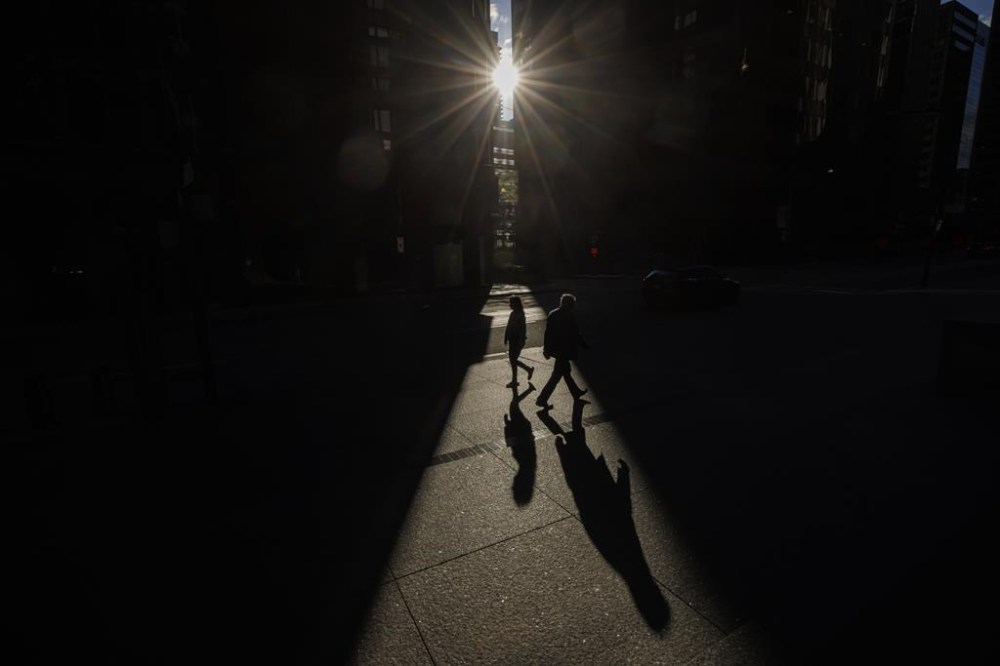
A new report from Statistics Canada says life expectancy for the average Canadian at birth has fallen for the last three years in a row, from 82.3 in 2019 to 81.3 years in 2022. Pedestrians walk through a sliver of sunlight in downtown Toronto on Wednesday, July 6, 2022. THE CANADIAN PRESS/Cole Burston

COVID-19 became the third-leading cause of death for Canadians last year, overtaking accidents and unintentional injuries for the first time since the disease emerged in 2020.

“This increase may in part be due to the exposure to new highly transmissible COVID-19 variants and the gradual return to normalcy,” the report said, pointing to reduced restrictions and the elimination of masking requirements.

Cancer and heart disease were the first and second most common causes of mortality, accounting for 41.8 per cent of all deaths in 2022.

New Brunswick saw the biggest decline in life expectancy among provinces, dropping more than a year to 79.8 years from 80.9 in 2021, the report said. Saskatchewan’s life expectancy has fallen the most over the past three years combined, dropping a full two years to 78.5 in 2022 from 80.5 in 2019. Prince Edward Island was not included in the yearly data breakdowns by province.

An increase in deaths among younger people last year was attributable in part to deaths under investigation by a coroner or medical examiner, which typically include suicides, homicides and drug toxicity deaths.

More than 19,700 Canadians died of COVID-19 last year, Statistics Canada said. Seniors bore the brunt of the increase, with those aged 80 and older seeing a 78-per-cent jump in COVID deaths last year compared to the year before.
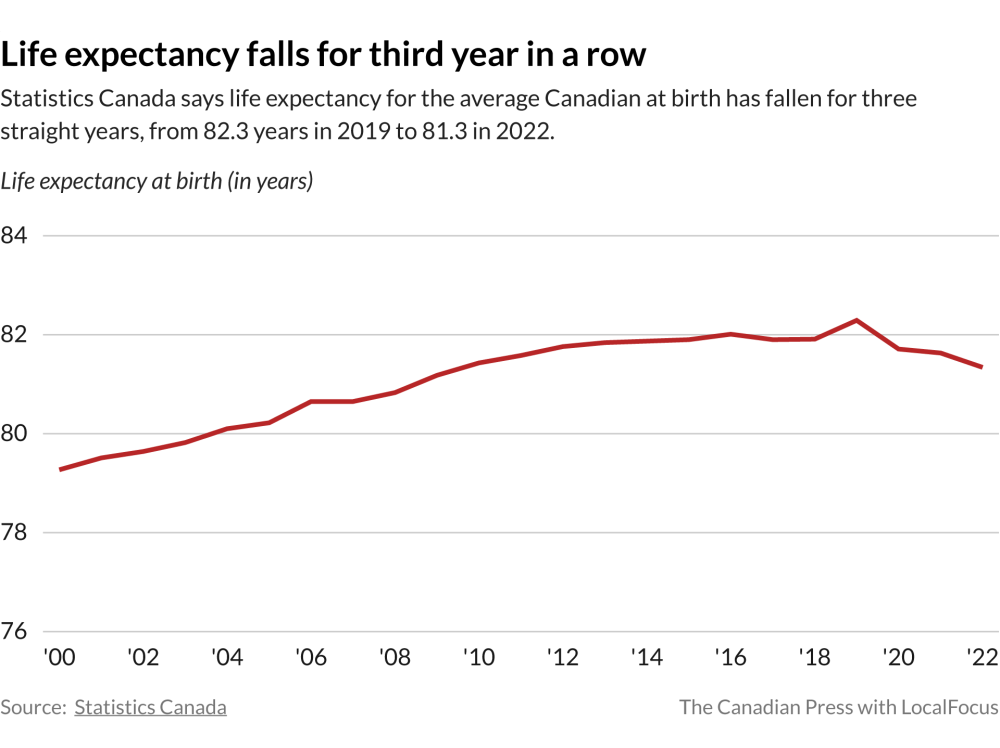
A new report from Statistics Canada says life expectancy for the average Canadian at birth has fallen for three straight years, from 82.3 years in 2019 to 81.3 in 2022.

People aged 65 and older accounted for 91.4 per cent of all COVID-19 deaths in 2022, the report said.

In Atlantic Canada, the rate of COVID-19 deaths in Atlantic Canada was more than seven times higher last year compared with the year before — the highest jump in any region of the country, the statistics agency said.

This report by The Canadian Press was first published Nov. 27, 2023.

Report Error Submit a Tip

More Stories

Brandonmeat packer thriving on its own

Abiola Odutola 3 minute read Preview

Brandonmeat packer thriving on its own

Abiola Odutola 3 minute read 2:01 AM CDT

BRANDON — Canada Packers has strengthened its business and laid the foundation for future growth during its first year as an independent company, its president says.

The Brandon-based pork producer, separated from Maple Leaf Foods in October 2025, established its own leadership, strategy, systems, culture and identity while continuing operations across its hog production farms and regional hog barns in southern and eastern Manitoba.

The company’s first year was focused on building a successful standalone business while continuing to serve customers, communities and shareholders, president Dennis Organ said.

“Market conditions over the past year have been more challenging than we anticipated when we became a separate entity,” he said in an email. “Despite that, we continued to execute against our priorities, including increasing processing volumes, maintaining disciplined operations and strengthening the business.”

Read
2:01 AM CDT

Clock ticks down on destruction of records documenting residential school abuses

Marsha McLeod 13 minute read Preview

Clock ticks down on destruction of records documenting residential school abuses

Marsha McLeod 13 minute read Yesterday at 12:49 PM CDT

In less than a year, a private company is set to destroy the largest cache of records detailing the widespread abuse of Indigenous children at residential schools in Canada.

The destruction, which was ordered by an Ontario court in 2014 and later upheld by the Supreme Court, is set to take place on Sept. 19, 2027.

This countdown is igniting emotional conversations that seek to balance the immense historical value of the records alongside the confidentiality survivors were promised as part of the process of providing detailed testimony about abuses they’d suffered.

The records were created as part of the Indian Residential Schools Settlement Agreement, a class-action settlement stemming from survivors who began suing the federal government in the late 1990s over the harm they’d been subjected to at residential schools.

Read
Yesterday at 12:49 PM CDT

Letters, Oct. 3

7 minute read 2:01 AM CDT

A morning in the life …

My very first lesson does not start when I walk into that lecture hall, oh no — it starts long before. It begins when I walk to my car, check the estimated arrival time to the University of Manitoba and hope that Winnipeg traffic agrees with it.

A drive that appears completely manageable changes almost immediately when I’m greeted by a tsunami of orange pylons and a line of cars that appears to go on forever. Traffic moves by the inch, lanes magically disappear and the detour I took yesterday now has a detour of its own. These factors make me do a calculation that I have become all too familiar with. How late can I arrive and still find parking, run to my class across campus and get to class with enough time left to make it worth it?

I have grown used to people saying, “Why not just leave earlier?” I do. But when I’m already leaving for my 8:30 a.m. class at 7 a.m., there’s only so much I can do. This drive that some would think is relaxing is one that feels like an assignment that I didn’t know I had to complete and is due at 8:30 a.m.

Puzzles Palace

1 minute read Monday, Jul. 27, 2026

To solve our puzzles, please subscribe with this special offer: |

Manitoba marks end of sending simple workplace problems to doctor’s office

Tory McNally 7 minute read Preview

Manitoba marks end of sending simple workplace problems to doctor’s office

Tory McNally 7 minute read 2:01 AM CDT

There are some changes in the workplace that make you think: “Well, it’s about time.”

This is one of them.

Starting Oct. 1, Manitoba changed the rules around sick notes. I think it is going to be a wonderful change — not just for doctors and patients, but for employers, employees and the way we think about accountability at work.

The change comes from Bill 11, the Employment Standards Code Amendment Act (Sick Notes for Employee Absences), which received royal assent on June 1 and came into force Thursday. Under the new rules, employers generally cannot require a sick note for an illness or injury unless the employee is away for more than one week or has been absent because of illness or injury for more than 10 scheduled workdays in the calendar year.

Read
2:01 AM CDT

A 22-year-old man is dead and an 18-year-old is in hospital in critical condition after a two-vehicle crash on Highway 8 on Thursday evening.

A Gimli RCMP officer was driving north on the highway, near Riverton, when he witnessed the collision at about 6:45 p.m.

A vehicle headed north had passed the Mountie at a high speed before colliding with an SUV that was turning west onto Provincial Road 329 from Highway 8.

The driver of the first vehicle, an 18-year-old man from Arborg, was rushed to hospital by a helicopter ambulance with injuries RCMP describe as serious and life-threatening.