In Rio, rife with dengue, bacteria-infected mosquitoes are making a difference
Advertisement
Read this article for free:
or
Already have an account? Log in here »
To continue reading, please subscribe:
Digital Subscription
One year of digital access for only $1.44 a week*
- Enjoy unlimited reading on winnipegfreepress.com
- Read the E-Edition, our digital replica newspaper
- Access News Break, our award-winning app
- Play interactive puzzles
*Billed as $5.77 plus GST every four weeks. After 52 weeks, price increases to the regular rate of $19.95 plus GST every four weeks. Offer available to new and qualified returning subscribers only. Cancel any time.
To continue reading, please subscribe:
Add Free Press access to your Brandon Sun subscription for only an additional
$1 for the first 4 weeks*
- Enjoy unlimited reading on winnipegfreepress.com
- Read the E-Edition, our digital replica newspaper
- Access News Break, our award-winning app
- Play interactive puzzles
*Your next Brandon Sun subscription payment will increase by $1.00 and you will be charged $17.95 plus GST for four weeks. After four weeks, your payment will increase to $24.95 plus GST every four weeks.
Read unlimited articles for free today:
or
Already have an account? Log in here »
Hey there, time traveller!
This article was published 02/03/2024 (962 days ago), so information in it may no longer be current.
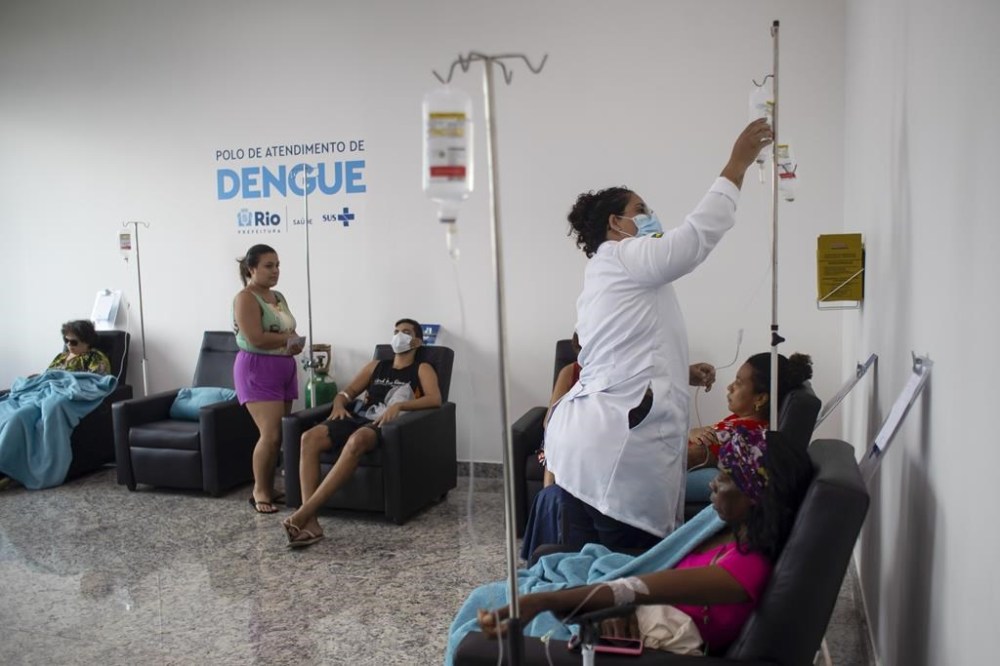
NITEROI, Brazil (AP) — Since Rio de Janeiro declared a public health emergency after an outbreak of dengue fever last month, the city has ramped up testing capacities, opened up a dozen dengue health centers and trained medical staff to attend to the ever-growing needs of its population.
But in Rio’s sister city of Niteroi, just across the Guanabara Bay, it’s a different story. Home to about half a million people, Niteroi has had just 403 suspected cases of dengue so far this year, and its incidence rate per capita is one of the lowest in the state, with 69 confirmed cases per 100,000 people.
By comparison, the city of Rio has an incidence rate of 700 per 100,000 people, with more than 42,000 cases.
The dengue virus is passed between humans by infected mosquitoes, but a type of bacteria called Wolbachia can interrupt transmission of the disease.
Health officials say a pilot program launched in Niteroi in 2015, in which scientists breed mosquitoes to carry the Wolbachia bacteria, has helped the city in its battle against dengue.
The Wolbachia strategy was pioneered over the last decade by the nonprofit World Mosquito Program. It was first tested in Australia in 2011 and the group has since run trials in more than a dozen countries, including Brazil. The initiative provides an appealing alternative at a time when the U.N. health agency warns that reported cases of dengue globally increased tenfold over the last generation.
In Niteroi, Mayor Axel Grael said he sought help after the 2012 dengue epidemics, when officials received thousands of notifications and one person died. The city sealed a partnership with the state-run Fiocruz Institute, the World Mosquito Program and the Health Ministry, and cases have been going down ever since.
“It was a moment of great concern in the country and in Rio,” Grael recalled in an interview Friday with The Associated Press in Niteroi. “Today, after applying the Wolbachia technique, we have a much better results.”
Dengue is a viral infection transmitted to humans through infected mosquitoes. Many who are infected never develop symptoms, but others get a high fever, headaches, body aches, nausea and a rash. While most get better after a week or so, some develop a severe form that requires hospitalization and can be fatal.
Frequent rains and high temperatures, which accelerate the hatching of mosquito eggs and the development of larvae, make the famously hot city of Rio especially susceptible. Every couple of years, outbreaks become epidemics.
In spite of the low number of cases, the city of Niteroi, like its neighbors, is still investing heavily in prevention. Every day, hundreds of city health workers are sent to survey neighborhoods, streets, rooftops, forested areas, small businesses and junkyards to promote best practices, mostly watching out for any standing water where mosquitoes could lay their eggs.
On Friday, under scorching heat, Augusto Cesar, 63, climbed up the Morro da Penha, or Penha Hill, a low-income neighborhood, known in Brazil as a favela. For more than two decades, the city agent has been entering local residents’ homes, climbing roofs, picking up trash and inspecting every corner of the Penha neighborhood, looking for standing water. Even the cap of a plastic bottle, if filled with rain water, can become breeding groound for larvae, he said.
“The greatest challenge is access,” Cesar said, pearls of sweat trickling down his face. Favelas, often built informally, can be hard to navigate, like mazes. After spotting a large plastic water tank on a roof that he would like to inspect, Cesar makes his way through a tiny alley, squeezed between two walls of concrete and red bricks, but fails to find a path to the rooftop.
Further down the road, he spots two more unsealed water tanks. He climbs a wall and starts removing the loose sheets of metal covering them. He installs mosquito nets and replaces the metal sheets. In a shady alley, he lifts the tops of two water tanks, gets a flashlight and scrutinizes the surface for any sign of mosquito larvae.
Another challenge, said Fiocruz researcher Luciano Moreira, is security, with vast swaths of the city run by either drug traffickers or militias. Moreira leads the Wolbachia project in Brazil.
Dozens of municipalities have reached out to national and city authorities, Cesar and Moreira said, anxious to implement the Wolbachia method on their own turf. The Health Ministry announced late last year plans to build a large factory to breed Wolbachia-carrying mosquitoes that, over the next 10 years, will be able to produce 100 million eggs per week, ten times Fiocruz’ current capacity.