Some doctors sneak education into their online content to drown out misinformation
Advertisement
Read this article for free:
or
Already have an account? Log in here »
To continue reading, please subscribe:

Digital Subscription
One year of digital access for only $205*
- Enjoy unlimited reading on winnipegfreepress.com
- Read the E-Edition, our digital replica newspaper
- Access News Break, our award-winning app
- Play interactive puzzles
*First annual payment billed as $205.00 + GST for one year. This annual subscription will automatically renew at $233.00 + GST every 52 weeks (10% off the regular annual price of $259.35). Offer available to new and qualified returning subscribers only. Cancel any time.
To continue reading, please subscribe:
Add Free Press access to your Brandon Sun subscription for only an additional
$1 for the first 4 weeks*
- Enjoy unlimited reading on winnipegfreepress.com
- Read the E-Edition, our digital replica newspaper
- Access News Break, our award-winning app
- Play interactive puzzles
*Your next Brandon Sun subscription payment will increase by $1.00 and you will be charged $17.95 plus GST for four weeks. After four weeks, your payment will increase to $24.95 plus GST every four weeks.
Read unlimited articles for free today:
or
Already have an account? Log in here »
Hey there, time traveller!
This article was published 16/03/2024 (940 days ago), so information in it may no longer be current.
TORONTO – When Dr. Siobhan Deshauer makes online videos, her primary goal is to demystify medicine. Her secondary goal?
“I call it ‘smuggling in education,'” said the physician and YouTuber, who boasts nearly a million subscribers on the platform. “You’re coming for this mystery and this excitement, but I’m smuggling in some topics that I think are really important and that I’m passionate about.”
Some experts say one of the best ways to fight a rising tide of medical misinformation on social media is to drown it out with captivating content backed by science, and Deshauer, an Ontario-based internal medicine and rheumatology specialist, is among a growing cohort of doctors and researchers doing just that.
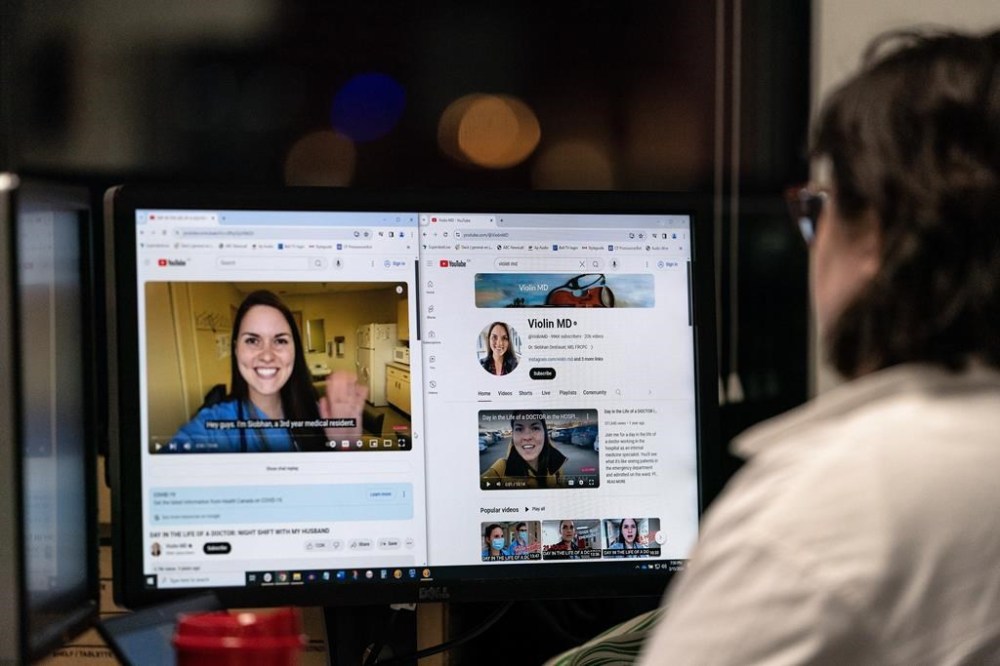
Take one of her medical mystery videos, for example. In it, Deshauer tells the story of a woman who had lead poisoning. Doctors took ages to figure out what was causing her symptoms, but ultimately realized they were a result of lead in the Ayurvedic supplements she was taking.
It’s a compelling video with a title designed to draw you in: “Deadly illness from THIS SUPPLEMENT: Medical Mystery.” The video’s thumbnail image shows Deshauer looking shocked in front of a bright blue background. Behind her, big block letters spell out “POISONED” and an arrow points to an X-ray image of someone’s lower leg.
Those are the things that hook the viewer, but for Deshauer, much of the value in the video comes from that “smuggled-in” education.
“I brought in the concept of how are supplements regulated and what should you look for when you’re buying a supplement? How do you keep yourself safe? That wasn’t the topic, that wasn’t the title of the video, but someone would walk away learning those things.”
Deshauer, who goes by the username ViolinMD online in a nod to her pre-medicine career as a violinist, said she got her start making videos when she was in school to document all she was learning.
“And with the community (of viewers) building, I got to hear their comments, their concerns, what they had seen in health care, perhaps some of their fears,” she said. “And I got the sense that a lot of fears around health care came from not being able to access it or see what happens behind closed doors.”
The algorithms that feed compelling content to users can bolster those fears, experts said. They tend to boost sensationalized misinformation and generalizations, turning social media sites into a harmful echo chamber for some users, said Timothy Caulfield, a health policy and law professor at the University of Alberta, who has in recent years become one of Canada’s loudest voices on the topic.
“It’s going to be a never-ending battle,” he said. “There’s never going to be one simple tool that’s going to fix this incredibly complex cultural, social, economic and technological challenge — but we are getting more and more good research that tells us what kinds of approaches work best.”
Caulfield said the most effective science communicators use some of the same tactics as those spreading misinformation — but back it up with accurate data instead of pseudoscience.
There are a number of people doing this well, he said. Dr. Jen Gunter, a gynecologist, has been at it for a while, first taking aim at misinformation published by Gwyneth Paltrow’s wellness website Goop, and Dr. Samir Gupta is on Instagram and TikTok debunking wellness fads and misinformation.
Caulfield said some doctors don’t think very much about how they present their content, but those who gain an audience are more mindful of that.
“Think about what your content’s going to look like,” he said. “Often the clinical community, the scientific community doesn’t do that, and the people pushing misinformation do.”
One of those techniques, he said, is through easily shareable infographics and art.
Caulfield is on the executive advisory committee for Science Up First, an initiative that aims to debunk health misinformation. They encourage independent experts to create science-backed content and the organization also creates some of its own.
Jonathan Jarry, a science communicator with McGill University’s Office for Science and Society, said another tactic involves using anecdotes.
“Share your own personal experiences if you can, because stories resonate more than tables and graphs,” he said, addressing scientists and doctors.
But those personal experiences need to be backed up by a body of evidence, he said.
It’s also best to show people the evidence, rather than simply telling them how they should feel, Jarry said.
“People don’t want to be to be told what to think. They don’t want you to be paternalistic. They want you to show them your work. Show them your research. Show them how you arrived at your conclusion,” he said. “Transparency engenders trust.”
Dr. Kathleen Ross, president of the Canadian Medical Association, said her organization has done polls that show doctors are a trusted source of health information.
“Unfortunately at this moment in Canada, many Canadians — almost seven million — don’t have access to that longitudinal primary care source to go and have these discussions with. So misinformation and uptake of misinformation is a tremendous risk and leading to bad outcomes,” she said.
“To address that, we have to to point towards trusted sources.”
This report by The Canadian Press was first published March 16, 2024.
Related Articles
Winnipeg-born physician moving back to Canada after ‘rank misogyny’ drives devolution of women’s rights
Advertisement Advertise With Us
Advertisement Advertise With Us