

A mystery illness in Congo has killed more than 50 people hours after they felt sick
Advertisement
Read this article for free:
or
Already have an account? Log in here »
To continue reading, please subscribe:
Monthly Digital Subscription
$1 per week for 24 weeks*
- Enjoy unlimited reading on winnipegfreepress.com
- Read the E-Edition, our digital replica newspaper
- Access News Break, our award-winning app
- Play interactive puzzles
*Billed as $4.00 plus GST every four weeks. After 24 weeks, price increases to the regular rate of $19.95 plus GST every four weeks. Offer available to new and qualified returning subscribers only. Cancel any time.
Monthly Digital Subscription
$4.99/week*
- Enjoy unlimited reading on winnipegfreepress.com
- Read the E-Edition, our digital replica newspaper
- Access News Break, our award-winning app
- Play interactive puzzles
*Billed as $19.95 plus GST every four weeks. Cancel any time.
To continue reading, please subscribe:
Add Free Press access to your Brandon Sun subscription for only an additional
$1 for the first 4 weeks*
*Your next subscription payment will increase by $1.00 and you will be charged $16.99 plus GST for four weeks. After four weeks, your payment will increase to $23.99 plus GST every four weeks.
Read unlimited articles for free today:
or
Already have an account? Log in here »
Hey there, time traveller!
This article was published 24/02/2025 (396 days ago), so information in it may no longer be current.
KINSHASA, Congo (AP) — An unknown illness first discovered in three children who ate a bat has rapidly killed more than 50 people in northwestern Congo over the past five weeks, health experts say.
The interval between the onset of symptoms – which include fever, vomiting and internal bleeding – and death has been 48 hours in most cases and “that’s what’s really worrying,” said Serge Ngalebato, medical director of Bikoro Hospital, a regional monitoring center.
These “hemorrhagic fever” symptoms are commonly linked to known deadly viruses, such as Ebola, dengue, Marburg and yellow fever, but researchers have ruled these out based on tests of more than a dozen samples collected so far.
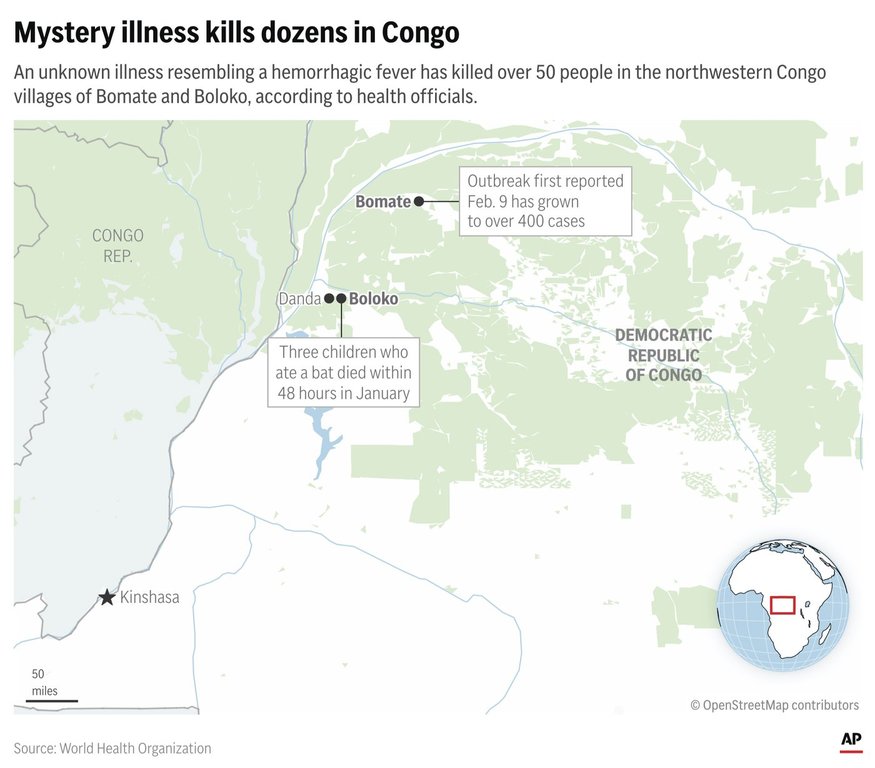
The latest disease outbreak in the Democratic Republic of Congo began on Jan. 21, with 419 cases recorded and 53 deaths.
The outbreak began in the village of Boloko after three children ate a bat and died within 48 hours, the Africa office of the World Health Organization said Monday.
There have long been concerns about diseases jumping from animals to humans in places where wild animals are popularly eaten. The number of such outbreaks in Africa has surged by more than 60% in the last decade, the WHO said in 2022.

After the second outbreak of the mystery disease began in the village of Bomate on Feb. 9, samples from 13 cases were sent to the National Institute for Biomedical Research in Congo’s capital, Kinshasa, for testing, the WHO said. All samples were negative for common hemorrhagic fever diseases, although some tested positive for malaria.
Last year, another mystery flu-like illness that killed dozens of people in another part of Congo was determined likely to be malaria.
Related Articles
What we know about the illnesses that have sickened over 400 people and killed more than 50 in Congo
Advertisement Advertise With Us
Advertisement Advertise With Us