A horse therapy program in Namibia brings joy to children with learning disabilities
Advertisement
Read this article for free:
or
Already have an account? Log in here »
To continue reading, please subscribe:

Digital Subscription
One year of digital access for only $205*
- Enjoy unlimited reading on winnipegfreepress.com
- Read the E-Edition, our digital replica newspaper
- Access News Break, our award-winning app
- Play interactive puzzles
*First annual payment billed as $205.00 + GST for one year. This annual subscription will automatically renew at $233.00 + GST every 52 weeks (10% off the regular annual price of $259.35). Offer available to new and qualified returning subscribers only. Cancel any time.
To continue reading, please subscribe:
Add Free Press access to your Brandon Sun subscription for only an additional
$1 for the first 4 weeks*
- Enjoy unlimited reading on winnipegfreepress.com
- Read the E-Edition, our digital replica newspaper
- Access News Break, our award-winning app
- Play interactive puzzles
*Your next Brandon Sun subscription payment will increase by $1.00 and you will be charged $17.95 plus GST for four weeks. After four weeks, your payment will increase to $24.95 plus GST every four weeks.
Read unlimited articles for free today:
or
Already have an account? Log in here »
Hey there, time traveller!
This article was published 20/04/2025 (529 days ago), so information in it may no longer be current.
WINDHOEK, Namibia (AP) — Susan de Meyer’s horses have different effects on different children. Hyperactive kids learn to be a little quieter around them while nonverbal children are moved to communicate and to bond with them.
De Meyer runs a program in the southern African country of Namibia that harnesses the power but also the gentleness of horses to help children with learning disabilities and conditions like ADHD and autism.
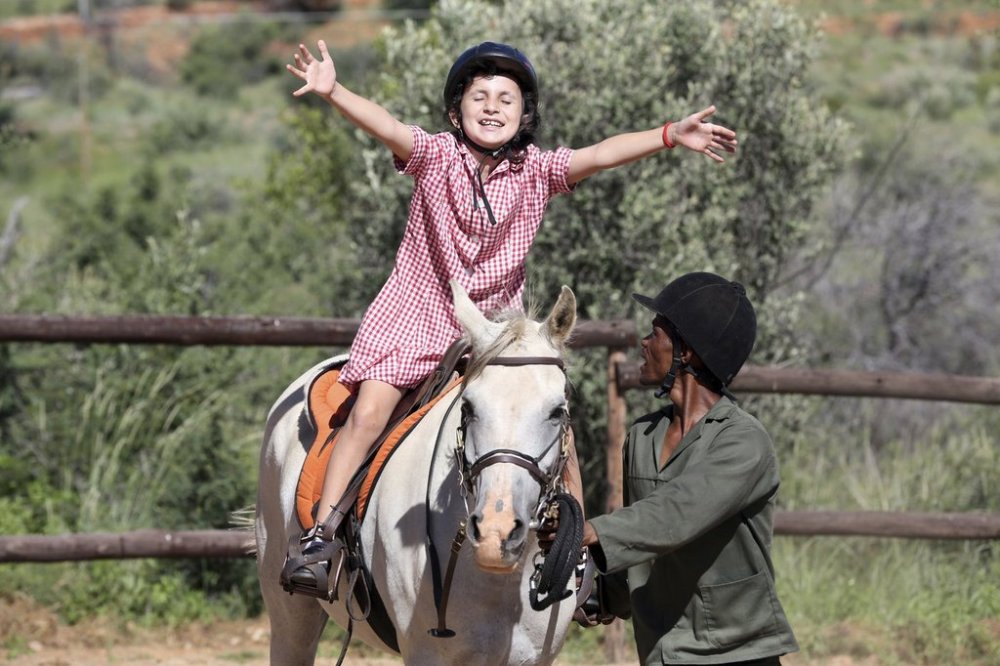
Each weekday morning, de Meyer’s dusty paddock just outside the capital, Windhoek, is enlivened by a group of eight to 10 children from one of the special schools she helps. The children ride the horses, groom them, stroke them and often, de Meyer says, talk to them.
De Meyer grew up on a farm surrounded by horses and they’ve always been part of her life. She said they have a quality that is invaluable: They don’t judge the children, no matter how different they are.
“The horse is the hero in this whole situation because these kids don’t want to be around a lot of people,” de Meyer said.
De Meyer’s program, “Enabling Through the Horse,” is supported by the Namibian Equestrian Federation and won an award last year from the International Equestrian Federation because it “underlines the wonderful characteristics of the horse in exuding sensitivity and intuition.”
Horse therapy has been promoted by autism groups and those that work with children with learning disabilities as having a positive impact. And animal therapy in general has been found to be useful in many instances, like dogs that help military veterans with post-traumatic stress disorder and therapy cats that are taken to hospitals and nursing homes.
Some survivors of the devastating 2023 Hawaii wildfires found relief in horse therapy while grieving loved ones they had lost.
De Meyer jokes she has “two-and-a-half horses.” These include two Arabians — a white mare named Faranah and a brown gelding, Lansha — while the “half” is a miniature horse called Bonzi, who is about head-high for a 5-year-old.
The Arabians are often the most useful for the children’s therapy because of their size, de Meyer said.
“It gives them self-esteem. When they stroke the horse, the therapy starts because this is a very big animal compared to their height, and they are not scared to stroke the horse … and then to ride it and tell the horse what they want,” she said.
De Meyer works with children with a range of conditions or disabilities, including autism, attention-deficit/hyperactivity disorder, Down syndrome, those who are nonverbal or touch sensitive, and some who were born with fetal alcohol syndrome and have developmental problems.
She has received interest from other countries in Africa and Asia to start similar programs there.
“The changes that I’ve seen with the learners are significant,” said Chriszell Louw, a teacher at Dagbreek School, which says it is one of just two government schools in Namibia for children with intellectual disabilities. “We have a learner that likes to talk a lot. When we come here, she knows she has to keep quiet. She sits in her place.”
“Some of them you see they are more open, they are happy. Some of them were very scared when they started with the horse riding but now they are very excited. When they hear we’re going to the horses they are very excited and just want to go by themselves,” Louw said.
De Meyer said her program helps with fine-motor skills, gross-motor skills, muscle strengthening, coordination, balance and posture, all important for kids who struggle to sit at a desk at school and learn.
One simple exercise de Meyer has children do when they ride is to let go of the reins and stretch their arms out straight and to the sides, using only their torso and lower body to balance as a groom leads the horse around the paddock.
Some of the kids break out in smiles when they let go and look like they’re soaring.

“We make the world different for these kids,” de Meyer said.
___
For more on Africa and development: https://apnews.com/hub/africa-pulse
___
The Associated Press receives financial support for global health and development coverage in Africa from the Gates Foundation. The AP is solely responsible for all content. Find AP’s standards for working with philanthropies, a list of supporters and funded coverage areas at AP.org.