Indigenous groups criticize Ecuador’s $47 billion oil expansion plan in Amazon
Advertisement
Read this article for free:
or
Already have an account? Log in here »
To continue reading, please subscribe:

Digital Subscription
One year of digital access for only $205*
- Enjoy unlimited reading on winnipegfreepress.com
- Read the E-Edition, our digital replica newspaper
- Access News Break, our award-winning app
- Play interactive puzzles
*First annual payment billed as $205.00 + GST for one year. This annual subscription will automatically renew at $233.00 + GST every 52 weeks (10% off the regular annual price of $259.35). Offer available to new and qualified returning subscribers only. Cancel any time.
To continue reading, please subscribe:
Add Free Press access to your Brandon Sun subscription for only an additional
$1 for the first 4 weeks*
- Enjoy unlimited reading on winnipegfreepress.com
- Read the E-Edition, our digital replica newspaper
- Access News Break, our award-winning app
- Play interactive puzzles
*Your next Brandon Sun subscription payment will increase by $1.00 and you will be charged $17.95 plus GST for four weeks. After four weeks, your payment will increase to $24.95 plus GST every four weeks.
Read unlimited articles for free today:
or
Already have an account? Log in here »
Hey there, time traveller!
This article was published 24/09/2025 (387 days ago), so information in it may no longer be current.
BOGOTA, Colombia (AP) — Seven Indigenous groups in Ecuador’s Amazon have denounced a government plan to offer dozens of blocks of land for oil exploration, saying it threatens their ancestral lands and violates constitutional protections.
The criticism targets a plan from the Ministry of Energy and Mines in August to auction the rights for 49 oil and gas projects worth more than $47 billion.
Officials say the “hydrocarbon roadmap” is a strategy to modernize Ecuador’s oil industry, attract foreign capital and boost production. Their plan includes contract renegotiations and new licensing rounds that the government says comply with existing legal frameworks.
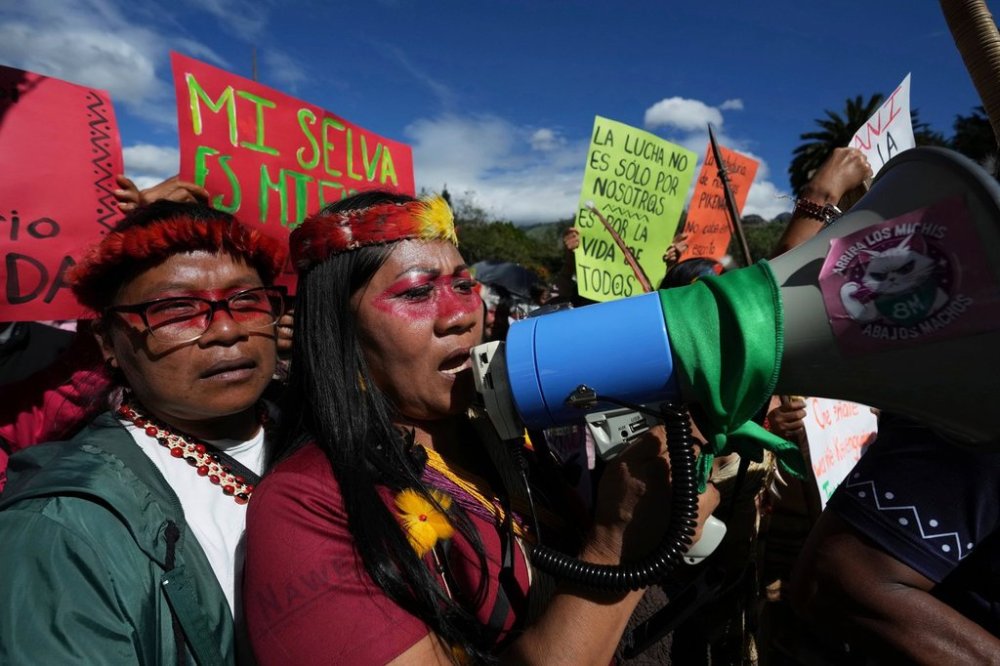
Indigenous groups say 18 of the proposed oil blocks overlap their territories — an area roughly the size of Belgium.
Leaders from the Andwa, Shuar, Achuar, Kichwa, Sapara, Shiwiar and Waorani peoples say their communities were not consulted and accuse the government of ignoring court rulings that struck down earlier consultations as unconstitutional.
“The government is pushing ahead with plans to auction 18 oil blocks in our ancestral territories without free, prior and informed consent. That is a constitutional and international right the state is violating,” said Nemo Guiquita, a Waorani leader with the Confederation of Indigenous Nationalities of the Ecuadorian Amazon.
Several recent moves by President Daniel Noboa have alarmed environmentalists and Indigenous leaders who say the country’s green reputation is unraveling.
Noboa’s administration has moved to scrap Ecuador’s independent Environment Ministry. He also supported a law passed by the National Assembly that lets private and foreign entities co-manage conservation zones that critics say weakens protections and threatens Indigenous land rights.
“There have been protests, lawsuits and companies forced to withdraw in the past, but now they are once again offering up Amazon oil fields,” Guiquita said. “We are resisting, and we call on the international community to oppose this expansion and help protect the Amazon and our rights.”
Ecuador’s Ministry of Energy and Mines did not immediately respond to questions from The Associated Press. The government has maintained that a 2012 consultation remains valid and that the hydrocarbon plan follows existing regulations.
The Noboa government has already opened new licensing rounds. In April 2025, international firms submitted bids for four oil blocks, and the government said it planned further auctions in Amazon and sub-Andean regions in late 2025 and 2026.
“The Amazon is not for sale. We will defend our territories because we have not been consulted — this is our home,” said Nadino Calapucha, a Kichwa leader.
The dispute comes amid a state of emergency and a national strike over fuel prices, extractive projects and the government’s failure to honor a referendum limiting drilling in Yasuní National Park. On Tuesday, farmers, Indigenous groups and transport unions clashed with police outside the town of Tabacundo as nationwide protests entered a second day.
“Ecuador already showed its will in the Yasuní referendum, when 59% voted to keep oil in the ground. Yet the government insists on imposing extraction, violating our rights,” Calapucha said.
Oil is Ecuador’s top export, accounting for about a third of government revenue in some years. The country produces around 480,000 barrels per day, though output has declined over the past decade. Successive governments have tried to lure foreign capital into the Amazon, but projects have often stalled amid legal battles and Indigenous resistance.

Noboa, who took office in late 2023, has staked much of his fiscal plan on boosting resource revenues to stabilize public finances. His administration is also promoting mining investment, drawing fire from Indigenous leaders who say he is ignoring constitutional guarantees of free, prior and informed consent.
“Ecuador’s plans to auction new oil blocks in the Amazon are doomed to fail,” Kevin Koenig, Amazon Watch’s director for climate, energy and extraction industry said. “Indigenous resistance, civil society mobilization, and growing international pressure will continue to expose these projects as illegitimate, unlawful, and unfinanceable.”
California’s state senate recently expressed concern over imports of Amazon crude and approved a resolution to examine the state’s role as one of the world’s top buyers, underscoring how Ecuador’s oil strategy could reverberate beyond its borders.
___
The Associated Press’ climate and environmental coverage receives financial support from multiple private foundations. AP is solely responsible for all content. Find AP’s standards for working with philanthropies, a list of supporters and funded coverage areas at AP.org.