

Hypothermia claims newborn in Gaza and more babies are at risk, doctor says
Advertisement
Read this article for free:
or
Already have an account? Log in here »
To continue reading, please subscribe:
Monthly Digital Subscription
$1 per week for 24 weeks*
- Enjoy unlimited reading on winnipegfreepress.com
- Read the E-Edition, our digital replica newspaper
- Access News Break, our award-winning app
- Play interactive puzzles
*Billed as $4.00 plus GST every four weeks. After 24 weeks, price increases to the regular rate of $19.95 plus GST every four weeks. Offer available to new and qualified returning subscribers only. Cancel any time.
Monthly Digital Subscription
$4.99/week*
- Enjoy unlimited reading on winnipegfreepress.com
- Read the E-Edition, our digital replica newspaper
- Access News Break, our award-winning app
- Play interactive puzzles
*Billed as $19.95 plus GST every four weeks. Cancel any time.
To continue reading, please subscribe:
Add Free Press access to your Brandon Sun subscription for only an additional
$1 for the first 4 weeks*
*Your next subscription payment will increase by $1.00 and you will be charged $16.99 plus GST for four weeks. After four weeks, your payment will increase to $23.99 plus GST every four weeks.
Read unlimited articles for free today:
or
Already have an account? Log in here »
KHAN YOUNIS, Gaza Strip (AP) — As December’s chill settled over Gaza, the family’s nylon tent offered little refuge. So each night, Eseid Abdeen covered his frail newborn son with four blankets, periodically shining a flashlight on the baby’s eyes to confirm he was all right.
Until Wednesday night, when 29-day-old Saeed, his tiny body wracked by the cold, did not respond.
The infant, who had been born prematurely and very underweight, became the second baby to die of hypothermia in recent days at Nasser Hospital, doctors said Thursday. They warned there could soon be others if conditions in the tent camps housing thousands of Palestinians are not improved.
“I always feared for him and tried to keep him warm. But it is very cold,” the child’s mother, Rawya Abdeen, told The Associated Press on Thursday. When doctors reported her son had died, her screams of anguish drew the neighbors. “Why him?” she cried.
Dr. Ahmed al-Farra, the director of pediatrics at Nasser, said the baby arrived at the hospital late Wednesday night with a body temperature of 30 degrees Celsius (86 Fahrenheit), well below the level where hypothermia sets in. Medics did everything they could to revive the child, but he died early Thursday, al-Farra said.
Overnight temperatures in Gaza have reached 6 degrees Celsius (43 degrees Fahrenheit) in recent days.
“We are warning that this tragedy will happen again unless there is a permanent solution for babies, and specifically premature babies, because they are more vulnerable to the dropping temperatures,” al-Farra said. “They live in worn-out tents that are exposed to winds and cold weather and lack all means to stay warm in these tents.”
The doctor said cold is a particular threat to premature babies because their fat tissues are underdeveloped and their bodies lose energy quickly.
The infant’s death raises to 13 the number of people killed in Gaza since a strong storm hit the strip last week, the health ministry said. They included 11 people killed when heavy rains collapsed already damaged buildings, as well as the two children who perished because of the cold. The first baby lost to hypothermia, two-week-old Mohamed Khair, had been born after a full-term pregnancy.
Though the current ceasefire has been in place for two months, not enough shelter materials have been allowed into Gaza, aid groups say. Recently released Israeli military figures suggest it hasn’t met the ceasefire stipulation of allowing 600 trucks of aid into Gaza a day, though Israel disputes that finding. American officials with the U.S.-led center coordinating aid shipments into Gaza also say deliveries have reached the agreed-upon levels.

The vast majority of Gaza’s 2 million people have been displaced, and most people live in tent camps stretching along the coast or set up among the shells of damaged buildings. The buildings lack adequate flooding infrastructure and people use cesspits dug near tents as toilets.
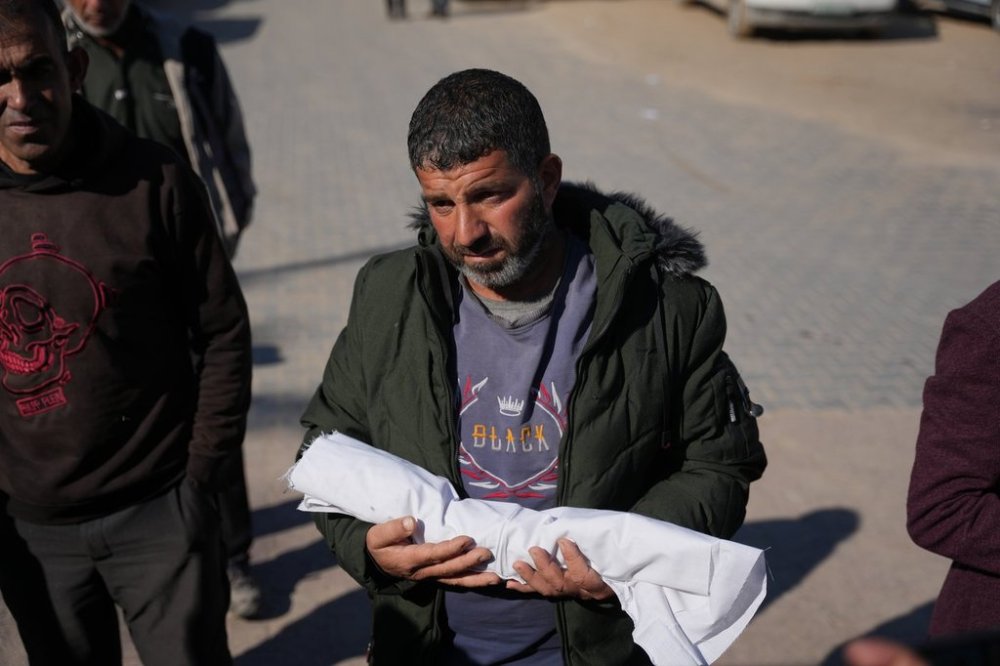
The Abdeens said their makeshift tent, in southern Gaza’s Muwasi, is regularly inundated by rainwater.
Rawya Abdeen said her son had weighed just 1.3 kilograms (2.9 pounds) at birth and spent two weeks in the neonatal intensive care unit.
When the boy’s father shone a light on him at around 10 p.m. Wednesday, the baby did not respond with his usual squint. An examination under the light revealed the child was throwing up, his mother said, and the family rushed him to the hospital. His father said he had prayed for Saeed’s survival, before doctors called in the morning to tell them the infant had perished.
“I was willing to trade my soul to save him,” Eseid Abdeen said.
Related Articles
Holy Land's top Catholic leader visits Gaza parish, greeted by children in Santa hats and keffiyeh



Advertisement Advertise With Us
Advertisement Advertise With Us