

World creeps closer to eradicating human Guinea worm cases, with just 10 last year: Carter Center
Advertisement
Read this article for free:
or
Already have an account? Log in here »
To continue reading, please subscribe:
Monthly Digital Subscription
$1 per week for 24 weeks*
- Enjoy unlimited reading on winnipegfreepress.com
- Read the E-Edition, our digital replica newspaper
- Access News Break, our award-winning app
- Play interactive puzzles
*Billed as $4.00 plus GST every four weeks. After 24 weeks, price increases to the regular rate of $19.95 plus GST every four weeks. Offer available to new and qualified returning subscribers only. Cancel any time.
Monthly Digital Subscription
$4.99/week*
- Enjoy unlimited reading on winnipegfreepress.com
- Read the E-Edition, our digital replica newspaper
- Access News Break, our award-winning app
- Play interactive puzzles
*Billed as $19.95 plus GST every four weeks. Cancel any time.
To continue reading, please subscribe:
Add Free Press access to your Brandon Sun subscription for only an additional
$1 for the first 4 weeks*
*Your next subscription payment will increase by $1.00 and you will be charged $16.99 plus GST for four weeks. After four weeks, your payment will increase to $23.99 plus GST every four weeks.
Read unlimited articles for free today:
or
Already have an account? Log in here »
ATLANTA (AP) — There were only 10 reported cases of Guinea worm infections confined to three countries in 2025, a historic low announced Friday by The Carter Center.
The new mark comes barely a year after the death of former U.S. President Jimmy Carter, who often said he hoped to outlive the Guinea worm. When the former president’s center launched an eradication program in the mid-1980s, the parasite still afflicted millions of people in developing countries.
“We think about President Carter’s legacy” and his push to get to zero cases, said Adam Weiss, director of the center’s Guinea worm eradication program, in an interview. “These might not be seen as the number one problems in the world, but they are the number one problems for people that suffer from these diseases. So we continue to charge ourselves with his mission of alleviating as much pain and suffering as we can.”
In 2025, four human cases were reported in Chad, four in Ethiopia and two in South Sudan. Animal infections still number in the hundreds, declining in some countries but up slightly overall and making it harder to predict when Guinea worm might be eradicated.
The 10 human cases mark a 33% decline from 15 cases reported in 2024. Angola, Cameroon, the Central African Republic, and Mali reported zero human cases for the second consecutive year.
Guinea worm would join smallpox as only the two human diseases to be eradicated.
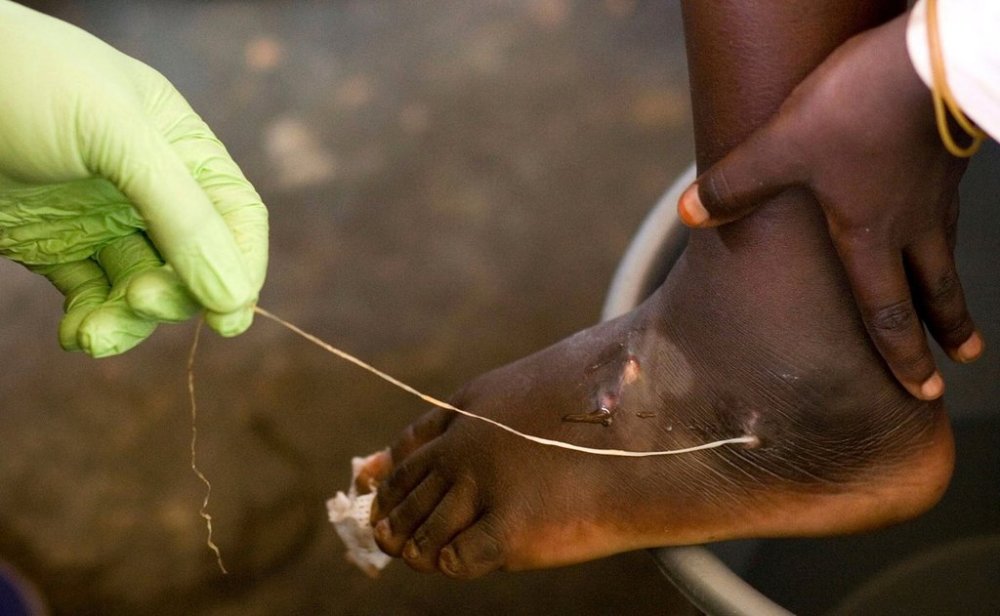
The worm is contracted by consuming water that contains larvae. It then grows inside an infected person, reaching as much as a meter long and the diameter of spaghetti. The worm then exits the person’s body through a blister, which causes intense pain.
Infections can spread when those who suffer from the condition sometimes immerse themselves in water to ease symptoms — allowing the worm to deposit larvae that can be consumed by others. The same cycle can happen through land animal infections when they come to the water source. Humans also can be infected by consuming fish or amphibious creatures that have consumed larvae.
The Carter Center’s eradication program has worked alongside government health ministries and other organizations for decades to educate the public, train volunteers and distribute water filters in affected areas.
There is no treatment for Guinea worm, though infected people can take pain medication.
Weiss said the eradication program’s next step is developing diagnostic tests, especially for animals. Testing long before an infected person or animal becomes symptomatic would allow behavioral changes to minimize or eliminate the chances of them allowing more larvae to enter a water source.
The Carter Center said Chad reported 147 animal infections in 2025, a 47% drop for what was once the global epicenter of animal infections. Cameroon reported 445, while Angola reported 70, Mali 17, South Sudan three and Ethiopia one.
Carter and his wife, Rosalynn, traveled extensively across the affected countries with Carter Center staff who worked with the World Health Organization, national health ministries and local officials to build the coordinated eradication effort.
Weiss said the President Donald Trump’s decision to leave the WHO and pull back funding and U.S. involvement from a range of international aid efforts has forced some logistical changes to the center’s work on Guinea worm and in other areas. But, Weiss said, it has not stopped the Guinea worm program at ground level.