Manitoba to screen infants for defect that causes sight, hearing problems

Advertisement

Advertise with us

Manitoba has become the third jurisdiction in Canada to implement universal newborn screening for congenital cytomegalovirus, which can lead to complications as a child grows up, including hearing loss, vision problems and developmental disabilities.

Read this article for free:


or

Already have an account? Log in here »

To continue reading, please subscribe:

Subscribe and receive a limited-edition Free Press branded hat or tote.

Digital Subscription

One year of digital access for only $205*

  • Enjoy unlimited reading on winnipegfreepress.com
  • Read the E-Edition, our digital replica newspaper
  • Access News Break, our award-winning app
  • Play interactive puzzles

*First annual payment billed as $205.00 + GST for one year. This annual subscription will automatically renew at $233.00 + GST every 52 weeks (10% off the regular annual price of $259.35). Offer available to new and qualified returning subscribers only. Cancel any time.

To continue reading, please subscribe:

Add Free Press access to your Brandon Sun subscription for only an additional

$1 for the first 4 weeks*

  • Enjoy unlimited reading on winnipegfreepress.com
  • Read the E-Edition, our digital replica newspaper
  • Access News Break, our award-winning app
  • Play interactive puzzles
Start now

*Your next Brandon Sun subscription payment will increase by $1.00 and you will be charged $17.95 plus GST for four weeks. After four weeks, your payment will increase to $24.95 plus GST every four weeks.

Manitoba has become the third jurisdiction in Canada to implement universal newborn screening for congenital cytomegalovirus, which can lead to complications as a child grows up, including hearing loss, vision problems and developmental disabilities.

Universal screening for congenital CMV began in December, with more than 1,500 newborns tested since then, said Health Minister Uzoma Asagwara Tuesday.

Congenital CMV affects around one in 200 births and is the “leading infectious cause of infant disability,” said Asagwara, noting that without universal screening, it can easily go undetected.
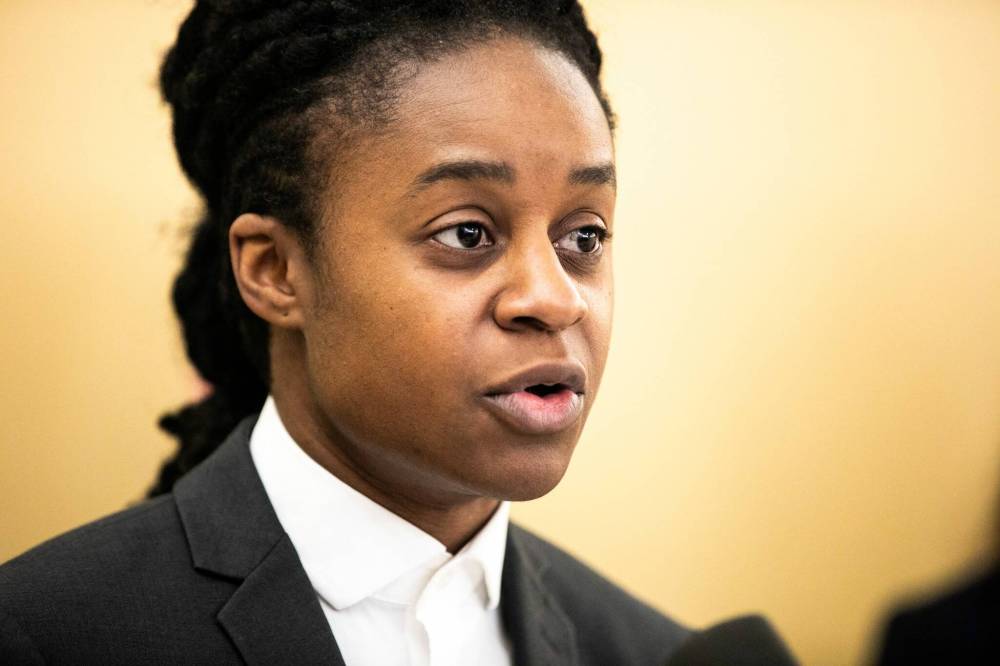
MIKAELA MACKENZIE / FREE PRESS FILES
                                Health Minister Uzoma Asagwara

MIKAELA MACKENZIE / FREE PRESS FILES

Health Minister Uzoma Asagwara

“Most babies show no symptoms at birth, which means that without screening, families may not know that something is wrong until months or even years later, when hearing loss or developmental delays begin to really show themselves. Universal screening changes that,” the minister said.

“Families are receiving answers sooner. Clinicians have critical information earlier and more opportunities to intervene at the moment when that intervention can mean all the difference,” they said.

Rob Tétrault, president and co-founder of the Canadian CMV Foundation, explained why early intervention is critical.

“You have a very tiny window, in CMV treatment, in order to provide care, in order to provide antivirals. So there’s a couple of antiviral strategies that are working, they’re remarkably effective,” he said.

“If they’re provided in the first few months of birth, typically the first month or so of birth, they could have a dramatically positive impact… the earlier the treatment, the better,” he said.

For Tétrault, who ran across Manitoba two years ago to call for universal newborn screening of CMV, the issue is personal.

Nearly 18 years ago, his son was born with CMV, though without universal screening at that time, it was somewhat of a fluke that the positive result was caught.

Tétrault’s wife had surpassed her due date by about 10 days and additional testing as a result had revealed CMV. Their son became one of the first children in Winnipeg to be treated for CMV.

As of December, the test has been incorporated into the province’s newborn screening program, which uses a small blood sample from a heel prick to screen for several dozen rare disorders, a release from the province said, with testing being done at the Cadham Provincial Laboratory.

“(It’s) a few drops of blood that are taken from the baby and that’s it. So, there’s absolutely no risk (to testing),” Tétrault said.

Ontario and Saskatchewan were the first provinces to implement universal newborn screening for CMV.

marsha.mcleod@freepress.mb.ca

Marsha McLeod

Marsha McLeod
Investigative reporter

Marsha is an investigative reporter. She joined the Free Press in 2023.

Our newsroom depends on a growing audience of readers to power our journalism. If you are not a paid reader, please consider becoming a subscriber.

Our newsroom depends on its audience of readers to power our journalism. Thank you for your support.

Report Error Submit a Tip

More Stories

Chrysler refines Pacifica and Grand Caravan as buyers return to practical family hauler

Kelly Taylor 5 minute read Preview

Chrysler refines Pacifica and Grand Caravan as buyers return to practical family hauler

Kelly Taylor 5 minute read Yesterday at 3:00 AM CDT

BURLINGTON, Ont. — The mighty minivan — relegated to the scrap heap by the rush to crossovers and SUVs — is making a comeback, and Chrysler hopes to lead the way with its top-selling, Canadian-made Grand Caravan and Pacifica models.

While many manufacturers — Mazda, Ford, GM, Hyundai and Nissan — abandoned the once-popular family hauler, Chrysler has continued to play in the segment since it was launched by Lee Iacocca in 1983.

For 2027, the Pacifica gets a cosmetic refresh and the Grand Caravan is a holdover, but new this year are price savings of up to $7,200, Chrysler product planner Mike Szymkiewicz told journalists assembled here for the launch of the two vehicles.

“It’s primarily that we’re taking less margin, but we’re also adding content,” he said. “So less margin but we hope more volume.”

Read
Yesterday at 3:00 AM CDT

Watching while we work

Tory McNally 7 minute read Preview

Watching while we work

Tory McNally 7 minute read 2:01 AM CDT

For many employees, the idea that their employer might be tracking how long they spend at their keyboard, how often they move their mouse, or whether they are actively working throughout the day feels unsettling. For many employers, however, workplace surveillance is increasingly viewed as another management tool, particularly as hybrid and remote work become more common. The recent news that TD plans to monitor certain employees’ activity during the workday has reignited a conversation that has been quietly growing for several years: where is the line between legitimate oversight and excessive monitoring?

The reality is that workplace surveillance is nothing new. Employers have long monitored attendance, reviewed security camera footage, tracked company vehicles using GPS, audited expense reports, and reviewed internet usage on company-owned devices. What has changed is the sophistication of the technology. Today’s software can record login times, monitor application usage, track keystrokes, capture screenshots, analyze email activity, and even generate reports ranking employees based on their perceived productivity.

This naturally raises an important question. Does increased surveillance actually make people work harder?

The answer is not nearly as straightforward as many organizations hope.

Read
2:01 AM CDT

The view from here: Phyllis Green. Boob Tree, 1975

2 minute read Preview

The view from here: Phyllis Green. Boob Tree, 1975

2 minute read 2:01 AM CDT

Staycation: The Art of Being Here feautres more than 100 Manitoba-related artworks from the Winnipeg Art Gallery-Qaumajuq collection, spanning the past 50 years. These pieces reveal how the places around us are layered with memory, story and lived experience. Over the coming weeks, the Free Press will spotlight works from this eclectic exhibition, each one offering a new way of seeing home. Experience it in person and enjoy some staycation time at the gallery, on view until December.

Phyllis Green. Boob Tree, 1975

(Yarn, wood. Collection of the Winnipeg Art Gallery; Acquired with funds from the Estate of Mr. and Mrs. Bernard Naylor, funds administered by The Winnipeg Foundation, 2014-128. Photo: Ernest Mayer.)

The year 1975 was designated International Women’s Year by the United Nations, and in celebration, the WAG staged the show Images of Women, which explored how women had historically been depicted, an impressive selection but by mostly male artists. Amid pushback from the community, Sharron Zenith Corne and Marian Yeo organized a second exhibition, Woman as Viewer, which challenged those portrayals by only featuring works by women. It was called the first Canadian exhibition of feminist art. American artist Phyllis Green’s Boob Tree, a four-foot-tall crochet sculpture of a cluster of breasts, adorned the exhibit posters, which were so popular they were snatched by passersby! The sculpture is playful and unsettling, re-appropriating the objectification of women’s bodies.

Read
2:01 AM CDT

Venezuela: unfinished business for the U.S.

Gwynne Dyer 5 minute read 2:01 AM CDT

Experienced imperialists understand that you can’t just take over a country and expect it to run itself. It takes time and work to turn it into an obedient and profitable colony and two months is not enough. Donald Trump moved on to his next target too soon and given how Iran’s been working out for him, he probably hasn’t thought of Venezuela in months.

U.S. Secretary of State Marco Rubio, who acts as Trump’s viceroy for Venezuela, hasn’t been there since the U.S. kidnapped President Nicolás Maduro and his wife in January. (In fact, he may never have been there at all — I can find no evidence of it.) But he does think about Venezuela. In fact, he controls the country very tightly from his Washington office.

He and Trump’s choice for interim president, Delcy Rodríguez, talk online every day, we are told. (She was the vice-president under Maduro, so she was the obvious choice if Trump wanted a local collaborator with supporters in the army and the secret police.) Rubio collects the government’s income and he tells her what she can spend her share on.

It’s an awkward arrangement, because the cabinet is still the core Chavista leaders, minus only Maduro himself. Trump thinks Rodríguez is a “terrific person” and doesn’t worry about elections: Venezuelans “wouldn’t even know how to have an election right now.” But Rubio understands that they really do expect an election to be part of the “transition.”

Kinder, gentler drug crackdown finds support, tempered expectations in Main Street area

Chris Kitching 9 minute read Preview

Kinder, gentler drug crackdown finds support, tempered expectations in Main Street area

Chris Kitching 9 minute read Yesterday at 7:11 PM CDT

Drawing a lighter from his pocket, a shirtless man perched on a concrete wall outside United Way Winnipeg’s Main Street headquarters heats a substance in a glass pipe and moves the tube toward his mouth.

Read
Yesterday at 7:11 PM CDT

City puts Osborne Village lot up for sale third time

Joyanne Pursaga 5 minute read Preview

City puts Osborne Village lot up for sale third time

Joyanne Pursaga 5 minute read Thursday, Aug. 6, 2026

The city is making a third attempt to sell a seemingly prime Osborne Street property, after an offer for the surface parking lot fell through earlier this year.

The 772-square-metre space at 145 Osborne St., which formerly operated as an official paid city parking lot, has been posted for sale once again.

It may puzzle some Winnipeggers to see the site in the heart of Osborne Village remain empty so long after the city declared it surplus in 2020.

However, a few different challenges may limit its appeal to potential buyers, alocal real estate agent said.

Read
Thursday, Aug. 6, 2026