Pennsylvania court overturns limits on Medicaid coverage for abortions

Advertisement

Advertise with us

A Pennsylvania court on Monday said that the state's constitution guarantees a right to abortion while striking down a decades-long law banning the use of state Medicaid funds to cover abortion costs.

Read this article for free:


or

Already have an account? Log in here »

To continue reading, please subscribe:

Subscribe and receive a limited-edition Free Press branded hat or tote.

Digital Subscription

One year of digital access for only $205*

  • Enjoy unlimited reading on winnipegfreepress.com
  • Read the E-Edition, our digital replica newspaper
  • Access News Break, our award-winning app
  • Play interactive puzzles

*First annual payment billed as $205.00 + GST for one year. This annual subscription will automatically renew at $233.00 + GST every 52 weeks (10% off the regular annual price of $259.35). Offer available to new and qualified returning subscribers only. Cancel any time.

To continue reading, please subscribe:

Add Free Press access to your Brandon Sun subscription for only an additional

$1 for the first 4 weeks*

  • Enjoy unlimited reading on winnipegfreepress.com
  • Read the E-Edition, our digital replica newspaper
  • Access News Break, our award-winning app
  • Play interactive puzzles
Start now

*Your next Brandon Sun subscription payment will increase by $1.00 and you will be charged $17.95 plus GST for four weeks. After four weeks, your payment will increase to $24.95 plus GST every four weeks.

A Pennsylvania court on Monday said that the state’s constitution guarantees a right to abortion while striking down a decades-long law banning the use of state Medicaid funds to cover abortion costs.

The ruling by a divided seven-judge panel of the appellate-level Commonwealth Court is a major victory for Planned Parenthood and abortion clinic operators who first sued Pennsylvania over its Medicaid funding restrictions in 2019.

While the case initially centered over state Medicaid limitations, the stakes significantly expanded after the U.S. Supreme Court in 2022 ended nearly a half-century of federal abortion protections by overturning Roe v. Wade.
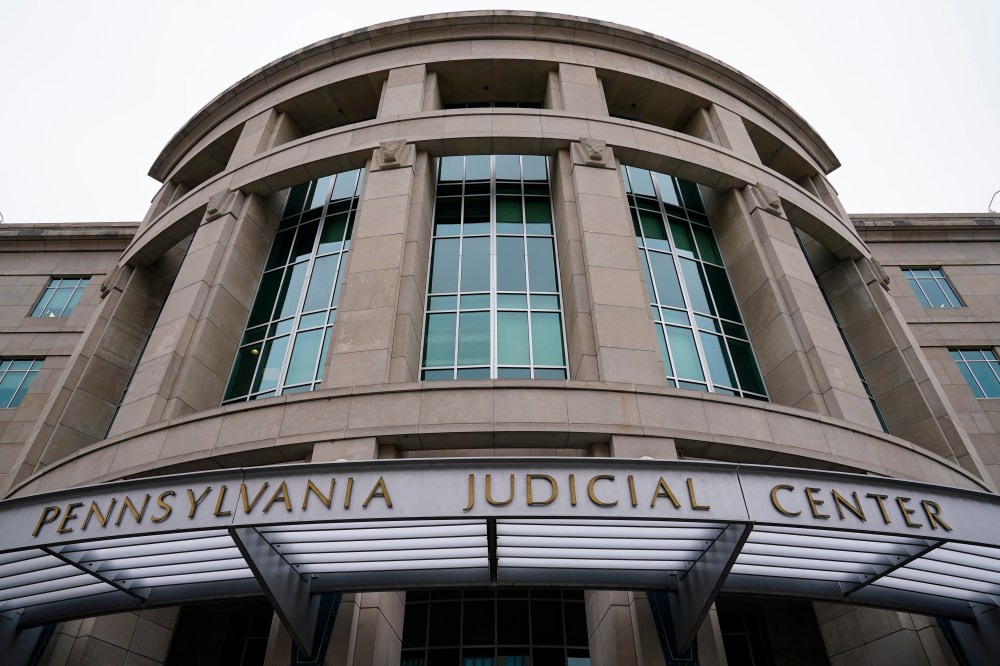
FILE - The Pennsylvania Judicial Center, home to the Commonwealth Court, is seen Feb. 21, 2023, in Harrisburg, Pa. (AP Photo/Matt Rourke, File)

The court’s finding on Monday marks the first time that the right to an abortion is protected by the Pennsylvania constitution, joining a handful of states where reproductive rights advocates have found success in protecting abortion access by pointing to state constitutions.

The case could still be appealed to Pennsylvania’s Supreme Court.

“Today, our Commonwealth Court, looking at the Pennsylvania constitution, held that there is a right to reproductive autonomy, and it’s the highest possible level of a right,” said Susan Frietsche, executive director of the Women’s Law Project, which helped represent the clinics.

A spokesperson for Attorney General David Sunday, a Republican, said the office was reviewing the decision and did not say whether it would appeal.

Democrats roundly praised the decision, as did abortion rights advocates.

“I’ve long opposed this unconstitutional ban, and as Governor, I did not defend it — because a woman’s ability to access reproductive care should never be determined by her income,” Gov. Josh Shapiro said in a statement.

The likely Republican nominee to challenge Shapiro in the fall general election, state Treasurer Stacy Garrity, said in a statement that the court’s decision “to force our tax dollars to pay for abortions is not only misguided, it is immoral.”

In 2019, plaintiffs asked the court to order the state’s Medicaid program to begin covering abortions, without restriction, arguing that a 1982 Pennsylvania law restricting state Medicaid funding violated the constitutional equal protection rights of low-income women.

The case has since taken several turns, with a lower-court ruling in 2021 that the plaintiffs did not have standing and also saying that they were bound by a state Supreme Court 1985 decision upholding the 1982 law.

However, in 2024, the state Supreme Court overturned the lower court’s ruling and also determined that previous court decisions did not fully consider the breadth of state constitutional protections against discrimination beyond those provided by the federal constitution.

The seven judges on the lower court who heard the case largely sided with the plaintiffs on Monday. The majority opinion said the state should invest in maternal and infant health care and other resources if it believes that women should carry a pregnancy to term.

The attorney general’s office had argued that the state had an interest in “protecting fetal life” and that the Medicaid coverage exclusion helped support that goal.

“If the state believes certain medical procedures may psychologically harm women, the state can license, regulate, and educate around such care. That is less intrusive than taking an entire medical procedure off the table categorically for some women, some of whom may benefit from that procedure — a fact the Attorney General does not dispute,” the majority opinion said.

Abortion opponents quickly criticized Monday’s decision.

“By declaring a sweeping constitutional ‘right to reproductive autonomy’ and mandating taxpayer-funded abortion through Medicaid, the court has overstepped its authority, ignored the plain text of our state constitution, and forced millions of Pennsylvanians who believe life begins at conception to subsidize the killing of unborn children,” said Michael Geer, president of Pennsylvania Family Institute, which opposes abortion rights.

In Pennsylvania, abortion is legal under state law through 23 weeks of pregnancy.

Report Error Submit a Tip

More Stories

Nurses disciplined for botched IV infusion

Nicole Buffie 3 minute read Preview

Nurses disciplined for botched IV infusion

Nicole Buffie 3 minute read Thursday, Oct. 8, 2026

Two nurses working at the Grace Hospital have been reprimanded and fined $2,500 each for an IV infusion gone bad and an attempted coverup.

The incident happened on November 23, 2023 when a nurse asked a colleague to set up an IV infusion on him in an unused operating room.

During the attempted IV start, the nurse lost consciousness. The nurse who attempted the IV drip and another who was in the room called for help and several staff responded.

The nurse regained consciousness and vomited, but recovered and continued to work his shift, a March 18 decision by the College of Registered Nurses of Manitoba says.

Read
Thursday, Oct. 8, 2026

Crime spree lands accused murderers behind bars

Dean Pritchard 4 minute read Preview

Crime spree lands accused murderers behind bars

Dean Pritchard 4 minute read Yesterday at 6:00 AM CDT

Three men have been sentenced to jail terms for a commercial robbery spree in southern Manitoba launched just two weeks after they are accused of killing a 19-year-old man in Abbotsford, B.C.

Twenty-two-year-old Ravdeep Gill of Winnipeg, pleaded guilty Monday to four counts of robbery and Harmandeep Gill, 27, of Brampton, Ont. and Jaskaran Singh, 21, of Surrey, B.C., each pleaded guilty to two counts of robbery for a 10-day crime blitz that targeted gas bars in Swan Lake, Teulon and St. Laurent, and a meat shop in Winnipeg.

Ravdeep Gill was sentenced to four years custody while Harmandeep Gill and Singh each received sentences of 30 months.

According to B.C. media reports, all three men are charged with first-degree murder in a Feb. 1, 2025 killing in Abbotsford that police there described as a targeted hit.

Read
Yesterday at 6:00 AM CDT

Is this the season of secession?

David McLaughlin 5 minute read Preview

Is this the season of secession?

David McLaughlin 5 minute read 2:01 AM CDT

Canada has entered its season of secession. Like El Nino, the currents of grievance can blow hot and cold. Today, they are hot. But how hot for how long? The odds of Alberta and now Quebec separating from Canada are not high, but they are never zero.

After a year of waving the flag in a surge of national patriotism to confront Donald Trump’s attacks on Canada — economic and verbal — it is both jarring and frustrating for most Canadians to be reminded of the pervasive and persistent tensions that come with governing our federation.

When we need new national purpose to confront big economic sovereignty and security challenges from outside, that purpose is undermined and diminished by having to confront homegrown grievances.

We’ve seen and seen off two separation referendums in Quebec. Now we have a newly elected separatist party coming to power. In Alberta, voters will soon decide whether the independence road is one they want to travel.

Read
2:01 AM CDT

Nature doesn’t waste its time

Russell Wangersky 7 minute read Preview

Nature doesn’t waste its time

Russell Wangersky 7 minute read 2:01 AM CDT

Sixteen months in and the black burn from a forest fire somehow transitions from the foreground to the background. I’m not sure if it actually softens, if it really changes, or if is just that your eyes, now used to the background, start seeing less of it.

One thing’s for certain: nature doesn’t waste any time taking its opportunities. In the sheltered ground behind where the shed over our Newfoundland root cellar used to be, a forest of sorrel has arisen, its dark-green leaves with their distinctive double horns at their base crowding in tight amongst each other.

It’s no surprise: sorrel is new beginnings, often the first plant I see recultivating abandoned gardens or disturbed ground and I’m happy to have it around always. Its distinctive lemony bite is a fine addition to salads, though we’re not likely to choose it from that particular root cellar patch. Not with the way the asphalt roof shingles burned right around there. I shovelled up the heavy pats of congealed black tar last spring, right after the fire, bringing them up from inside the cellar in big plastic buckets to send to safe disposal. But there’s probably plenty of tar still in the ground and out of sight — hardly an appetizing thought.

From other areas, maybe we will eventually sample sorrel: it depends on how close they were to the house or shed or anything else that burned. And so very much burned. The province has said gardens are safe from contamination by fire-retardant chemicals as nothing has shown up in tests. But we know what way the wind was blowing — what burned, and where, is always part of the equation. It’s a strange calculation to make: I’m just glad our house wasn’t heated with fuel oil, was too old to contain asbestos, and didn’t have indoor plumbing for decades.

Read
2:01 AM CDT

Landlords will face fines for breaching confidentiality

Carol Sanders 4 minute read Preview

Landlords will face fines for breaching confidentiality

Carol Sanders 4 minute read Yesterday at 5:04 PM CDT

The province is amending legislation to allow landlords to be penalized if they breach the confidentiality of tenants who break their lease by obtaining a domestic violence certificate.

“Hopefully, now there’s going to be measures in place so that if this happens again, and God forbid it happens again to anyone else, that there would be penalties imposed on landlords who do that,” said one victim whose concerns were published on the front page of the Free Press last month.

Under current legislation, landlords must ensure that any information received from those tenants regarding the termination of the tenancy is kept confidential, but there are no penalties for landlords who violate that section of the act. After hearing from victims put at risk when landlords broke the law by violating their confidentiality, the government announced Monday that it is amending the Residential Tenancies Act to allow for penalties.

The young woman who spoke to the Free Press showed that her landlord copied her alleged abuser in email correspondence that included her personal email address and the domestic violence certificate she obtained in 2025 to end a tenancy agreement early and leave an abusive relationship.

Read
Yesterday at 5:04 PM CDT

Phoneless concert a beautiful chance to bask in moment

Jen Zoratti 5 minute read Preview

Phoneless concert a beautiful chance to bask in moment

Jen Zoratti 5 minute read 2:01 AM CDT

Outside the Scotiabank Arena in Toronto, digital billboards flashed fans their singular photo op for the night: “I took this photo before I saw Phoebe Bridgers: The Lost Tour 2026.”

It is, as it is for so many other people, my only documentation of a concert by one of my favourite artists. The American singer-songwriter — who I discovered at the Winnipeg Folk Festival in 2018 — has had a meteoric rise in the past few years, winning three Grammys in 2024 as one third of Boygenius, the indie-rock supergroup rounded out by Lucy Dacus and Julien Baker, and opening for Taylor Swift on select dates of her titanic Eras Tour.

Now, Bridgers is touring in support of Lost Weekend, her third album and first since 2020’s Punisher. It’s a feat of a record, a richly textured meditation on loss and grief, written in the aftermath of the death of her dad, with whom she had a complicated relationship.

So she is in a position to not only play multiple sold-out arena shows, but also insist that those shows be phone-free.

Read
2:01 AM CDT