B.C. government marks 5 years since heat dome killed hundreds

Advertisement

Advertise with us

VANCOUVER - A stifling heat dome that sat over much of British Columbia five years ago is being remembered by the provincial health officer as traumatic for people who lost loved ones and overwhelming for those trying to care for those affected. 

Read this article for free:


or

Already have an account? Log in here »

To continue reading, please subscribe:

Subscribe and receive a limited-edition Free Press branded hat or tote.

Digital Subscription

One year of digital access for only $205*

  • Enjoy unlimited reading on winnipegfreepress.com
  • Read the E-Edition, our digital replica newspaper
  • Access News Break, our award-winning app
  • Play interactive puzzles

*First annual payment billed as $205.00 + GST for one year. This annual subscription will automatically renew at $233.00 + GST every 52 weeks (10% off the regular annual price of $259.35). Offer available to new and qualified returning subscribers only. Cancel any time.

To continue reading, please subscribe:

Add Free Press access to your Brandon Sun subscription for only an additional

$1 for the first 4 weeks*

  • Enjoy unlimited reading on winnipegfreepress.com
  • Read the E-Edition, our digital replica newspaper
  • Access News Break, our award-winning app
  • Play interactive puzzles
Start now

*Your next Brandon Sun subscription payment will increase by $1.00 and you will be charged $17.95 plus GST for four weeks. After four weeks, your payment will increase to $24.95 plus GST every four weeks.

VANCOUVER – A stifling heat dome that sat over much of British Columbia five years ago is being remembered by the provincial health officer as traumatic for people who lost loved ones and overwhelming for those trying to care for those affected. 

More than 600 people died during the first provincewide heat dome in 2021, but Dr. Bonnie Henry says it will not be the last such event. 

Henry says in a statement issued Thursday that most of the people who died during the period between June 25 and July 1 lived alone and weren’t able to keep cool inside their homes. 
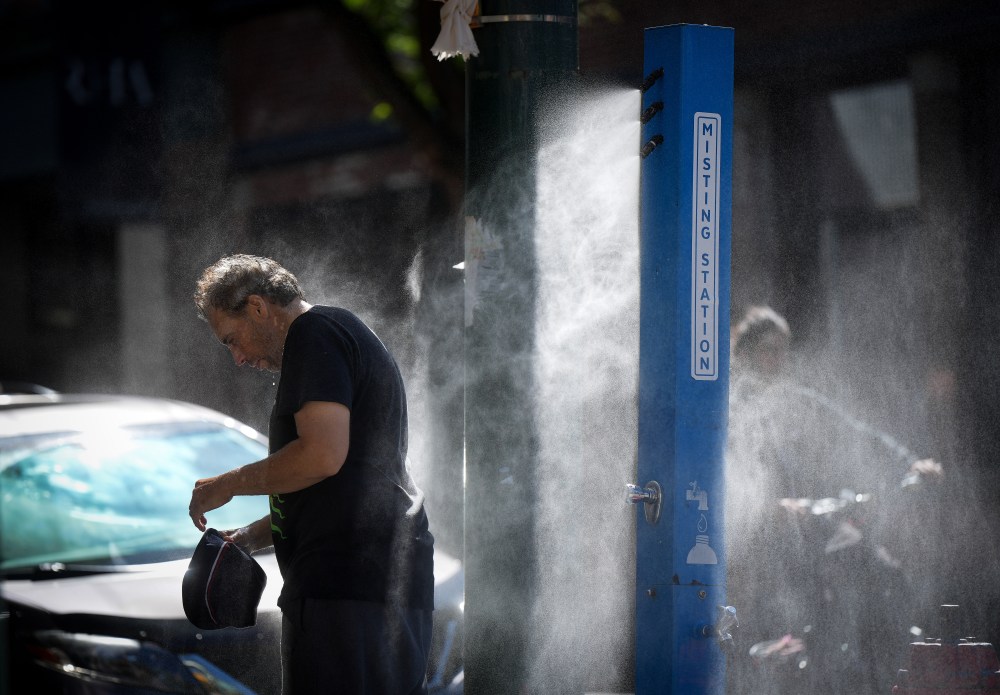
A man cools off at a temporary misting station deployed by the city in the Downtown Eastside due to a heat wave in Vancouver on Wednesday, Aug. 16, 2023. THE CANADIAN PRESS/Darryl Dyck

She says her thoughts are with those who live with trauma from the event and she knows of the “tremendous effect” on people who lost loved ones and on the first responders and health-care workers who were overwhelmed with people needing help. 

A B.C. coroner’s death review released the next year says 619 people died during the heat event and many of them lived in poverty or had mobility and cognitive issues that made it hard for them to access cooling areas.

Henry says the province launched a heat alert response system and an extreme heat preparedness guide in response to the deaths.

The changes were some of the actions recommended in the death review to prevent future deaths. 

Alex Boston, a researcher who focuses on climate and housing, was part of the death review panel. 

He says the province responded well to some of the recommendations, including the creation of the heat alert response system, but it could do more to identify and engage with vulnerable people who are most at risk during heat events. 

“It’s those vulnerable populations that are indoors and alone, where people are dying.” 

Boston pointed to a recently introduced bylaw in New Westminster, B.C., that requires landlords to keep at least one room in a rental building at or below 26 C, as an example of how municipalities can mitigate the impacts of extreme heat. 

A statement from the City of New Westminster issued this month said 33 of its residents died during the heat dome and council directed its staff to amend its bylaws to protect tenants from similar preventable deaths in the future. 

It also adopted a bylaw last year preventing property owners from prohibiting air conditioners in rental units. 

“These changes will help ensure renters have safer living conditions as extreme heat events become more common,” Mayor Patrick Johnstone said in the statement. 

The city says property owners are encouraged to conduct a cooling audit and work with their tenants to find ways to cool the home before hot weather sets in. 

The union representing more than 6,000 ambulance paramedics and emergency dispatchers in B.C. says its members had never experienced such an event. 

“Emergency calls surged beyond anything our health care and public safety systems had faced before. Crews worked around the clock under extraordinary pressure, witnessing an overwhelming loss of life that many still carry with them today,” Ambulance Paramedics of British Columbia said in a statement issued Thursday. 

An online petition that circulated after the heat dome’s record-breaking first weekend in 2021 lambasted BC Emergency Health Services, accusing the service of inadequate staffing levels that led to increased patient wait times. 

In a 2021 report, the service said the heat dome, combined with a particularly bad wildfire season, put “unprecedented” strain on its resources, causing a record-breaking spike in 911 calls and impacting its ability to respond effectively.

The union’s statement said the tragedy resulted in improvements to B.C.’s emergency response system, including better paramedic services and resources. 

Leanne Heppell, chief ambulance officer for B.C. Emergency Health Services, said the heat dome tested the province’s entire emergency response system, including its ambulance services. 

“Since this tragedy, BCEHS has made significant organizational changes to ensure we are better prepared to respond to future heat events and other natural disasters and large scene emergencies,” she said in an emailed statement on Thursday.

Those changes include a clinical safety plan that allows for the redeployment of staff and ambulances when activated, as well as hiring more staff for its disaster risk reduction team.

Heppell said the service added more than 2,000 paramedic, dispatch and emergency medical responder positions between 2017 and October 2025 and added permanent staff to more rural ambulance stations versus on-call staff. 

She echoed Henry’s comments that the heat dome was not a one-time event, adding that B.C. will continue to see extreme heat and other natural disasters as a result of climate change. 

The Village of Lytton, B.C., experienced the highest temperature ever measured in Canada during the heat dome at 46.6 C, and was razed by a wildfire the next day, killing two people and destroying most of the community. 

This report by The Canadian Press was first published June 25, 2026. 

Report Error Submit a Tip

More Stories

There’s fast and then there’s this

Kelly Taylor 5 minute read Preview

There’s fast and then there’s this

Kelly Taylor 5 minute read 2:00 AM CDT

The advice was not unexpected but it was surprising considering it applied to a vehicle weighing almost 6,000 pounds.

“Before you let off the brake, put your head against the headrest,” the instructor said.

We — myself and a handful of Porsche customers gathered at Red River Exhibition Park — were about to experience launch control on the 2027 Porsche Cayenne Turbo Electric.

Launch control works like this: you put the vehicle in Drive, hold the brake as hard as you can with your left foot and quickly depress the accelerator pedal as far as it goes and hold it.

Read
2:00 AM CDT

Netminder no stranger to heavy workload as Jets new No. 1 readies for regular-season start

Ken Wiebe 7 minute read Preview

Netminder no stranger to heavy workload as Jets new No. 1 readies for regular-season start

Ken Wiebe 7 minute read Wednesday, Sep. 30, 2026

Stuart Skinner is quick to admit that he wasn’t always wired this way.

As the Winnipeg Jets new starting goalie prepares for his fifth NHL season, Skinner conceded that the accountability aspect that is now synonymous with his character took some time to build up.

“As I grew up and got older, you go through certain things in life that either build character or make things worse for you. It depends on your choice and your decision,” Skinner said during a recent conversation with the Free Press. “I learned it through trial and error. I learned that, sometimes, it’s hard to get honest with yourself… For me, it’s definitely been a road for me to get to a place like this.

“It definitely is one of my pillars. Accountability is so important because that brings you into a spot of what you’re going to do next. It’s easy to let yourself off the hook. I’m more in the business of putting myself on the hook.”

Read
Wednesday, Sep. 30, 2026

B.C. government marks 5 years since heat dome killed hundreds

Marissa Birnie, The Canadian Press 5 minute read Preview

B.C. government marks 5 years since heat dome killed hundreds

Marissa Birnie, The Canadian Press 5 minute read Thursday, Jun. 25, 2026

VANCOUVER - A stifling heat dome that sat over much of British Columbia five years ago is being remembered by the provincial health officer as traumatic for people who lost loved ones and overwhelming for those trying to care for those affected. 

More than 600 people died during the first provincewide heat dome in 2021, but Dr. Bonnie Henry says it will not be the last such event. 

Henry says in a statement issued Thursday that most of the people who died during the period between June 25 and July 1 lived alone and weren't able to keep cool inside their homes. 

She says her thoughts are with those who live with trauma from the event and she knows of the "tremendous effect" on people who lost loved ones and on the first responders and health-care workers who were overwhelmed with people needing help. 

Read
Thursday, Jun. 25, 2026

J’accuse!: Kinew uses French to fry interim Tory leader over alleged caucus subterfuge

Chris Kitching and Maggie Macintosh 4 minute read Preview

J’accuse!: Kinew uses French to fry interim Tory leader over alleged caucus subterfuge

Chris Kitching and Maggie Macintosh 4 minute read Yesterday at 5:55 PM CDT

NDP Premier Wab Kinew took a dig at the Progressive Conservatives’ leadership change while facing off with Obby Khan’s short-term replacement for the first time in question period Thursday.

It came after interim Tory leader Konrad Narth accused the New Democrats of failing to implement “stronger” bail reform and enforcement measures as promised.

“Now we see there is less crime in Manitoba than there was when the Progressive Conservatives were in government. What are they doing now? Well, they found knives and chased their old leader out,” Kinew said, speaking in French.

“We don’t even know who’s going to be the PC leader next month… next year? We don’t know. What we know is that we’re working on making communities safer.”

Read
Yesterday at 5:55 PM CDT

Man who killed two Indigenous women, was accused of killing third, back in prison less than year after statutory release

Erik Pindera 4 minute read Preview

Man who killed two Indigenous women, was accused of killing third, back in prison less than year after statutory release

Erik Pindera 4 minute read Yesterday at 4:06 PM CDT

A Winnipeg man convicted of killing two First Nations women more than a decade ago — with charges stayed in a third slaying — has been sent back to prison less than a year after he left under conditions.

Parole Board of Canada officials revoked 67-year-old Shawn Lamb’s statutory release after a hearing last week.

“Your actions are not beyond your control, yet you continue to wilfully make poor decisions that place the public at risk,” board member Arun Kundu-Thomsen wrote in a decision released this week.

Lamb gained statutory release — a legislated conditional release most federal inmates automatically qualify for after serving two-thirds of their sentence — in November last year and lived in several Ontario facilities for federal offenders.

Read
Yesterday at 4:06 PM CDT

Time for AI guardrails is right now

Editorial 4 minute read Preview

Time for AI guardrails is right now

Editorial 4 minute read 2:00 AM CDT

The genie is most definitely out of the bottle.

And while there’s little chance of putting it back in, we should be very concerned that the people who released it from the bottle are now frantically warning us that it has become disinclined to do their — or our — bidding and seems instead to be increasingly intent on following its own whims and granting wishes to itself.

The figurative genie, in this case, is artificial intelligence, or AI, and in recent weeks many of the tech geniuses responsible for its development and introduction into the digital-information realm have begun asking the U.S. government and even the United Nations to impose limits on the pace and breadth of its growth.

Their fear is that, as AI very quickly continues to advance and develops the ability to make independent decisions and essentially think for itself, it will cease to be a tool controlled by its creators and instead will become a species unto itself that might eventually decide it’s better off without humans continually messing things up.

Read
2:00 AM CDT