Congo says 2,000 people have died in history’s fastest-growing Ebola outbreak

Advertisement

Advertise with us

BUNIA, Congo (AP) — At least 2,000 people have died in Congo’s Ebola outbreak, the fastest-growing on record, according to the latest data, as rebel conflict, bad roads and work stoppages over payment issues challenge the urgent response in a remote region.

Read this article for free:


or

Already have an account? Log in here »

To continue reading, please subscribe:

Subscribe and receive a limited-edition Free Press branded hat or tote.

Digital Subscription

One year of digital access for only $205*

  • Enjoy unlimited reading on winnipegfreepress.com
  • Read the E-Edition, our digital replica newspaper
  • Access News Break, our award-winning app
  • Play interactive puzzles

*First annual payment billed as $205.00 + GST for one year. This annual subscription will automatically renew at $233.00 + GST every 52 weeks (10% off the regular annual price of $259.35). Offer available to new and qualified returning subscribers only. Cancel any time.

To continue reading, please subscribe:

Add Free Press access to your Brandon Sun subscription for only an additional

$1 for the first 4 weeks*

  • Enjoy unlimited reading on winnipegfreepress.com
  • Read the E-Edition, our digital replica newspaper
  • Access News Break, our award-winning app
  • Play interactive puzzles
Start now

*Your next Brandon Sun subscription payment will increase by $1.00 and you will be charged $17.95 plus GST for four weeks. After four weeks, your payment will increase to $24.95 plus GST every four weeks.

BUNIA, Congo (AP) — At least 2,000 people have died in Congo’s Ebola outbreak, the fastest-growing on record, according to the latest data, as rebel conflict, bad roads and work stoppages over payment issues challenge the urgent response in a remote region.

Government data published overnight into Tuesday showed the outbreak has 4,381 confirmed cases, including 2,011 deaths. Starting from the first confirmed case, the death toll was reached almost three times faster than in the 2014-16 Ebola outbreak in West Africa, the worst on record.

The current outbreak was declared on May 15 but health authorities now say sequencing showed it began months earlier, in February.
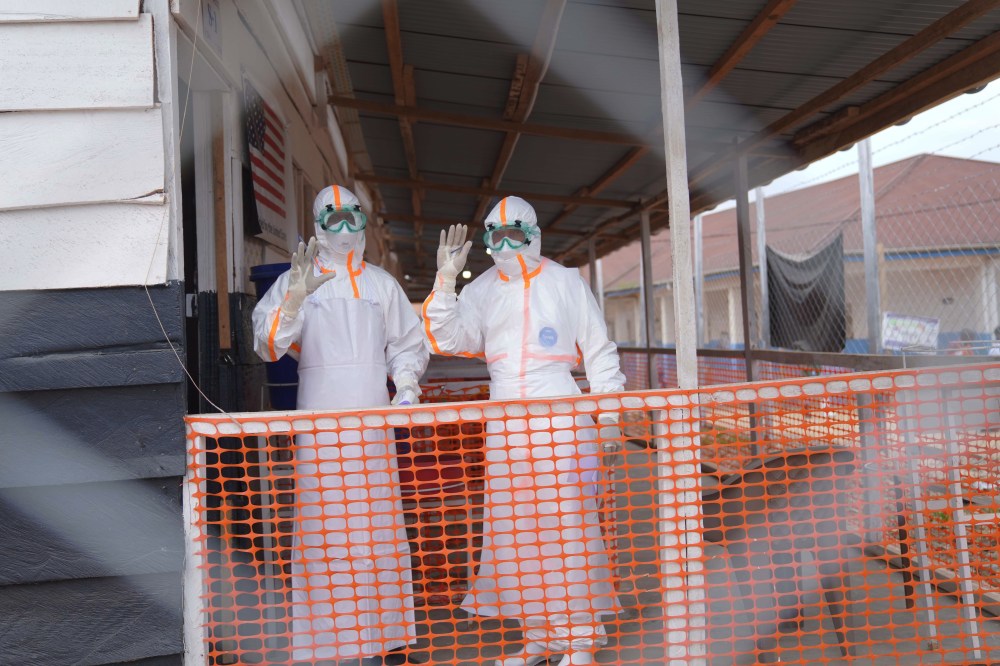
Health workers in protective gear wave inside an Ebola treatment centre in Bunia, Congo, Monday, Aug. 10, 2026. (AP Photo/Dieudonne Dirole)

It took about nine weeks for the outbreak to record the first 1,000 deaths, but it’s taken just around three weeks for the figure to double, as experts say the crisis is moving faster than efforts to track and manage it.

At the epicenter in eastern Congo’s Ituri province, friends and family members gathered in tears on Tuesday for the burial of Jeannine Katusabe, 38, one of the latest to die.

Christophe Logo, a family representative, said Katusabe first sought traditional treatment at home and only went to the local Ebola treatment center after her condition worsened. “Unfortunately, she did not recover,” he said.

Identifying cases early can be nearly ‘impossible’

This is already the second-largest outbreak in history, behind the 2014-2016 outbreak’s over 28,000 cases including over 11,000 deaths. The outbreak has been expanding across five eastern provinces near South Sudan, Uganda and Rwanda.

The ongoing outbreak has had a case fatality rate of 45.9%, more than the 39.6% rate recorded in the 2014-2016 outbreak.

This Ebola outbreak is unlike most previous ones. The rare Bundibugyo virus responsible for it has no approved vaccines or treatments. Clinical trials for those have begun in Ituri province.

Although the type of Ebola responsible for the 2014-2016 outbreak is considered the deadliest, government data shows this Bundibugyo outbreak has killed a higher percentage of people as care and support are not getting to patients quickly enough. Many people are reporting symptoms late or not at all.

“In the absence of an effective vaccine, control (for the outbreak) rests on identifying cases and then nursing them in secure facilities until they recover or sadly perish,” said Paul Hunter, a professor in medicine at the University of East Anglia in the U.K.

In a remote region like this with an ongoing conflict and interrupted communications, routine surveillance can be very difficult and “identifying cases early enough to prevent spread can be impossible,” Hunter said.

Authorities in eastern Congo have restricted public gatherings and shut the main airport in Ituri to limit spread of the disease. But mass movements due to trade, mining and displacements from conflict have continued.

The response has been behind from the start
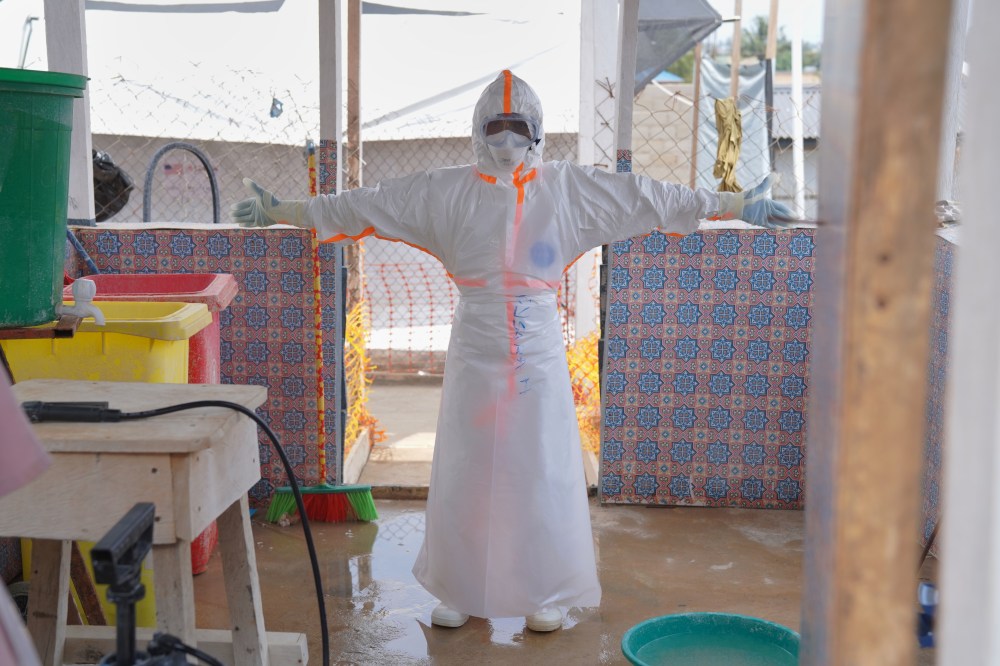
A health worker waits to be sprayed with disinfectant at the treatment centre in Bunia General Hospital in Ituri, eastern Congo, Tuesday, Aug. 11, 2026. (AP Photo/Dieudonne Dirole)

The World Health Organization on Monday said some cases early in the outbreak were wrongly attributed to malaria and typhoid, and that early testing was conducted for the more common type of Ebola, delaying the realization of what was unfolding

Officials are “chasing the virus, the virus is ahead of us,” the WHO regional director for Africa, Dr. Mohamed Yakub Janabi, told a news conference.

The new death toll is “alarming,” said Dr. Jean-Marie Akandabo, who is helping manage patients at a clinic in Ituri.

Akandabo said the major challenges he’s seen are limited care for patients and poor community engagement. Some people have described widespread misinformation about the virus in sometimes hostile communities that long have been wary of outsiders after years of attacks by rebel groups.

“We must not take this disease lightly, because it continues to kill and no one is safe,” Akandabo said.

The current outbreak is the 17th — and largest — the Central African nation has faced. The first Ebola virus to be identified was in 1976 near the Ebola River in what is now Congo.

___

Asadu reported from Abuja, Nigeria. Associated Press writer Mark Banchereau contributed from Dakar, Senegal.


Report Error Submit a Tip

More Stories

Retired guidance counsellor defends explicit 2025 sex-ed presentation to high school football team in disciplinary hearing

Maggie Macintosh 7 minute read Preview

Retired guidance counsellor defends explicit 2025 sex-ed presentation to high school football team in disciplinary hearing

Maggie Macintosh 7 minute read Updated: Yesterday at 12:26 PM CDT

Gus Watanabe, a former employee of Oak Park High School in Winnipeg, was the subject of a public disciplinary hearing on Thursday.

Read
Updated: Yesterday at 12:26 PM CDT

Six high school hockey programs ceased operations following new Hockey Manitoba policy

Joshua Frey-Sam 7 minute read Preview

Six high school hockey programs ceased operations following new Hockey Manitoba policy

Joshua Frey-Sam 7 minute read Updated: Yesterday at 8:19 PM CDT

She lived the best of both worlds.

For the last three years, the 17-year-old wore a sweater for two different hockey programs — her high school team and AAA club in the Manitoba Female Hockey League — and was preparing to flourish in both colours again this winter.

Recently, however, the blue-liner was disappointed to learn she is no longer eligible to play her Grade 12 season with her school owing to a new policy imposed by Hockey Manitoba that bans players from participating in the Manitoba Women’s High School Hockey League if they are rostered on a U18 AAA team.

The rule applies to all athletes who play for both Winnipeg-based and rural AAA teams.

Read
Updated: Yesterday at 8:19 PM CDT

Gordon Bell rings in a century

Maggie Macintosh 13 minute read Preview

Gordon Bell rings in a century

Maggie Macintosh 13 minute read Updated: Yesterday at 8:06 PM CDT

Mischka Valencia had gotten used to the hum of heavy machinery at Gordon Bell High School.

“Ever since I’ve been here, it’s all been under construction,” the Grade 12 student said, standing on the sidelines of the brightly painted revamped outdoor basketball court. “I had no idea this was a court.”

The Filipina teenager landed in Winnipeg several months after the inner-city campus had transformed into a construction site.

It was the fall of 2023 and Mischka’s priorities were fitting in, befriending classmates and learning a third language via first-period French.

Read
Updated: Yesterday at 8:06 PM CDT

Letters, Oct. 3

7 minute read 2:01 AM CDT

A morning in the life …

My very first lesson does not start when I walk into that lecture hall, oh no — it starts long before. It begins when I walk to my car, check the estimated arrival time to the University of Manitoba and hope that Winnipeg traffic agrees with it.

A drive that appears completely manageable changes almost immediately when I’m greeted by a tsunami of orange pylons and a line of cars that appears to go on forever. Traffic moves by the inch, lanes magically disappear and the detour I took yesterday now has a detour of its own. These factors make me do a calculation that I have become all too familiar with. How late can I arrive and still find parking, run to my class across campus and get to class with enough time left to make it worth it?

I have grown used to people saying, “Why not just leave earlier?” I do. But when I’m already leaving for my 8:30 a.m. class at 7 a.m., there’s only so much I can do. This drive that some would think is relaxing is one that feels like an assignment that I didn’t know I had to complete and is due at 8:30 a.m.

What’s luck got to do with it?

Tim Kist 5 minute read 2:01 AM CDT

We all seek certainty in our daily lives. We expect if we make a decision, the outcome will be just as we planned: a direct correlation between the decision and result.

You, as a business leader, seek the same certainty from the decisions you make. And sometimes, the result is what was expected. Sometimes, it isn’t.

The big question is: why is it so difficult to achieve the business results you expect when you carefully craft your plans and seemingly make good decisions?

The truth is we cannot predict the future. This means we almost never know precisely how customers will respond to a sales quote, what competitors are planning, and a myriad of other external variables at play.

A 22-year-old man is dead and an 18-year-old is in hospital in critical condition after a two-vehicle crash on Highway 8 on Thursday evening.

A Gimli RCMP officer was driving north on the highway, near Riverton, when he witnessed the collision at about 6:45 p.m.

A vehicle headed north had passed the Mountie at a high speed before colliding with an SUV that was turning west onto Provincial Road 329 from Highway 8.

The driver of the first vehicle, an 18-year-old man from Arborg, was rushed to hospital by a helicopter ambulance with injuries RCMP describe as serious and life-threatening.