Inside the Montreal lab working to prepare Canada against future pandemics
Advertisement
Read this article for free:
or
Already have an account? Log in here »
To continue reading, please subscribe:

Digital Subscription
One year of digital access for only $205*
- Enjoy unlimited reading on winnipegfreepress.com
- Read the E-Edition, our digital replica newspaper
- Access News Break, our award-winning app
- Play interactive puzzles
*First annual payment billed as $205.00 + GST for one year. This annual subscription will automatically renew at $233.00 + GST every 52 weeks (10% off the regular annual price of $259.35). Offer available to new and qualified returning subscribers only. Cancel any time.
To continue reading, please subscribe:
Add Free Press access to your Brandon Sun subscription for only an additional
$1 for the first 4 weeks*
- Enjoy unlimited reading on winnipegfreepress.com
- Read the E-Edition, our digital replica newspaper
- Access News Break, our award-winning app
- Play interactive puzzles
*Your next Brandon Sun subscription payment will increase by $1.00 and you will be charged $17.95 plus GST for four weeks. After four weeks, your payment will increase to $24.95 plus GST every four weeks.
Read unlimited articles for free today:
or
Already have an account? Log in here »
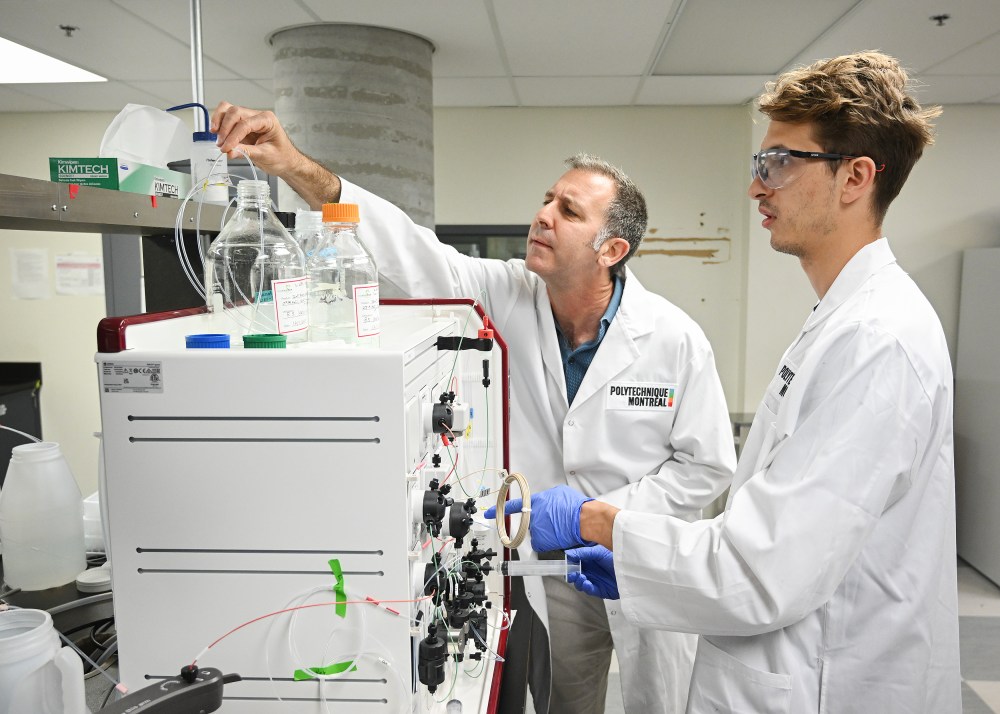
MONTREAL – In a biomedicine laboratory at Polytechnique Montréal, animal protein grows in a bubbling orange solution as researchers in white lab coats take samples with large syringes.
Neatly-labelled glass bottles filled with clear liquid line the shelves next to computer monitors, where the scientists examine the antibodies produced by the cells.
In a room down the hall, a large cryogenic freezer is filled with tubes containing samples of proteins and cells that can be used to develop vaccines and medicines.
Six years after the spread of COVID-19 caught the world by surprise, the Polytechnique lab is spearheading efforts to prepare Canada against future pandemics.
It’s part of a federal initiative called Ramp Up, which collaborates with research institutions across Canada to address gaps in the biomanufacturing sector.
While it’s impossible to predict the timing and nature of the next pandemic, head researcher Gregory De Crescenzo says preparation is critical.
“It’s not a matter of if, but when,” he said during a tour of the lab, which spans several rooms at the downtown Montreal engineering school.
With the proliferation of vaccine misinformation during the pandemic, De Crescenzo hopes giving the public a look inside his lab can help rebuild public trust in medicine.
He says Ramp Up aims to fast-track vaccine and biomedical processes, as well as training students. While scientists mainly work with viruses such as influenza and bird flu, De Crescenzo says the research can be applied to a wide range of diseases.
De Crescenzo says part of Ramp Up’s mission is to avoid repeating Canada’s mistakes during the COVID-19 pandemic, when governments, academics and industry stakeholders were working in silos. Canada’s biomedical production capacity was also limited, he said.
The supply chain is one of the main challenges identified by Ramp Up, as Canada was not capable of producing vaccines on a large scale and imports were limited.
Students and researchers work with the same equipment found in commercial labs, says De Crescenzo, including tubes to grow cells and industrial freezers where samples and bacteria are preserved for the long term.
Partner labs help identify key components, such as antibodies or viral proteins, that the Polytechnique team then produces and works to scale for industrial production.
De Crescenzo compares the lab’s role to creating recipes.
“Everything is normalized, is written, carefully verified, approved, transferred to the industries,” he explained.
“We are way more prepared than before COVID, that’s for sure. The government has done a great job here to patch the blind spots.”
However, he says there is still work to do to ensure the processes developed at the lab can be scaled to industry. He adds that actors in government, academia and industry are learning to work together.
“If we want to make something better and more resilient, please give us a couple of years,” he said. “We’ve got to…make sure that everybody’s on board.”
Isaac Bogoch, an infectious disease specialist at the University of Toronto, says a coordinated, multi-sector approach to pandemic preparedness is crucial.
“It’s a whole of government and a whole of society response. There’s not one lab that’s going to do it,” he says.
While Bogoch finds the government’s investments in biomedicals encouraging, he says areas such as transportation, food safety, and public health infrastructure must also be improved.
He pointed to Canada’s response to the hantavirus outbreak on a cruise ship in May – when four Canadians had to be repatriated and placed in preventive quarantine – as an example of cross-sector collaboration.
“We do have the tools to be prepared,” he said. “These are political questions, not scientific questions.”
Launched in 2024, Ramp Up collaborates with several institutions, including Université Laval, Université de Montréal, HEC Montréal, Simon Fraser University, and the BRIDGE Research Consortium. Their goal is to address gaps in Canada’s biomanufacturing sector.
According to the Ramp Up website, Canada will need more than 15,000 highly skilled workers in the field by 2029.
Health Canada says it has made significant investments to bolster the country’s pandemic response capabilities.
The federal agency reports that $712 million has been dedicated to upgrading biocontainment facilities across Canada, as well as the creation of research hubs led by institutions such as the University of British Columbia, the University of Alberta, the University of Ottawa, McMaster University, the University of Toronto, and Polytechnique Montréal.
Since 2020, the government invested $2.5 billion in vaccine, therapeutic and biomanufacturing projects, including supply chain resilience. Moderna’s vaccine production facility in Laval, Que., built in 2024, produced its first doses of the COVID-19 vaccine last year.
The federal agency says these developments will ensure Canadians can have timely access to life-saving medicines during future public health emergencies.
“This includes preparation for epidemics and pandemics, which are inevitable even if their timing is unpredictable,” said Health Canada spokesperson Mark Johnson in an email.
The health agency says it is also aiming to release details of a new emergency response plan in 2027 that will create better coordination between different levels of government, as well as international partners and Indigenous communities.
Master’s student Marie-Gael Tchummo says working with Ramp Up has helped her tackle vaccine hesitancy in those around her.

She says some of her family members and friends were skeptical at the speed at which COVID vaccines became available and were hesitant to get the jab.
“When I was open to tell them about what my study was and what is going on, the skepticism came down,” she said.
Like De Crescenzo, Tchummo says public trust is essential for the success of initiatives like Ramp Up.
“With the public, we need to …be transparent and they need to see what is going on, what is being put in those vaccines, how the process is going and how those vaccines are created,” she said.
This report by The Canadian Press was first published August 17, 2026.