5 challenges Congo faces in containing its fast-moving Ebola outbreak

Advertisement

Advertise with us

ABUJA, Nigeria (AP) — Authorities in eastern Congo are shifting to a village-centered approach to fight the Ebola outbreak, Africa’s top public health agency said Thursday, as the virus continues to spread faster than efforts to track and contain it.

Read this article for free:


By clicking the button above, an account will be created and you will begin to receive some of our recommended newsletters. You may opt out of any newsletter by visiting your Email and Communication Preferences page or by clicking "unsubscribe" at the bottom of any email.

or

Already have an account? Log in here »

To continue reading, please subscribe:

Digital Subscription

One year of digital access for only $1.44 a week*

  • Enjoy unlimited reading on winnipegfreepress.com
  • Read the E-Edition, our digital replica newspaper
  • Access News Break, our award-winning app
  • Play interactive puzzles

*Billed as $5.77 plus GST every four weeks. After 52 weeks, price increases to the regular rate of $19.95 plus GST every four weeks. Offer available to new and qualified returning subscribers only. Cancel any time.

To continue reading, please subscribe:

Add Free Press access to your Brandon Sun subscription for only an additional

$1 for the first 4 weeks*

  • Enjoy unlimited reading on winnipegfreepress.com
  • Read the E-Edition, our digital replica newspaper
  • Access News Break, our award-winning app
  • Play interactive puzzles
Start now

*Your next Brandon Sun subscription payment will increase by $1.00 and you will be charged $17.95 plus GST for four weeks. After four weeks, your payment will increase to $24.95 plus GST every four weeks.

ABUJA, Nigeria (AP) — Authorities in eastern Congo are shifting to a village-centered approach to fight the Ebola outbreak, Africa’s top public health agency said Thursday, as the virus continues to spread faster than efforts to track and contain it.

The Africa Centers for Disease Control and Prevention said the outbreak has likely not yet peaked. Since it was declared in mid-May, it has spread from three health zones to 60, with 6,250 cases, including 3,039 deaths, government data showed, mostly fueled by insecurity, displacement and intense population movements.

Compared with the outbreak of 2014 to 2016 across West Africa — the deadliest Ebola outbreak on record with more than 11,000 deaths — the current outbreak has recorded six times as many confirmed cases and five times as many deaths, the Africa CDC said.
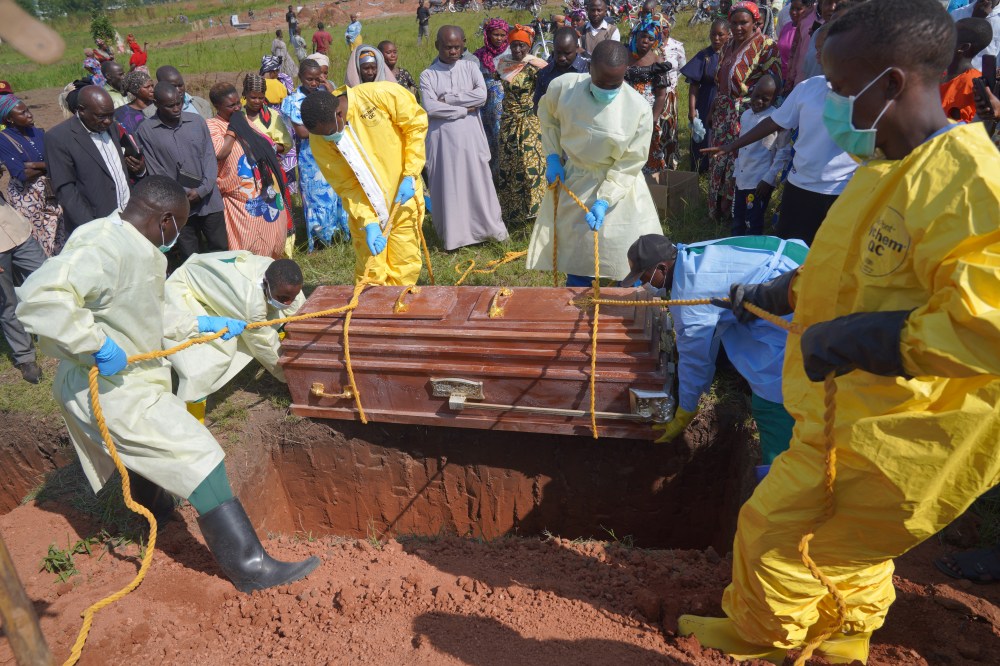
Health workers bury the coffin of Neema Minaro, a 66 year old woman who died of the Ebola virus, in Bunia, Congo, Wednesday, Sept. 2, 2026. (AP Photo/Dieudonne Dirole)

Here are five areas where Congo’s response to the outbreak is still falling short, according to a report this week from the U.S. Centers for Disease Control and Prevention:

Limited community-based surveillance systems

One major gap in the response is limited community-based surveillance to quickly investigate alerts to be able to detect, track and slow the spread of the virus, the U.S. health agency said.

Delays in detection, reluctance to report cases and inadequate community engagement are contributing to preventable deaths. At least 63% of deaths recorded in the past week occurred outside Ebola treatment centers, Africa CDC data showed.

Authorities are now using a “village-centered approach,” working with community leaders to help build trust and improve collaboration with residents, said Yap Boum, head of emergency preparedness and response at Africa CDC.

Ituri province, where the outbreak is concentrated, is also at the center of the rebel conflict in eastern Congo, complicating efforts to gain trust from residents. “Building that trust in the middle of an outbreak is quite complex,” Boum said.

Contact-tracing needs to improve

Quickly identifying and tracing the contacts of those who had come in contact with Ebola patients remains challenging across the six provinces affected.

Although 81% of contacts have been followed up with by surveillance teams, that figure does not reflect the full reality as it only refers to the listed contacts and doesn’t include those who have yet to be traced.

Africa CDC estimates that cases confirmed in the last three weeks should have generated 97,600 contacts, based on an average of 60 contacts per confirmed case. Only 19% of those total expected contacts have been traced.

More treatment and isolation capacity is needed

Health data shows that treatment centers had expanded capacity to more than 1,300 beds in late August while their occupancy rate is currently at 67% with 869 patients.

However, experts have called for more treatment and isolation centers and beds in affected health zones to prepare for cases that have yet to be detected.

Many affected health zones are in areas where cases go undetected or unreported for several reasons, including distrust in health authorities.

Some health zones are also not accessible to surveillance teams or health workers trying to treat patients, said Boum.

Laboratory testing capacity remains limited

Experts also say that laboratory testing capacity needs to be expanded in order to promptly identify cases and treat patients.

The World Health Organization said last month that several treatment and transit centres in Ituri, the outbreak’s epicenter, were “saturated” while North Kivu, the second-most affected province, lacked sufficient options to refer patients to specialized facilities.

Health workers at existing treatment centers are also exhausted, said Jeannot Krikeija, who works at an Ebola treatment center in Bunia, Ituri’s capital. “Ebola is tiring us all the more because we don’t know when this scourge will end. This ordeal is unbearable for me,” Krikeija said.

Gaps remain in how burials are carried out in affected health zones

Authorities have deployed safe and dignified burial teams for the more than 3,000 people who have died from Ebola, but gaps remain in how the burials are carried out, according to the U.S. health agency.

Ebola can spread between people through direct contact with the blood or other bodily fluids of someone who is sick with or has died from Ebola, and experts have warned that bodies of victims still carry large amounts of active virus.

In Ituri and other affected areas, burial teams have been attacked on multiple occasions, often by families seeking to protect loved ones who died of Ebola. It’s also common to see people surrounding graves of Ebola victims during burials, sometimes within a few meters away from the coffins.

___

AP writer Constant Same Bagalwa in Bunia, Congo and Mike Stobbe in New York contributed to this report.

Report Error Submit a Tip

More Stories

Katz ‘violated public trust,’ Sheegl lacked ‘moral compass,’ police HQ inquiry commissioner concludes

Joyanne Pursaga 8 minute read Preview

Katz ‘violated public trust,’ Sheegl lacked ‘moral compass,’ police HQ inquiry commissioner concludes

Joyanne Pursaga 8 minute read Updated: 7:29 PM CDT

The final report from the public inquiry into the scandal-plagued Winnipeg Police Service headquarters construction project concludes that former mayor Sam Katz and former city CAO Phil Sheegl broke public trust and engaged in unethical conduct.

And the report, released Monday by inquiry commissioner Garth Smorang, says the cost of the project — transforming a downtown Canada Post office tower and warehouse into the police HQ — soared, in part, because main contractor Caspian Projects overcharged the city by more than $40 million in expenses.

The project’s initial $135-million initial price tag rose to about $209 million in the end. The city purchased the complex in 2009; construction was completed in 2016.

Smorang’s report concludes Katz “violated the public trust” and council code of conduct, and Sheegl suffered from a “complete lack of a moral compass.”

Read
Updated: 7:29 PM CDT

Blue and Gold must win regular-season finale to punch post-season ticket

Taylor Allen 6 minute read Preview

Blue and Gold must win regular-season finale to punch post-season ticket

Taylor Allen 6 minute read 6:38 PM CDT

It’s now or never for the 2026 edition of the Winnipeg Blue Bombers.

For weeks, if not months, they’ve been talking about what they need to do to become a consistently good football team.

We’ve heard endless clichés — things like, “We just gotta look ourselves in the mirror” and “We just have to execute better” — but time and time again, nothing has changed. Now, the clock is about to hit zero, and they find themselves at serious risk of watching the playoffs from the couch.

“I didn’t think, obviously, we’d be in a situation like this,” admitted quarterback Zach Collaros after Monday’s practice at Fort Garry Lions Field. “But we are.”

Read
6:38 PM CDT

Bullet to the face nets 7.5 years behind bars

Morgan Modjeski 5 minute read Preview

Bullet to the face nets 7.5 years behind bars

Morgan Modjeski 5 minute read 6:13 PM CDT

Calling it “intimate partner terror,” a judge sentenced a Winnipeg man to seven-and-a-half years in prison for firing a loaded handgun held to his partner’s head causing her life-altering injuries.

The woman, who the Free Press is only identifying as A.W., watched as Machuor Akau sat silently and stared at the ground as Manitoba Judge Sidney Lerner read his ruling Monday.

Akau, 28, who pleaded guilty to aggravated assault, possession of a prohibited weapon, pointing a firearm and criminal negligence causing bodily harm, didn’t speak during the sentencing or look at his victim or her family members as court progressed.

At a previous proceeding, Crown prosecutor Ari Millo had requested a sentence of eight years, while defence counsel Saul Simmonds argued for between five and six.

Read
6:13 PM CDT

De Havilland calls for national water bomber fleet as it scrambles to meet demand

Christopher Reynolds, The Canadian Press 7 minute read Preview

De Havilland calls for national water bomber fleet as it scrambles to meet demand

Christopher Reynolds, The Canadian Press 7 minute read Updated: Yesterday at 1:49 PM CDT

MONTREAL - On July 13, a pair of Canadair water bombers touched down on the Seine River, skimming along its surface to refill their water tanks as they battled a wildfire south of Paris.

The "super scoopers," with their signature ketchup-red wing tips on a mustard-yellow body, sucked up 6,000-plus litres from France’s most famous waterway in one go as part of a fight against the flames then rampaging across Europe.

The event in north-central France underscored how wildfires are ranging even farther from their traditional grounds and fuelling an urgent need for water bombers to fend off climate disasters.

The iconic Canadair turboprops serve as the only amphibious firefighting aircraft currently in production built from the outset for that purpose, rather than being retrofitted to douse flames.

Read
Updated: Yesterday at 1:49 PM CDT

Four councillor candidates vie for wide-open Fort Rouge-East Fort Garry ward

Malak Abas 6 minute read Preview

Four councillor candidates vie for wide-open Fort Rouge-East Fort Garry ward

Malak Abas 6 minute read Yesterday at 3:21 PM CDT

One of Winnipeg’s most densely populated wards is up for grabs come election day.

Four candidates are in the running in Fort Rouge-East Fort Garry, with the councillor position wide open after area Coun. Sherri Rollins announced in July she would be withdrawing her candidacy.

Journalist Brook Jones, hospitality worker and union organizer Carson Mauthe, city planner Jeff Palmer and retired finance worker Kevin Stuart have thrown their hats in the race.

Palmer has worked as a city planner for more than 20 years, in both the non-profit and private sectors, including CentreVenture and the University of Winnipeg Community Renewal Corporation.

Read
Yesterday at 3:21 PM CDT

Puzzles Palace

1 minute read Friday, Oct. 16, 2026

To solve our puzzles, please subscribe with this special offer: |