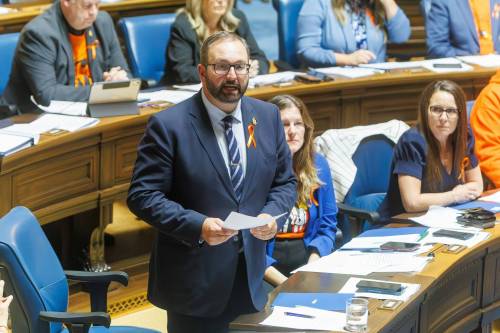
Trump’s shift from ‘Housing First’ is causing upheaval for homelessness programs and many they serve
Advertisement
Read this article for free:
or
Already have an account? Log in here »
To continue reading, please subscribe:

Digital Subscription
One year of digital access for only $205*
- Enjoy unlimited reading on winnipegfreepress.com
- Read the E-Edition, our digital replica newspaper
- Access News Break, our award-winning app
- Play interactive puzzles
*First annual payment billed as $205.00 + GST for one year. This annual subscription will automatically renew at $233.00 + GST every 52 weeks (10% off the regular annual price of $259.35). Offer available to new and qualified returning subscribers only. Cancel any time.
To continue reading, please subscribe:
Add Free Press access to your Brandon Sun subscription for only an additional
$1 for the first 4 weeks*
- Enjoy unlimited reading on winnipegfreepress.com
- Read the E-Edition, our digital replica newspaper
- Access News Break, our award-winning app
- Play interactive puzzles
*Your next Brandon Sun subscription payment will increase by $1.00 and you will be charged $17.95 plus GST for four weeks. After four weeks, your payment will increase to $24.95 plus GST every four weeks.
Read unlimited articles for free today:
or
Already have an account? Log in here »
LOUISVILLE, Ky. (AP) — Light streamed through stained-glass windows in a former church, illuminating long white tables where weary men gathered. Johnny Henderson was glad for the rest. The 71-year-old — who has one arm, heart disease and vision problems — slept on the street the night before.
Henderson is a regular at the St. John Center men’s day shelter. So are a great-grandfather in a wheelchair who has prostate cancer, a 54-year-old with four psychiatric disorders and a 66-year-old with a walker who wears a hospital bracelet warning “fall risk.”
All are potential candidates for permanent, government-subsidized apartments under a “Housing First” approach, a model rooted in the belief that people need a stable place to live before addressing other problems. But the approach that’s been central to federal government policy for more than a decade is disappearing under President Donald Trump’s administration. The upheaval, providers and advocates say, threatens the lives of some of the most vulnerable people in the nation.
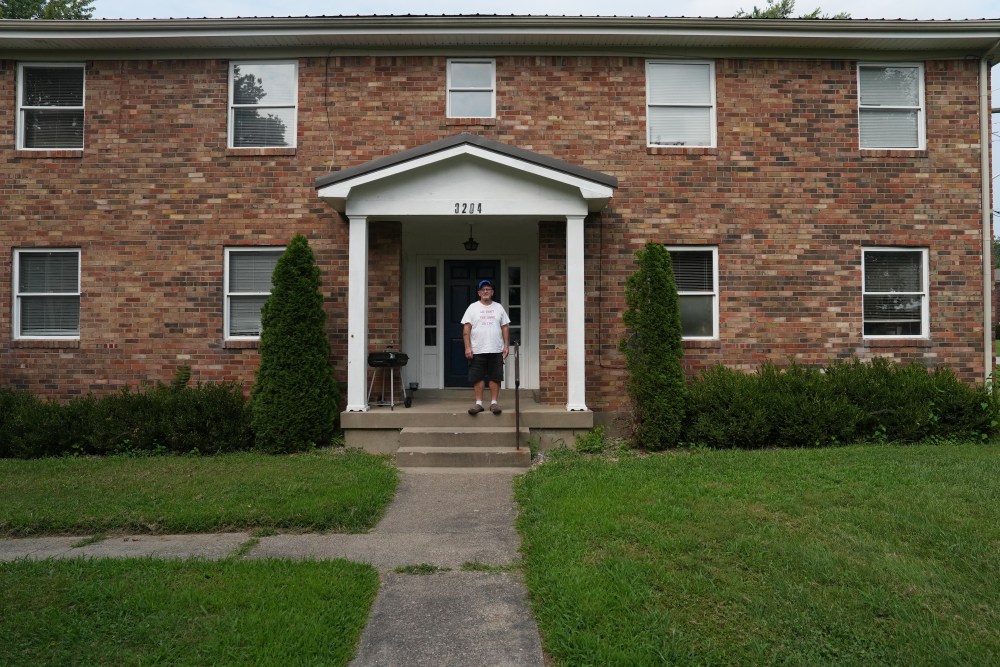
“Housing is healthcare,” said St. John executive director Ra’Shann Martin, whose organization provides housing and outreach in addition to the shelter. “The longer people stay unhoused, the more fragile they become.”
Housing organizations across the U.S. that depend on federal funds are now reluctantly making changes to comply with new government policies that favor a “Treatment First” approach and short-term “transitional” housing — changes they fear will push people with extreme health risks back on the street or keep others, like Henderson, there.
Planned housing projects have been scrapped in communities such as Corbin, Kentucky. Less housing is available for homeless people in places including Santa Cruz County, California. And in cities such as Louisville, nonprofits are looking at making some permanent housing temporary, including most of St. John’s 200 apartments.
US homelessness numbers have trended upward
Across America, nearly 750,000 people were homeless last year, according to an estimate compiled by the U.S. Department of Housing and Urban Development. That number is down slightly from 2024 but up 31% from 2019.
The portion considered chronically homeless — having a disability and long-term or repeated episodes of homelessness of at least a year — has also risen since 2019. It’s now about a quarter of the total.
Overall, research shows, roughly half of homeless adults live with a disability, up to two-thirds have mental illness and 2 in 5 have substance use disorder. Rates of disability, heart disease and diabetes are two to three times higher than in the general population.
In Louisville, outreach specialist Angel Sivado said such statistics are reflected in the people she serves, whose living conditions make it extremely difficult to care for themselves, get to doctors or keep up with medications.
On a recent day, she parked a St. John van near a fast-food restaurant and hiked into the woods to visit a couple living in a tent. Later, she and a colleague walked toward encampments surrounded by trees just off a highway, yelling “outreach” over the low roar of cars.
One of their main jobs is to shepherd clients through the process for getting housing.
“They’re not just homeless people; they’re people,” Sivado said. “They’re somebody’s son. They’re somebody’s mother. They’re someone’s daughter.”
Occasionally, Sivado savors a victory. Before heading home, she stopped under a downtown overpass to see James Myers, 66, who is blind, has congestive heart failure and is undergoing treatment for prostate cancer. She told him he should be in an apartment soon.
“I’m tired. I mean, the streets will beat you down, and I think they put a few years on me,” he said, standing near his busted guitar. “I can’t wait to get off the street.”
Others are not so lucky. Henderson, the St. John regular, survived a train accident that cost him an arm and led to a yearslong opioid addiction. Recently, he’s been dealing with heart disease, an eye problem, spinal surgery, and auditory hallucinations.
“I’m going to die sleeping outdoors,” he said, choking up. “But I got nowhere to go.”
The Trump administration favors ‘Treatment First’ and short-term housing
Each person’s path to homelessness is unique. Determining the “best” solutions depends on the lens used to judge what’s best. The answer may be different if the goal is reducing overall homelessness, helping people into the job market, spending as little taxpayer money as possible, improving health outcomes — or just keeping people alive.
The Housing First idea was pioneered by a New York nonprofit in the 1990s and has been at the heart of federal homelessness policy since 2013. Today, there are roughly 173,000 “permanent supportive housing” beds for chronically homeless people, and 235,000 for other populations, including veterans. These are long-term apartments paired with voluntary services. Tenants often must contribute 30% of their income, after certain expenses, to rent and utilities.
Studies have consistently shown that Housing First programs keep people stably housed. Some research says they do so better than other models, including “Treatment First,” which favors mandatory services for addiction and serious mental illness. But findings on health outcomes have been mixed.
Last year, Trump signed an executive order calling for an end to federal support for Housing First policies. His proposed budget for fiscal 2027 calls for eliminating the federal initiative that goes mostly to Housing First programs. The administration favors housing lasting up to two years, during which people would be required to get treatment.
“Housing First has failed our most vulnerable and enabled addiction,” HUD said in an email. “HUD’s proposed reforms seek to address the root causes of homelessness and advance recovery, self-sufficiency, and competition that drives accountability.”
Many opponents of Housing First policies don’t think services including addiction and mental health treatment should be optional.
“That is the biggest difference between Housing First and not Housing First,” said Devon Kurtz, the director of public safety policy for the Cicero Institute. Kurtz is also concerned that permanent supportive housing was becoming a “one-size-fits-all approach,” including for populations better served by transitional housing.
Service providers say short-term housing won’t work for some people
Service providers acknowledge that transitional housing is a good option for some people, such as those getting on their feet after evictions. But they say most chronically homeless people can’t pull their lives together within two years and would likely wind up homeless again.
“If you want to gradually work on reducing social services that are funded by the federal government, OK,” said Jennifer Clark, CEO and executive director of St. Vincent de Paul Louisville, which offers permanent and transitional housing. “But you cannot make a huge sweeping change and big cuts and take an ax to everything and think that there aren’t going to be consequences for some people who are really in need.”
John Franklin, 58, said transitional housing wouldn’t work for him. He spent nearly 14 years on the streets dealing with severe alcoholism, and it took a long time to adjust to normal life. He now gets by on disability, as a throat cancer survivor with heart failure, and can’t imagine either having to fully pay for housing or surviving the streets.
“I could not make it,” said Franklin, who shares a permanent supportive apartment in suburban Louisville with his orange tabby, Moe. “This is my safe haven.”
Housing First provides homes and other help
The welcome mat outside Phillip Sieveking’s permanent supportive apartment says “Home Sweet Home,” a sentiment precious to him after a couple years on the streets.
Sieveking lives at St. John’s Sheehan Landing, a complex with 80 furnished one-bedroom apartments plus a clinic space, food pantry, meeting rooms, and a community garden that he spends much of his free time tending.
The former chef has diabetes but didn’t take care of it while homeless. Doctors had to amputate part of one leg. On a recent morning, he put on his prosthetic, grabbed his crutches and slowly made his way to the garden to check on the roses, sunflowers and vegetables.
He credits his caseworker with encouraging him to keep up with medical care and navigate systems for getting disability and food benefits. He also attends meetings at the complex, including one where residents discuss wellness and sobriety while working on art projects.
“They have helped me, you know, go from being homeless to being a part of society,” said Sieveking, 47. “I feel blessed to be here.”
In New Jersey, Tatiana Velez has been in permanent supportive housing since 2021, soon after connecting with the Camden Coalition, which serves people with complex health and social needs.
After spending 18 years in prison for robbery, she had lived in abandoned buildings and struggled with opioids for a couple years. Velez had never signed a lease or opened a bank account when, in her late 30s, she learned she was pregnant and decided she was ready to make changes.
“I didn’t know what it was to have a roof over my head or pay the bills,” said Velez, who receives disability payments for psychological and educational disabilities.
She now shares a first-floor suburban apartment with her daughter, 5, and a formerly homeless cat named Snowball. A preschool graduation certificate hangs on the wall.
Policy changes rock communities
After HUD tried to rework its homelessness grants to fit the administration’s favored policies, a consortium of local governments and advocates for homeless people sued. A federal judge agreed with them. But this month, an appeals court said the administration could move ahead.
Meanwhile, Trump’s proposed budget calls for eliminating the $4 billion Continuum of Care program, which in 2024 awarded money to 6,500 projects. At that time, more than 60% went to permanent supportive housing, mostly to continue existing efforts. Just 1% went to transitional housing.
Trump’s proposed changes have left homelessness organizations scrambling to figure out how to alter their housing strategies so they can keep getting federal money.
“It’s like psychological warfare the last two years, trying to figure out how to navigate these changes that are looming right over us,” Martin, the St. John director, said.
Dr. Robert Ratner, director of housing for health in Santa Cruz County, California, said losing permanent supportive housing funds would exacerbate problems caused by the winding down of another federal program: pandemic-era emergency housing vouchers. People set to lose those vouchers are being prioritized for available housing, meaning the county can’t help as many people who are homeless now.
A similar dynamic is playing out at The Delores Project in Denver, which serves women and transgender and nonbinary people. Program leaders expect people already in the permanent housing on their campus will stay because they won’t have access to vouchers to move out into the community. That will mean fewer spots for new people.
In Louisiana, the state housing agency applied to redirect federal money away from rental assistance and toward the establishment of a 200-bed shelter with strict mandates for participants. That effort was rejected by local coalitions in charge of the money, but local housing advocates worry it’s a harbinger of what’s to come.
Some communities are seeing planned projects nixed. For 18 months, Volunteers of America Mid-States worked with Eastern Kentucky University and others on a permanent supportive housing project in Corbin that would have included childcare and access to college classes. “That project is now dead,” said CEO Jennifer Hancock.
Many nonprofit leaders feel forced to shift toward transitional housing. In Louisville, St. Vincent de Paul and Family Health Centers-Phoenix Health Care for the Homeless are looking at converting some permanent supportive housing apartments into transitional units. St. John would only be left with Sheehan Landing after converting its 120 community apartments to transitional housing.
The result for people like Henderson? More time on the streets as they grow older and sicker.
“The lady in the housing office told me, she said, ‘Mr. Henderson, you got a stent in your heart. You got one eye and one arm. Something’s going to have to happen for you.’”

But with “just a little life left,” he said, it may not happen soon enough.
___
Mulvihill reported from Oaklyn, New Jersey. Katie Jane Fernelius of Verite News in New Orleans contributed to this story.
___
The Associated Press’ health and science coverage receives financial support from the AP Fund for Journalism and private foundations. AP is solely responsible for all content. Find AP’s standards for working with philanthropies, a list of supporters and funded coverage areas at AP.org.