Vaccine creates ‘safe space’ in care homes, says worker who got Ottawa’s first dose
Advertisement
Read this article for free:
or
Already have an account? Log in here »
To continue reading, please subscribe:

Digital Subscription
One year of digital access for only $205*
- Enjoy unlimited reading on winnipegfreepress.com
- Read the E-Edition, our digital replica newspaper
- Access News Break, our award-winning app
- Play interactive puzzles
*First annual payment billed as $205.00 + GST for one year. This annual subscription will automatically renew at $233.00 + GST every 52 weeks (10% off the regular annual price of $259.35). Offer available to new and qualified returning subscribers only. Cancel any time.
To continue reading, please subscribe:
Add Free Press access to your Brandon Sun subscription for only an additional
$1 for the first 4 weeks*
- Enjoy unlimited reading on winnipegfreepress.com
- Read the E-Edition, our digital replica newspaper
- Access News Break, our award-winning app
- Play interactive puzzles
*Your next Brandon Sun subscription payment will increase by $1.00 and you will be charged $17.95 plus GST for four weeks. After four weeks, your payment will increase to $24.95 plus GST every four weeks.
Read unlimited articles for free today:
or
Already have an account? Log in here »
Hey there, time traveller!
This article was published 15/12/2020 (2086 days ago), so information in it may no longer be current.
OTTAWA – At 8:05 a.m. on a cold, cloudless day, personal support worker Jo-Anne Miner became the first person of 1.4 million in the Ottawa-Gatineau area to receive the COVID-19 vaccine, hours before the federal government announced that hundreds of thousands more doses would arrive in Canada by the end of the year.
Frigid boxes holding some of the up to 417,000 vaccine doses set to arrive by the end of the month touched down in at least six provinces Tuesday, while several prepared to administer the medicine to health workers.
Miner is part of the legions of front-line staff and seniors-home residents slated for inoculation across the country this month amid a surging second wave.
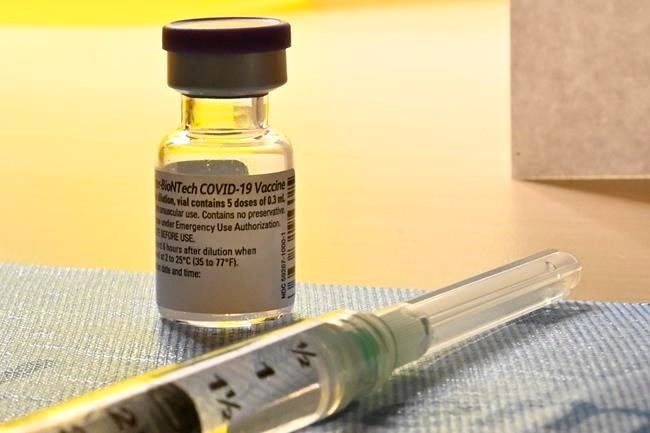
“This will help create a safe space for me, my colleagues and the residents,” she said in a release from the Ottawa Hospital’s Civic campus, where 3,000 doses of the vaccine from Pfizer and its partner BioNTech sit in ultracold storage — enough for 1,500 people to get the two doses needed for maximum protection.
“It has been a challenging year for so many people living and working in long-term care.”
Prime Minister Justin Trudeau and Health Minister Patty Hajdu met with workers at the hospital to thank them and witness the city’s inaugural inoculations.
These followed historic needle jabs in Toronto, Montreal and Quebec City on Monday after the first doses of the Pfizer-BioNTech vaccine arrived in Canada Sunday evening.
Later Tuesday, Alberta announced its first shots were given in Edmonton and Calgary. Saskatchewan said vaccinations had started in Regina. And doses had been administered in British Columbia, although officials did not disclose where.
“It’s very moving, very emotional. I’ve been emotional for two days,” Hajdu told reporters. “The light is shining, now we can actually see it.”
“This is a good day,” Trudeau added.
The prime minister announced Tuesday that Canada has signed a contract to receive up to 168,000 doses of Moderna’s COVID-19 vaccine by the end of December, ahead of their planned January arrival and part of 40 million doses Ottawa has secured for delivery by the end of 2021.
The Moderna vaccine has not yet been approved by Health Canada, but Trudeau said deliveries could begin within 48 hours of it getting the green light.
Canada is also set to receive about 200,000 of its total early shipment of Pfizer-BioNTech doses next week, on top of 30,000 this week. They are bound for 70 distribution sites across the country — up from 14 now — where the vaccine can be administered.
“That’s not going to be enough to extinguish any fires,” said chief public health officer Dr. Theresa Tam, but she added that the incoming vaccines give her “great hope.”
“I’m definitely looking forward to 2021 being a better year.”
Health workers in all 10 provinces prepared to roll up their arms this week.
Officials are expected to start immunization in Manitoba on Wednesday. And shipments touched down in all four Atlantic provinces Tuesday, with all but New Brunswick also gearing up to begin immunizations Wednesday.
The injections come as case counts keep rising.
Ontario reported 2,275 new coronavirus cases and 20 more deaths on Tuesday. The case tally marks a single-day record, but is partly due to a change in the province’s data extraction time that produced a “one-time increase,” according to Public Health Ontario.
More than half of the new cases are in Toronto and neighbouring Peel Region.
Some 134 of the province’s 626 long-term care homes are experiencing coronavirus outbreaks, with 695 residents infected and one new death reported Tuesday, provincial health officials said.
Quebec reported 1,741 new cases — nearly one-third of them in Montreal — and 39 more deaths on Tuesday.
Alberta announced 1,341 new infections, but still had the highest rate of daily cases in the country.
British Columbia reported 522 new cases.
As of Tuesday afternoon, 370,238 people in Canada have been infected, and 12,032 have died.
Enough vaccine doses are set to start arriving in April for provinces to expand the vaccination program beyond the initial priority groups. Canada expects to be able to vaccinate every Canadian who wants an inoculation by the end of September 2021.
Moderna’s vaccine can be stored at -20 C, compared to -70 C for Pfizer’s, making it more easily transportable to remote areas.
“Doses of this vaccine will be directed to the North as well as to remote and Indigenous communities,” Trudeau said.
The three territories are scheduled to start receiving vials “in the coming” weeks, with medical-grade freezers already shipped, he added.
Dr. Supriya Sharma, chief medical adviser at Health Canada, says there are still some outstanding manufacturing documents needed from Moderna before authorities can approve its product.
The timeline for finishing up reviews of two more vaccines is less certain. The vaccine candidate from AstraZeneca potentially needs more study before Health Canada is ready to make a decision, and the Johnson & Johnson vaccine candidate’s review is still in the early stages.
Health Canada approved the vaccine from Pfizer-BioNTech on Dec. 9.
Authorities are still calling on Canadians to keep two metres apart from each other, wear face masks and practise careful hygiene to curb the spread of the novel coronavirus.
In Ottawa, nurse Venus Lucero took stock shortly after injecting a dose into Miner’s tattooed arm.
“I just feel great enthusiasm by being part of the solution to this ongoing pandemic that we have,” she said. “It’s part of history, I would say.”
This report by The Canadian Press was first published Dec. 15, 2020.
Note to readers: This is a corrected story. A previous version said health workers in British Columbia are set to begin receiving the COVID-19 vaccine Wednesday.