Traffic heavy as Atlantic provinces lift travel restrictions within region

Advertisement

Advertise with us

HALIFAX - Soon after the four Atlantic provinces lifted travel restrictions within the region early Friday, heavy cross-border traffic was reported across the Maritimes.

Read this article for free:


or

Already have an account? Log in here »

To continue reading, please subscribe:

Subscribe and receive a limited-edition Free Press branded hat or tote.

Digital Subscription

One year of digital access for only $205*

  • Enjoy unlimited reading on winnipegfreepress.com
  • Read the E-Edition, our digital replica newspaper
  • Access News Break, our award-winning app
  • Play interactive puzzles

*First annual payment billed as $205.00 + GST for one year. This annual subscription will automatically renew at $233.00 + GST every 52 weeks (10% off the regular annual price of $259.35). Offer available to new and qualified returning subscribers only. Cancel any time.

To continue reading, please subscribe:

Add Free Press access to your Brandon Sun subscription for only an additional

$1 for the first 4 weeks*

  • Enjoy unlimited reading on winnipegfreepress.com
  • Read the E-Edition, our digital replica newspaper
  • Access News Break, our award-winning app
  • Play interactive puzzles
Start now

*Your next Brandon Sun subscription payment will increase by $1.00 and you will be charged $17.95 plus GST for four weeks. After four weeks, your payment will increase to $24.95 plus GST every four weeks.

Hey there, time traveller!
This article was published 03/07/2020 (2268 days ago), so information in it may no longer be current.

HALIFAX – Soon after the four Atlantic provinces lifted travel restrictions within the region early Friday, heavy cross-border traffic was reported across the Maritimes.

Residents of New Brunswick, Nova Scotia, Newfoundland and Labrador and Prince Edward Island can now travel to any of the other three provinces without self-isolating for 14 days after arriving — a change that has created a so-called Atlantic bubble.

Video footage from the Confederation Bridge showed a steady stream of vehicles heading to P.E.I. after midnight when the restrictions were lifted.

Motorists from the mainland go through checkpoints after they came off Confederation Bridge in Borden-Carleton, P.E.I., Friday, July 7, 2020. THE CANADIAN PRESS/Brian McInnis

In the morning, photos shared on social media showed P.E.I. Premier Dennis King greeting travellers at the toll booths on the P.E.I. side of the bridge, where tourists were also being offered potato bags holding a selection of Island products.

A P.E.I. Health Department spokesperson said the province received 5,200 applications for entry — a requirement under the Island’s rules — for the first three days of the bubble.

And images taken at the border between Nova Scotia and New Brunswick showed long lines of cars, trucks and recreational vehicles.

The lineup to get into Nova Scotia at 8 a.m. was holding up traffic for about 15 minutes, but once at the front of the line the screening process took less than a minute to complete. No application is required.

Typically about 3,000 vehicles enter Nova Scotia from New Brunswick every day, but that number was reached well before noon on Friday.

“Our border was backed up for several kilometres,” Nova Scotia Premier Stephen McNeil said.

“People are going through the Maritimes, anxious to see loved ones and keen to play tourists …. Opening up the Atlantic region is good for our economy and it will help us gain confidence as we learn to live with COVID.”

However, the premier also said he was concerned by increasing chatter on social media about vehicles from outside the region — including those with American plates — entering the province.

“We want to make sure that we’re capturing anyone who is from outside the Atlantic bubble so that we can communicate to them directly,” McNeil said.

Anyone who lives outside the Atlantic region must isolate themselves for 14 days once they arrive in one of the four provinces — and that includes Atlantic Canadians travelling from outside the region.

McNeil said Nova Scotians’ growing concerns about people coming from the United States has prompted his government to ramp up its efforts to keep track of those entering the province who are not from another part of Atlantic Canada.

“Your health is our top priority, but we need to open up,” McNeil told a news conference, adding that restrictions will return if there is a spike in COVID-19 cases.

“This weekend, when you see visitors from Atlantic Canada, don’t forget, they are nervous, too. They haven’t left their province in almost four months …. So, get out there. Say hi to a tourist. Thank them for coming. Do it in a Nova Scotia way — with a smile. If you’re wearing your mask, give them a wave and do it from a distance.”
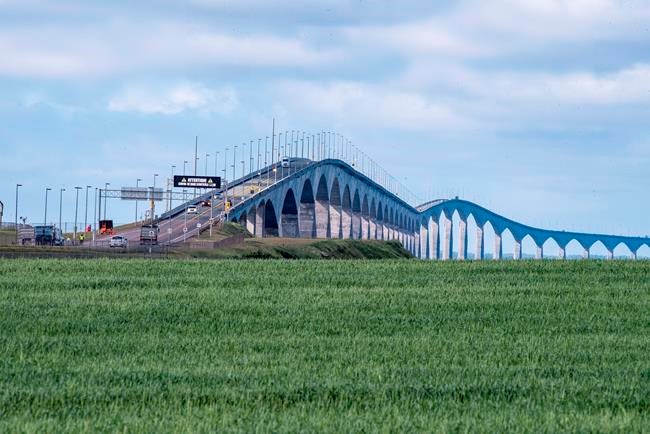
Motorists line up to cross the Confederation Bridge as the so-called tourism bubble for the Atlantic region begins, Friday July 3, 2020. Motorists coming off the bridge from New Brunswick have to go through a check point and present certain documents but they wont have to self isolate for 14 days. The whole process takes less than five minutes depending on the traffic. The same is true for drivers using the Northumberland Ferries at Wood Islands. THE CANADIAN PRESS/Brian McInnis

Meanwhile, the lineup for those heading from Nova Scotia to New Brunswick stretched for several kilometres in the morning.

“Traffic is very heavy today, as expected,” a New Brunswick official said in a brief statement.

“Officers are working hard to welcome travellers efficiently, making adjustments as they go. They were pleased to note that an increasing number of travellers have printed and filled out their roadside questionnaire before arriving at the border, which helped save time.”

The premiers of Newfoundland and Labrador and New Brunswick have hinted restrictions could soon be lifted for visitors from the rest of Canada if all goes well. McNeil said that could happen as early as next week.

Some residents have criticized the so-called “Atlantic bubble” over fears the novel coronavirus could re-emerge in the region, but health officials are encouraging people to trust the science behind the decision and keep following health measures.

Marine Atlantic, which operates the ferry between Nova Scotia and Newfoundland and Labrador, says it’s received 3,000 bookings since the plan was announced. The company says it will gradually increase passenger capacity over several weeks.

The Crown corporation reported that 140 passengers arrived in Port aux Basques, N.L., after the Atlantic bubble opened.

Another vessel with 104 passengers aboard was scheduled to arrive at 6 p.m. Friday, Marine Atlantic said in a statement.

This report by The Canadian Press was first published July 3, 2020.
Report Error Submit a Tip

More Stories

‘A new future’: city dentist Cholakis donates $2M to school of dental hygiene

Melissa Martin 3 minute read Preview

‘A new future’: city dentist Cholakis donates $2M to school of dental hygiene

Melissa Martin 3 minute read Updated: Yesterday at 3:25 PM CDT

Dental hygienist training in Manitoba is getting a big boost, after a major gift from a local dentist.

On Thursday, the dental hygiene school at the University of Manitoba’s Dr. Gerald Niznick College of Dentistry unveiled a new $2-million donation from Dr. Ernest Cholakis. It’s the largest gift the program has ever received, and in honour of the funding, the school will be named the Cholakis School of Dental Hygiene.

The gift was unveiled at a ceremony Thursday morning at the U of M’s Brodie Centre in the Health Sciences Centre complex. The benefactor and other dignitaries, including Premier Wab Kinew, were in attendance, as well as the three-year program’s current students.

Cholakis, who graduated from the U of M’s dentistry school in 1982, had high praise for the dental hygiene profession.

Read
Updated: Yesterday at 3:25 PM CDT

Canada-U.S. trade relationship is broken, but the damage can — and will — be repaired

Tom Brodbeck 5 minute read Preview

Canada-U.S. trade relationship is broken, but the damage can — and will — be repaired

Tom Brodbeck 5 minute read Yesterday at 1:35 PM CDT

Canada needs to get serious about diversifying its trade beyond the United States. But at the same time, Canadians should expect relations with the U.S. to normalize after Donald Trump is no longer in the White House.

For generations, Canada-U.S. trade was considered almost a fact of geography. The two countries share the world’s longest undefended border, deeply integrated supply chains and a century of commercial relationships.

Canadian manufacturers depend on American customers. American manufacturers depend on Canadian suppliers. Energy, agriculture, automotive production and countless other industries operate across the border as though it barely exists.

That isn’t going to change dramatically, even in the midst of a bitter trade war unleashed by the U.S. president.

Read
Yesterday at 1:35 PM CDT

Winnipeg author relies on typewriter collection to punch out manuscripts

Sheldon Birnie 8 minute read Preview

Winnipeg author relies on typewriter collection to punch out manuscripts

Sheldon Birnie 8 minute read Yesterday at 6:22 PM CDT

Local author Michael Clark has not only taken the words “keep at it” to heart, but repeated them so often that last year, his daughter, 29, suggested the pair get matching tattoos bearing the mantra before her wedding.

The words are inked to appear as though they were punched onto his forearm by a typewriter.

Clark has a thing for typewriters. The award-winning crime fiction author figures he has 50 or more stashed in various nooks and crannies of his St. Vital home.

“There’s a joke in the typewriter community: if you leave four typewriters in your car unlocked, when you come back there’ll be three more,” the 57-year-old says with a laugh.

Read
Yesterday at 6:22 PM CDT

Kinew delivered what most of us wanted; now we’ll have to deal with the consequences

Dan Lett 5 minute read Preview

Kinew delivered what most of us wanted; now we’ll have to deal with the consequences

Dan Lett 5 minute read Yesterday at 4:35 PM CDT

Premier Wab Kinew has decided to adopt permanent daylight savings time, which means a permanent end to the spring forward, fall back tradition of adjusting our clocks. And absolutely no one is surprised.

Read
Yesterday at 4:35 PM CDT

‘One of a kind’: CEO, philanthropist Doug Harvey dies at 72

Morgan Modjeski 5 minute read Preview

‘One of a kind’: CEO, philanthropist Doug Harvey dies at 72

Morgan Modjeski 5 minute read Updated: Yesterday at 12:57 PM CDT

Doug Harvey, a Winnipeg business titan and philanthropist, has died after battling cancer for more than a decade.

Harvey gave millions of dollars to Winnipeg organizations while he was CEO of DLH Group, a nationwide network of businesses that support heavy duty truck and trailer users.

Loren Remillard, CEO and president of the Winnipeg Chamber of Commerce, said the business community is mourning the loss of the influential businessman who helped shape Winnipeg.

“We are a transportation and logistics hub in Winnipeg and it was partly the result of geography, and a big part because of leaders and visionaries like Doug Harvey,” he said.

Read
Updated: Yesterday at 12:57 PM CDT

Gerdau recycling workers on strike

Gabrielle Piché 3 minute read Preview

Gerdau recycling workers on strike

Gabrielle Piché 3 minute read Yesterday at 7:29 PM CDT

Workers behind recycling operations for Selkirk’s steel mill walked off the job last week, calling for higher wages.

Unionized members voted to strike July 23, with a 92 per cent mandate. Months of bargaining hasn’t produced a new deal, said United Steelworkers Local 8740. The union represents 78 members striking at Gerdau AmeriSteel Manitoba Metals recycling plant.

“We’re not being recognized for the amount of work we’ve been doing,” Andrew Sealey, acting president of the local, said Thursday. “The mill is a sensational beast … We’ve got to feed her all the time, and she’s always hungry.”

The scrap metal inspected and unloaded at the recycling facility is used in steel mill operations.

Read
Yesterday at 7:29 PM CDT