B.C. offers rights advisers for mentally ill patients who are involuntarily detained

Advertisement

Advertise with us

VANCOUVER - British Columbia has introduced legislation that would allow people to get independent advice about their rights after they've been involuntarily detained for treatment of a severe mental health disorder.

Read this article for free:


or

Already have an account? Log in here »

To continue reading, please subscribe:

Subscribe and receive a limited-edition Free Press branded hat or tote.

Digital Subscription

One year of digital access for only $205*

  • Enjoy unlimited reading on winnipegfreepress.com
  • Read the E-Edition, our digital replica newspaper
  • Access News Break, our award-winning app
  • Play interactive puzzles

*First annual payment billed as $205.00 + GST for one year. This annual subscription will automatically renew at $233.00 + GST every 52 weeks (10% off the regular annual price of $259.35). Offer available to new and qualified returning subscribers only. Cancel any time.

To continue reading, please subscribe:

Add Free Press access to your Brandon Sun subscription for only an additional

$1 for the first 4 weeks*

  • Enjoy unlimited reading on winnipegfreepress.com
  • Read the E-Edition, our digital replica newspaper
  • Access News Break, our award-winning app
  • Play interactive puzzles
Start now

*Your next Brandon Sun subscription payment will increase by $1.00 and you will be charged $17.95 plus GST for four weeks. After four weeks, your payment will increase to $24.95 plus GST every four weeks.

Hey there, time traveller!
This article was published 28/04/2022 (1619 days ago), so information in it may no longer be current.

VANCOUVER – British Columbia has introduced legislation that would allow people to get independent advice about their rights after they’ve been involuntarily detained for treatment of a severe mental health disorder.

The province’s Mental Health Act allows those in crisis to be treated for their own protection, or the protection of others.

Mental Health and Addictions Minister Sheila Malcolmson said Thursday the rights-advice service is aimed at assuring people will be treated fairly.
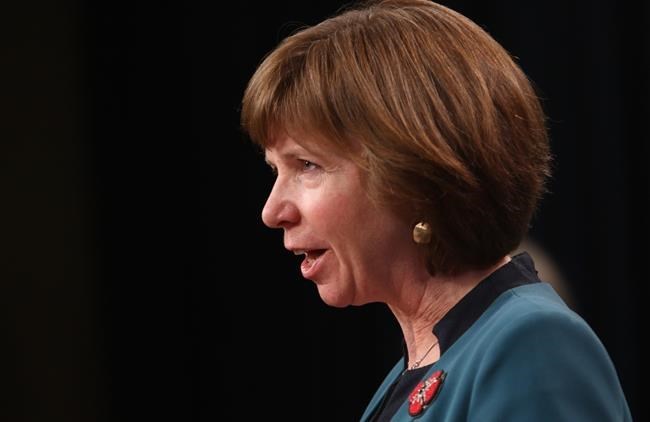
Sheila Malcolmson speaks during a news conference in the press gallery at the Legislature in Victoria, Monday, Nov. 1, 2021. British Columbia has introduced legislation that would allow people to get independent advice about their rights after they've been involuntarily detained for treatment of a severe mental health disorder. The mental health and addictions minister says the rights-advice service is aimed at assuring people will be treated fairly. THE CANADIAN PRESS/Chad Hipolito

The service is expected to be available early next year, but patients must request it, the Attorney General’s Ministry said.

“Patients will be notified of the option to speak with a mental health rights adviser upon admission, transfer or renewal of involuntary status by a staff person,” it said in a written statement.

The rights-advice service will later be automatically notified, though a timeline for when that could happen has not been set, the ministry said of the service, which will mostly be available by video conferencing and phone.

It said in-person appointments may be available in some circumstances, including for patients with a disability or other health condition that could make virtual communication difficult.

The number of patients admitted involuntarily in B.C. has risen significantly in recent years, with increases in mental health and substance use disorders contributing significantly to that trend, the ministries of Mental Health and Addictions and Attorney General said in a release.

Laura Johnston, legal director of Health Justice, an advocacy group promoting human rights in mental health and substance use care in the province, said a legal advice service that is not automatically triggered from the start would end up being inaccessible.

It should also remain independent from health authorities because the bill introduced Thursday does not define independence, she said.

“I’m not saying that this will lack independence, but that’s something we’ll be keeping an eye on.”

Johnston also said many people experiencing a mental health crisis may need personal contact with an adviser on a ward in order to provide the most benefit from the service that many patients themselves have long lobbied for.

“That means that the person actually gets to sit down with their rights adviser and have a meaningful connection and contact with them,” she said. “It also means that we’re really opening up the doors on the detaining facilities because now there will be independent eyes on the ward about the practices that are taking place.”

Those who struggle with technology, don’t speak English or may be suffering to the point that they think they’re under surveillance when going online would also need to have a legal adviser visit them, Johnston said.

She called the provision a positive step, but said other updates are needed because the Mental Health Act has not been changed since it was introduced in the 1960s and needs a major overhaul, especially during an overdose crisis.

“We’ve seen consistently that our province has fallen far behind other places in Canada when it comes to making sure our mental health laws and policies and practices are evidence-based,” Johnston said.

An overreliance on involuntary practices that some consider coercive can create harmful interactions in the health-care system, she said, adding the use of seclusion rooms and mechanical restraints in some cases have caused long-lasting trauma.

Patients currently sign a rights-advice form, but British Columbia’s ombudsperson, Jay Chalke, has criticized the province for failing to ensure it does get signed.

He said in a 2019 report that a month-long audit of all provincial psychiatric facilities showed the form was not found in 51 per cent of patient files.

Chalke’s report highlighted the need for facilities to have all legally required forms completed and ensure patients, who are at significant risk because of their illness, know about their right to speak to a lawyer.

Alberta, Saskatchewan, Ontario, New Brunswick, Nova Scotia, and Newfoundland and Labrador already offer rights-advice services for people who are involuntarily admitted under mental health legislation.

This report by The Canadian Press was first published April 28, 2022.

Report Error Submit a Tip

More Stories

Khan should’ve taken high road: Goertzen

Carol Sanders 5 minute read Preview

Khan should’ve taken high road: Goertzen

Carol Sanders 5 minute read Yesterday at 6:39 PM CDT

The veteran Progressive Conservative who championed Obby Khan’s leadership bid says the former Blue Bomber dropped the ball by dissing his Tory teammates before he stepped down.

“I wouldn’t recommend it, and I didn’t recommend it,” Kelvin Goertzen (Steinbach) said in an interview Friday.

Khan resigned as PC leader and quit the caucus Monday saying some members were secretly plotting his ouster, even after he won a confidence vote on Sept. 25.

On Tuesday, Khan lashed out in a CJOB interview, naming the alleged plotters, saying constituents deserved to know which of their elected representatives “lacked moral integrity.” Khan told the Free Press he was “deeply emotionally hurt,” and felt stabbed in the back.

Read
Yesterday at 6:39 PM CDT

J’accuse!: Kinew uses French to fry interim Tory leader over alleged caucus subterfuge

Chris Kitching and Maggie Macintosh 4 minute read Preview

J’accuse!: Kinew uses French to fry interim Tory leader over alleged caucus subterfuge

Chris Kitching and Maggie Macintosh 4 minute read Thursday, Oct. 1, 2026

NDP Premier Wab Kinew took a dig at the Progressive Conservatives’ leadership change while facing off with Obby Khan’s short-term replacement for the first time in question period Thursday.

Read
Thursday, Oct. 1, 2026

What’s luck got to do with it?

Tim Kist 5 minute read 2:01 AM CDT

We all seek certainty in our daily lives. We expect if we make a decision, the outcome will be just as we planned: a direct correlation between the decision and result.

You, as a business leader, seek the same certainty from the decisions you make. And sometimes, the result is what was expected. Sometimes, it isn’t.

The big question is: why is it so difficult to achieve the business results you expect when you carefully craft your plans and seemingly make good decisions?

The truth is we cannot predict the future. This means we almost never know precisely how customers will respond to a sales quote, what competitors are planning, and a myriad of other external variables at play.

A spiritual vision will help anchor a health civic outlook

John Longhurst 5 minute read 2:01 AM CDT

We have an election coming up. With that in mind, the Free Press asked some of their columnists to write about the challenges ahead and how the city can become better.

For Tom Brodbeck, the main challenge is finances — and how candidates will pay for their many promises for fixing roads, improving public safety and making transit better.

Rebecca Chambers said that the concerns of inner-city residents need to be taken seriously by those who aspire to work at city hall.

Niigaan Sinclair said the most pressing issue in Winnipeg isn’t construction projects, light-rail transit, public safety, taxes or social services. For him, it’s the city’s relationship with Indigenous people.

Confidence vote was gamble for MLA, Tories: political expert

Alex Lambert 5 minute read Preview

Confidence vote was gamble for MLA, Tories: political expert

Alex Lambert 5 minute read Thursday, Oct. 1, 2026

BRANDON — A Progressive Conservative MLA’s decision to put forward a confidence motion against the party’s former leader carries a lot of risk for her and the Tories, a political science expert says.

Obby Khan resigned as leader of the PCs on Monday after Jodie Byram (Agassiz) initiated a confidence vote against him the previous week.

The majority of the PC caucus voted in favour of Khan, but he resigned a few days later, citing continued efforts to undermine him by a minority of MLAs.

Brandon University political science Prof. Kelly Saunders said while she doesn’t know what Byram’s motivations were for triggering the vote, such a move carries a lot of risk.

Read
Thursday, Oct. 1, 2026

The idea of Alberta separation viewed through a faith lens shows further fracture lines

Josiah Neufeld 10 minute read Preview

The idea of Alberta separation viewed through a faith lens shows further fracture lines

Josiah Neufeld 10 minute read 2:01 AM CDT

CALGARY — One morning in May, John Pentland, a minister at Hillhurst United Church in Calgary, opened his newspaper and read about a group of Albertans who were trying to divide his country.

Something inside of him felt like it cracked open. He started to weep.

“I couldn’t stop, I couldn’t breathe,” he said. He called a friend and told him: “I think I’m losing my mind.”

Pentland has always believed in Canada — flawed as it might be — as a nation gifted with diversity and welcoming of asylum seekers, refugees and immigrants. But recently that belief has been shaken as he’s witnessed right-wing ideologies charged with anti-immigrant sentiment take root in his province. It makes him angry and embarrassed for the country he loves.

Read
2:01 AM CDT