DOJ will ask Supreme Court to halt Texas abortion law
Advertisement
Read this article for free:
or
Already have an account? Log in here »
To continue reading, please subscribe:

Digital Subscription
One year of digital access for only $205*
- Enjoy unlimited reading on winnipegfreepress.com
- Read the E-Edition, our digital replica newspaper
- Access News Break, our award-winning app
- Play interactive puzzles
*First annual payment billed as $205.00 + GST for one year. This annual subscription will automatically renew at $233.00 + GST every 52 weeks (10% off the regular annual price of $259.35). Offer available to new and qualified returning subscribers only. Cancel any time.
To continue reading, please subscribe:
Add Free Press access to your Brandon Sun subscription for only an additional
$1 for the first 4 weeks*
- Enjoy unlimited reading on winnipegfreepress.com
- Read the E-Edition, our digital replica newspaper
- Access News Break, our award-winning app
- Play interactive puzzles
*Your next Brandon Sun subscription payment will increase by $1.00 and you will be charged $17.95 plus GST for four weeks. After four weeks, your payment will increase to $24.95 plus GST every four weeks.
Read unlimited articles for free today:
or
Already have an account? Log in here »
Hey there, time traveller!
This article was published 14/10/2021 (1788 days ago), so information in it may no longer be current.
AUSTIN, Texas (AP) — The Biden administration said Friday it will turn next to the U.S. Supreme Court in another attempt to halt a Texas law that has banned most abortions since September.
The move comes as the Texas clinics are running out of avenues to stop the GOP-engineered law that bans abortions once cardiac activity is detected, which is usually around six weeks. It amounts to the nation’s biggest curb to abortion in nearly 50 years and makes no exception for cases of rape or incest.
By going to the Supreme Court, the Justice Department is taking the route that clinics have sought as other legal challenges have failed. In the meantime, Texas women have turned to abortion clinics in neighboring states, some driving hours through the middle of the night and including patients as young as 12 years old.
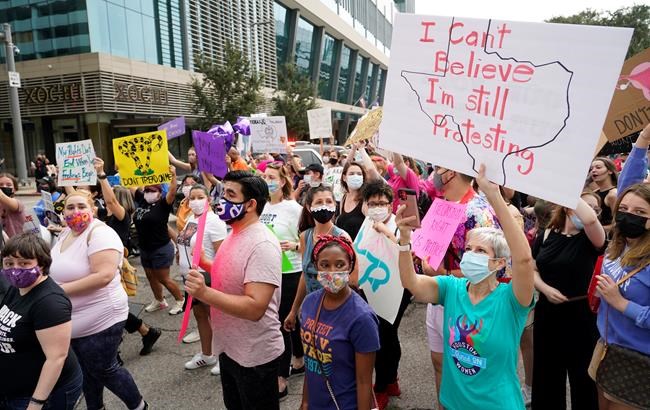
“People are scared, confused, and other than very early abortion, have nowhere to turn to access safe, legal abortion unless they are able to travel hundreds of miles to another state,” said Jeffrey Hons, president of Planned Parenthood South Texas, whose clinics have stopped offering all abortion services since the law took effect Sept. 1.
The latest defeat for clinics came Thursday night when a federal appeals panel in New Orleans, in a 2-1 decision, allowed the restrictions to remain in place for a third time in the last several weeks alone. Justice Department spokesman Anthony Coley said the federal government will now ask the Supreme Court to reverse that decision but did not say how quickly.
The court already once allowed the restrictions to take effect, but did so without ruling on the law’s constitutionality.
The Texas Attorney General’s Office called Thursday night’s decision by the 5th U.S. Circuit Court of Appeals a “testament that we are on the right side of the law and life.”
A 1992 decision by the Supreme Court prevented states from banning abortion before viability, the point at which a fetus can survive outside the womb, around 24 weeks of pregnancy. But Texas’ law has outmaneuvered courts so far because it offloads enforcement to private citizens. Anyone who brings a successful lawsuit against an abortion provider for violating the law is entitled to claim at least $10,000 in damages, which the Biden administration says amounts to a bounty.
Only once has a court moved to put the restrictions on hold — and that order stood for just 48 hours.
During that brief window, some Texas clinics rushed to perform abortions on patients past six weeks, but many more appointments were canceled after the 5th Circuit moved to swiftly reinstate the restrictions last week.

Texas had roughly two dozen abortion clinics before the law took effect, and operators have said some may be forced to close if the restrictions stay in place for much longer.
Texas Right to Life, the state’s largest anti-abortion group, set up a tip line to receive allegations against abortion providers but has not filed any lawsuits. Kimberlyn Schwartz, a spokeswoman, said Thursday the group expected the Biden administration to go to the Supreme Court next and was “confident Texas will ultimately defeat these attacks on our life-saving efforts.”
Already the stakes are high in the coming months over the future of abortion rights in the U.S. In December, the new conservative majority on the Supreme Court will hear Mississippi’s bid to overturn the landmark Roe v. Wade decision that guarantees a woman’s right to an abortion.
On Wednesday, 18 state attorneys generals from mostly GOP-controlled states threw new support behind the Texas law, urging the court to let the restrictions stand while accusing the federal government of overstepping in bringing the challenge in the first place. Last month, more than 20 other states, mostly run by Democrats, had urged the lower court to throw out the law.
U.S. Attorney General Merrick Garland has called the law “clearly unconstitutional” and warned that it could become a model elsewhere in the country unless it’s struck down.