COVID-19 behind one per cent cut to Vancouver’s policing budget: council

Advertisement

Advertise with us

VANCOUVER - The union representing Vancouver's police officers joined the police chief Thursday in criticizing a budget cut passed by city council, arguing their services shouldn't be reduced during the COVID-19 pandemic.

Read this article for free:


or

Already have an account? Log in here »

To continue reading, please subscribe:

Subscribe and receive a limited-edition Free Press branded hat or tote.

Digital Subscription

One year of digital access for only $205*

  • Enjoy unlimited reading on winnipegfreepress.com
  • Read the E-Edition, our digital replica newspaper
  • Access News Break, our award-winning app
  • Play interactive puzzles

*First annual payment billed as $205.00 + GST for one year. This annual subscription will automatically renew at $233.00 + GST every 52 weeks (10% off the regular annual price of $259.35). Offer available to new and qualified returning subscribers only. Cancel any time.

To continue reading, please subscribe:

Add Free Press access to your Brandon Sun subscription for only an additional

$1 for the first 4 weeks*

  • Enjoy unlimited reading on winnipegfreepress.com
  • Read the E-Edition, our digital replica newspaper
  • Access News Break, our award-winning app
  • Play interactive puzzles
Start now

*Your next Brandon Sun subscription payment will increase by $1.00 and you will be charged $17.95 plus GST for four weeks. After four weeks, your payment will increase to $24.95 plus GST every four weeks.

Hey there, time traveller!
This article was published 14/05/2020 (2316 days ago), so information in it may no longer be current.

VANCOUVER – The union representing Vancouver’s police officers joined the police chief Thursday in criticizing a budget cut passed by city council, arguing their services shouldn’t be reduced during the COVID-19 pandemic.

City council passed a motion Wednesday to reduce the police department’s $314 million budget by one per cent, equating to about a $3.5 million budget cut.

The Vancouver Police Union estimates that could rise to $8.5 million depending on the outcome of arbitration related to a collective bargaining agreement.
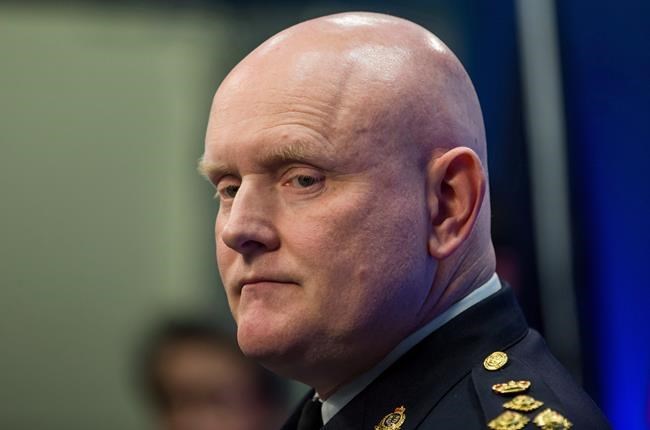
Vancouver Police Chief Adam Palmer pauses during a news conference in Vancouver, B.C., on Monday January 22, 2018. The union representing Vancouver's police officers joined the police chief Thursday in criticizing a budget cut passed by city council, arguing their services shouldn't be reduced during the COVID-19 pandemic. THE CANADIAN PRESS/Darryl Dyck

About 27 per cent of the city’s revenue is spent on police services.

“These are really tough discussions we’re having and it’s a result of our revenue loss,” Mayor Kennedy Stewart told a news conference on Thursday. “We’ve had negotiations with the other unions about how we can at least slow down further layoffs or postpone them and this is just another one of those discussions.”

Police officers are already expressing worries over the proposed cuts, said union president Ralph Kaisers.

“Our members are concerned. My phone has exploded today with concerns and comments,” he said. “Now’s not the time for cuts.”

In a statement, police Chief Adam Palmer criticized the secretive nature of the cuts, which were debated in an in-camera meeting.

“There was zero consultation with the Vancouver Police Board, VPD, or any VPD unions on the motion itself and how it will affect the safety and security of Vancouver residents,” Palmer said.

Palmer said city, library and park board layoffs were related to a decline in demand for services, which isn’t the case for the police.

Stewart acknowledged the work Vancouver’s police force does, but argued the cuts are the result of the financial fallout the city is facing.

“I think all of us are aware how essential police are during times of crisis and I think people would also recognize that the city is under significant financial challenges and we have to find a way forward that best works for everybody,” Stewart said.

The police department recently returned to 2009 staffing levels, while Vancouver’s population has increased by 11 per cent, the police board’s finance committee chairman wrote in a letter to city council before the motion was approved.

“Any service reductions would have a disproportionate negative impact to such a marked degree that these impacts would outweigh the potential savings that could be achieved,” Barj Dhahan wrote.

Another factor complicating budget cuts is the creation of a new police department in nearby Surrey to replace the RCMP with Vancouver facing an “impending threat” to retaining its officers, Dhahan added.

Kaisers agrees the creation of a new force in Surrey is a factor for Vancouver’s police officers.

“There’s going to be a great opportunity in a new organization with chances for advancement that they maybe wouldn’t have had there,” said Kaisers, who estimated that a few hundred of the union’s members could leave for the new force.

The city says the pandemic has resulted in a 27 per cent drop in business revenues, with 13,400 businesses closing down and 90,000 jobs lost in April.

Council says a revenue loss of $152 million is projected for the city and it’s required by law to balance its books.

Stewart reiterated his call for more funding from the provincial and federal governments.

City council will look for ways of helping businesses reopen with an added emphasis on plans that help women and seniors because those groups have been hit harder than others by the pandemic, Stewart said.

This report by The Canadian Press was first published May 14, 2020.

Note to readers: This is a corrected story. A previous version based on information provided by the city said Vancouver has seen a $27 billion drop in business revenues.
Report Error Submit a Tip

More Stories

You can’t hold a government accountable for what it won’t let you see.

That is the uncomfortable lesson from the dispute between Progressive Conservative health critic Kathleen Cook and Prairie Mountain Health over her recent attempt to visit the Dauphin Regional Health Centre.

Cook wanted to see the temporary emergency department that reopened Sept. 7 after flooding forced the hospital to close in July. She wanted to speak with officials about the reopening, the challenges they were facing and the work still required.

Prairie Mountain Health said no.

Nothing wrong with planting trees, but it won’t get province very far on path to net zero

Dan Lett 5 minute read Preview

Nothing wrong with planting trees, but it won’t get province very far on path to net zero

Dan Lett 5 minute read Monday, Sep. 14, 2026

Manitoba’s new plan to achieve net zero carbon emissions by 2050 is a lot of things. It’s detailed. It’s certainly comprehensive in scope. But when it is all said and done, it is still very much a work in progress.

Read
Monday, Sep. 14, 2026

Police cracking down on gangs, organized crime in bars and lounges

Nicole Buffie 4 minute read Preview

Police cracking down on gangs, organized crime in bars and lounges

Nicole Buffie 4 minute read Updated: Yesterday at 6:56 PM CDT

Patrons can expect to see more police officers in and around bars and lounges in the coming months as the Winnipeg Police Service plans to crack down on gangs and organized crime.

Uniformed officers will be patrolling bars, lounges and other licensed establishments, targeting gang members and people associated with organized crime. Priority will be given to those who pose the greatest risk to public safety, WPS said in a news release Tuesday.

“We’ve seen — time and time again — where people involved in gangs, in organized crime, attract violence or commit violence, on people who they would perceive as their rivals,” Insp. Josh Ewatski, who heads the service’s organized crime unit said, noting the plan was in the works for a while.

He said while there was no specific incident that resulted in the new push, but said violence — including stabbings, assaults and shootings — over the years is behind the move.

Read
Updated: Yesterday at 6:56 PM CDT

Winnipeg, police and downtown crime

Editorial 4 minute read Preview

Winnipeg, police and downtown crime

Editorial 4 minute read 2:01 AM CDT

A safer downtown is not much use if people are still afraid to walk there.

That is the uncomfortable message from Winnipeg’s latest police citizen survey, and one city council should take seriously.

Downtown crime has fallen this year, according to the most recent police statistics. Violent crime is down even more. But for most Winnipeggers, the downtown still feels like a place to avoid, particularly after dark.

Only 44 per cent of survey respondents said they feel very or reasonably safe walking alone downtown during the day. At night, that number plunges to just eight per cent. Among women, it is an appalling three per cent, compared with 14 per cent of men.

Read
2:01 AM CDT

Putting together annual fashion show takes many hard-working hands

AV Kitching 8 minute read Preview

Putting together annual fashion show takes many hard-working hands

AV Kitching 8 minute read 2:00 AM CDT

A frenzy of activity is taking place behind the closed doors of WAG-Qaumajuq on Monday. It’s the day before Crafted on the Catwalk, the gallery’s annual fashion and design show, and the clock is ticking.

There’s less than 30 hours before the big event and it’s all hands on deck.

A steady stream of people walk in and out of the Memorial Boulevard entrance towards the main hall, which glows in soft hues as technicians test out lighting equipment.

The ground floor is teeming with people lugging chairs and pushing trolleys. A stream of white material unravelling from its roll prompts a shouted “OK to step on this?” and receives an equally loud ‘No!” in reply, voices raised above the metallic buzz of a drill as staff from a local production company put together seats.

Read
2:00 AM CDT

Food literacy curriculum on the menu

Maggie Macintosh 5 minute read Preview

Food literacy curriculum on the menu

Maggie Macintosh 5 minute read 2:01 AM CDT

Manitoba has a new recipe for health class and “food literacy” is a key ingredient.

The in-class portion of phys-ed has historically involved lessons about puberty, the risks of consuming drugs and dissecting Canada’s food guide.

A new pilot program asks teachers to expand their nutrition units and include in-depth discussions about how everything from diet culture to food insecurity affects eating habits.

“This is really moving beyond a conception of food as only fuel, where you just boil down food to its calories, its vitamins,” said Sarah Elvins, a food historian at the University of Manitoba who researches popular culture and marketing.

Read
2:01 AM CDT