Electronic tool effective in reducing overmedication in seniors, study finds

Advertisement

Advertise with us

MONTREAL - Many of Canada's seniors ingest a worrying, and perhaps unnecessary, amount of medication, according to the lead author of a new study that found a Canadian-made electronic tool is effective in safely reducing the medication overload.

Read this article for free:

or

Already have an account? Log in here »

To continue reading, please subscribe:

Subscribe and receive a limited-edition Free Press branded hat or tote.

Digital Subscription

One year of digital access for only $205*

  • Enjoy unlimited reading on winnipegfreepress.com
  • Read the E-Edition, our digital replica newspaper
  • Access News Break, our award-winning app
  • Play interactive puzzles

*First annual payment billed as $205.00 + GST for one year. This annual subscription will automatically renew at $233.00 + GST every 52 weeks (10% off the regular annual price of $259.35). Offer available to new and qualified returning subscribers only. Cancel any time.

To continue reading, please subscribe:

Add Free Press access to your Brandon Sun subscription for only an additional

$1 for the first 4 weeks*

  • Enjoy unlimited reading on winnipegfreepress.com
  • Read the E-Edition, our digital replica newspaper
  • Access News Break, our award-winning app
  • Play interactive puzzles
Start now

*Your next Brandon Sun subscription payment will increase by $1.00 and you will be charged $17.95 plus GST for four weeks. After four weeks, your payment will increase to $24.95 plus GST every four weeks.

Hey there, time traveller!
This article was published 08/10/2019 (2487 days ago), so information in it may no longer be current.

MONTREAL – Many of Canada’s seniors ingest a worrying, and perhaps unnecessary, amount of medication, according to the lead author of a new study that found a Canadian-made electronic tool is effective in safely reducing the medication overload.

The study by the Research Institute of the McGill University Health Centre was conducted with patients 65 and over who took five or more medications a day. It found doctors could safely reduce the number of medications given to their patients by using MedSafer, an electronic tool that helps monitor the different medications and flag potentially inappropriate ones.

Lead author Emily McDonald, a researcher and internal medicine physician at the McGill University Health Centre in Montreal, said taking multiple medications can be dangerous to people 65 and up, who are vulnerable to side effects.
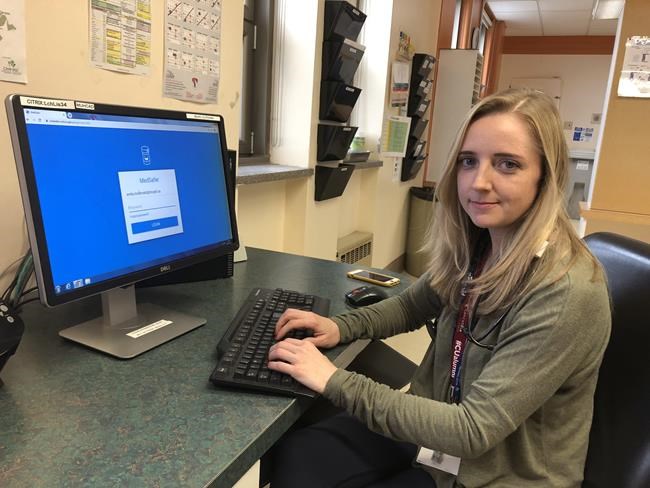
Dr. Emily McDonald, co-creator of MedSafer, first author of the study, and scientist at the RI-MUHC and physician in the Division of General Internal Medicine at the MUHC, is shown in a handout photo. THE CANADIAN PRESS/HO-Research Institute of the McGill University Health Centre MANDATORY CREDIT

Currently, some 40 per cent of older adults take five or more medications per day. In addition to the risk of side effects or complications, McDonald says some medications may not be appropriate for certain health problems, which can make seniors vulnerable to additional hospitalizations, memory problems, dizziness, and balance problems that lead to falls and fractures.

“It’s one of the most common causes of hospital visits,” she said in a phone interview.

“In seniors, polypharmacy — taking multiple medications — has increased enormously in recent years. We’re talking about taking five, 10, even 15 medications.”

While lists of potentially harmful medication combinations exist already, it can be complicated and time-consuming for doctors to research them, especially when several people are involved in a patient’s care.

“Performing a prescription checkup is a complex process for interprofessional teams, and often involves complicated decision-making,” she explained.

A desire to address the problem led McDonald and study co-author Todd Lee to create MedSafer. It checks the different combinations of medications prescribed to a patient and offers a recommendation of whether any can be safely stopped or reduced. Designed specifically for seniors, the tool can be used by doctors, pharmacists and nurse practitioners.

The goal of the study, published in September in the Journal of the American Geriatrics Society, was to see if the tool was useful in tapering off medications, and if it was safe to do so.

“Often, clinicians don’t want to stop a medication because they’re afraid of causing secondary reactions for the patient in withdrawing the medication,” McDonald said.

The study took place between Sept 2016 and May 2017 with 1,066 hospital patients at four research centres in Montreal, Ottawa and Toronto.

An initial report by MedSafer showed that 82 per cent of the subjects were receiving a potentially inappropriate medication. That triggered a review by a doctor, who made the final decision on whether the medication was necessary.

Later, the researchers compared the results of patients whose doctors had used MedSafer to those who had received the usual care. It found that 54.7 per cent of patients in the MedSafer group had had a medication de-prescribed by the time they were discharged, compared with 46.9 per cent for the second group.

The researchers believe the difference may be even greater in other clinical settings where there are fewer drug experts on site, such as long-term care homes.

Following the results of the study, MedSafer will be deployed in long-term care units in New Brunswick and Ontario. In Quebec, McDonald is hoping to start a pilot project at Lachine Hospital, part of the McGill University Health Centre.

McDonald said the researchers interviewed the patients and their families a month after leaving hospital and found the health of the MedSafer group was no worse as a result of the reduction in medication.

“There was no increase in no adverse effects,” McDonald said. “It’s safe.”

This report by The Canadian Press was first published Oct. 8, 2019.

Report Error Submit a Tip

More Stories

Time for a democratic reset

John R. Wiens 5 minute read 2:00 AM CDT

‘Amor mundi’, love of the world, is a basic tenet of Hannah Arendt’s philosophy of life and closely related to her idea of republican (i.e., democratic) politics. Currently, Western democracies have strayed far from the ideals stressed in this view.

Leave lonely lake life and get back to busy

Maureen Scurfield 5 minute read Yesterday at 2:00 AM CDT

DEAR MISS LONELYHEARTS: I’m going crazy! My husband and I are living up at a lake for the first summer after buying a beautiful new cabin. I thought it was going to be heaven, but it’s been hell for me.

I’m not retired, but I’m able to work at my office job remotely for the summer. The problem is, I’m already lonely and bored while my husband is out fishing. My man goes off in the boat with his buddies in the early morning, often for the whole day and the early evening, too. Now he says he’s “in fisherman’s heaven” with his retired buddies who go explore the many great angling lakes around us.

If it goes on all summer and into early fall, and I’ll be out of my mind by then. Most of the other guys’ wives stay back in the city now. They learned early on it’s a drag to be a fisherman’s “widow.”

I called my boss this morning after my husband left to go fishing. My manager says they’re really busy right now, and could use me there ASAP. Yay! I can come back to the office as soon as I want, but I feel guilty about leaving my husband alone. What should I do?

Decision on corridor for Trans-Canada twinning near Ontario border expected this fall, province says

Chris Kitching 4 minute read Preview

Decision on corridor for Trans-Canada twinning near Ontario border expected this fall, province says

Chris Kitching 4 minute read Updated: Yesterday at 5:24 PM CDT

The Manitoba government is taking more time to evaluate and select a preferred corridor for the twinning of a 16-kilometre section of the Trans-Canada Highway near the Ontario boundary.

An earlier timeline indicated Manitoba Transportation and Infrastructure expected to choose an alignment by the fall of 2025. A provincial spokesperson told the Free Press on Monday a decision is expected this winter, but a different spokesperson said Wednesday a decision is expected this fall.

“The department continues to evaluate corridor alternatives and will undertake additional geotechnical, environmental and design work as part of the (functional design study) to support the selection of a preferred corridor,” the spokesperson said in a statement.

The study, which will include Crown-Indigenous and public consultation, is expected to be completed in late 2027, with a detailed design to follow.

Read
Updated: Yesterday at 5:24 PM CDT

Good Samaritan stabbed attempting to help with suspected overdose

1 minute read Updated: Yesterday at 2:07 PM CDT

A Good Samaritan who was trying to help a woman who appeared to be suffering from a drug overdose on Tuesday night was instead stabbed by her companion, police say.

The victim, a 51-year-old man, came across the woman near Jubilee Avenue and Osborne Street at about 9:15 p.m. on Tuesday and tried to assist her, before a suspect came up and stabbed him in the upper body. Police say the suspect knows the woman.

The 51-year-old was rushed to hospital in unstable condition, where he was given medical treatment. The woman, too, was taken to hospital for medical attention. Winnipeg Fire Paramedic Service personnel alerted police to the incident.

Patrol officers, along with a police dog unit, found the suspect on the 400 block of Brandon Avenue just before 11 p.m. He tried to run, but officers made the arrest and seized two knives, police said.

Use it twice: a data centre we could support

Hersh Seth 5 minute read Preview

Use it twice: a data centre we could support

Hersh Seth 5 minute read 2:00 AM CDT

In June, Premier Wab Kinew rejected a massive AI data centre planned near Île-des-Chênes. The project would have used 500 megawatts of power, which is about the same as the Grand Rapids generating station, and would have run on six natural gas turbines. Kinew said the environmental cost was too high and the long-term benefit for Manitobans was too low.

Read
2:00 AM CDT

Former teacher would suit up with Bombers in just ninth game of three-down loop career

Taylor Allen 6 minute read Preview

Former teacher would suit up with Bombers in just ninth game of three-down loop career

Taylor Allen 6 minute read Tuesday, Jul. 28, 2026

In a way, Micah Vanterpool’s brief stint as a Grade 3 teacher in his hometown of Tulsa, Okla., prepared him for life in the CFL.

The third-year offensive lineman for the Winnipeg Blue Bombers only has eight career games on his resumé as he has bounced around between the practice roster, starting lineup and injury report.

But thanks to his time in the classroom, he’s developed the patience that’s required by a young American trying to make a name for oneself in the three-down loop.

Vanterpool got into teaching after failing to make the New England Patriots in 2023. He said goodbye to the education profession the following year and took his talents up north to Winnipeg.

Read
Tuesday, Jul. 28, 2026