First year of COVID-19 pandemic saw fewer Alberta stroke patients, more deaths: study

Advertisement

Advertise with us

CALGARY - The first year of the COVID-19 pandemic in Alberta saw fewer stroke patients, but a higher number of stroke-related deaths, according to new research.

Read this article for free:


or

Already have an account? Log in here »

To continue reading, please subscribe:

Subscribe and receive a limited-edition Free Press branded hat or tote.

Digital Subscription

One year of digital access for only $205*

  • Enjoy unlimited reading on winnipegfreepress.com
  • Read the E-Edition, our digital replica newspaper
  • Access News Break, our award-winning app
  • Play interactive puzzles

*First annual payment billed as $205.00 + GST for one year. This annual subscription will automatically renew at $233.00 + GST every 52 weeks (10% off the regular annual price of $259.35). Offer available to new and qualified returning subscribers only. Cancel any time.

To continue reading, please subscribe:

Add Free Press access to your Brandon Sun subscription for only an additional

$1 for the first 4 weeks*

  • Enjoy unlimited reading on winnipegfreepress.com
  • Read the E-Edition, our digital replica newspaper
  • Access News Break, our award-winning app
  • Play interactive puzzles
Start now

*Your next Brandon Sun subscription payment will increase by $1.00 and you will be charged $17.95 plus GST for four weeks. After four weeks, your payment will increase to $24.95 plus GST every four weeks.

Hey there, time traveller!
This article was published 27/03/2022 (1651 days ago), so information in it may no longer be current.

CALGARY – The first year of the COVID-19 pandemic in Alberta saw fewer stroke patients, but a higher number of stroke-related deaths, according to new research.

The study, published Monday in the Canadian Medical Association Journal, was conducted by a team of eight doctors and other researchers across the province.

“One of the things that we began to realize within the first few months of the pandemic … is that there seemed to be a decline in the number of people presenting with acute strokes,” lead author Dr. Aravind Ganesh, a neurologist at the University of Calgary, said in an interview.

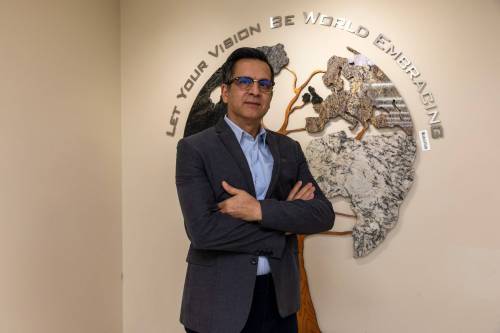
Dr. Aravind Ganesh, assistant professor of neurology at the University of Calgary, is pictured at the Cumming School of Medicine in Calgary, Alta., Thursday, March 24, 2022.THE CANADIAN PRESS/Jeff McIntosh

Several countries, he said, had started noticing a trend of fewer people seeking emergency care for a variety of medical issues during the pandemic.

“The question that people started asking was whether the … public health restrictions that we had implemented as a result of the pandemic might be having some unintended consequences of dissuading people from attending at the hospital for emergencies like stroke and heart disease,” said Ganesh.

“So, the premise for this study came from this very legitimate worry on our part.”

Researchers looked at data for 19,531 Alberta patients from January 2016 to February 2020 and another 4,900 patients during the first year of the COVID-19 pandemic.

“In the first wave of the pandemic in Alberta, we had quite a decline in the number of people who were presenting with acute ischemic stroke — that’s strokes because of blood clots in the brain,” explained Ganesh.

“Along with that, we also found the that the use of stroke therapies … declined by about the same amount.”

Researchers also found that the number of patients with stroke symptoms did not return to pre-pandemic levels after the first wave in spring 2020.

“Especially during the second- and third-wave periods of our study, when COVID-19 cases surged, we expected to observe an increase in stroke presentations instead of declines,” they write in the study.

Ganesh said he and other researchers were able to look at what happened to those patients by studying how many people died due to strokes.

“We found those out-of-hospital deaths ended up rising four out of the five time periods in the pandemic,” he said. “We ended up being able to find some of these missing strokes that way.”

Similar results were found in hospitals.

“During the second wave of the pandemic and the third wave of the pandemic, more people ended up dying in hospital who had strokes,” he said.

The study looked at population-level data, so it’s not clear why people decided not to seek treatment.

“Is it that people were waiting to seek help until their strokes became more severe?” he asked.

Ganesh said researchers don’t know for sure, but they believe people were trying to avoid hospitals.

“We suspect it was hospital avoidance because of the out-of-hospital deaths that we found.”

He said the results of the research weren’t all bad.

“We actually did end up catching up later on in the pandemic,” said Ganesh.

He said public health officials and doctors also worked to remind people to go to the hospital for emergencies.

“What we’ve understood is that we really need to think critically about the kind of public health messaging we do during the pandemic.”

This report by The Canadian Press was first published March 28, 2022
Report Error Submit a Tip

More Stories

’Disgusting’ posters being investigated by police

Morgan Modjeski 4 minute read 2:22 PM CDT

The Winnipeg Police Service major crimes unit is investigating what some have labelled offensive and hateful posters on full-display at a Winnipeg home.

One of the people irked by the display is Gracie Garrett. She’s has lived on Ashburn Street in Winnipeg’s Minto neighbourhood for almost ten years. She’s never felt unsafe in the neighbourhood before, but now, a set of posters plastered on a nearby house are making her feel uneasy.

The five signs, posted facing the street prominently on a front window, contain a slur, refer to Nazis as “heroes” and call Muslims, Christians and other groups “evil.”

Learning of the signs Friday, Garrett said she’ll be reporting the posters to police, as she worries they incite and promote violence.

Jets bench boss Arniel talks rebuilding from last season’s struggles

Mike McIntyre and Ken Wiebe 12 minute read Preview

Jets bench boss Arniel talks rebuilding from last season’s struggles

Mike McIntyre and Ken Wiebe 12 minute read Thursday, Oct. 1, 2026

Scott Arniel has a lot on his plate these days.

But the head coach of the Winnipeg Jets took some time Thursday to sit down with Free Press hockey writers Mike McIntyre and Ken Wiebe to discuss a number of topics on the eve of a new hockey season. This interview has been condensed and edited for clarity.

Wiebe: What was the evaluation of last season like? What did you personally do in an attempt to improve after going from first-overall to 26th-overall?

I just went back and looked at things and made sure my communication was where it needed to be with my players. Was my communication where it needed to be with my boss, with my general manager (Kevin Cheveldayoff)? How our coaching staff worked. How we handled highs and lows. Things I felt I could have done better.

Read
Thursday, Oct. 1, 2026

Blown lead spoils Jets opener

Mike McIntyre 7 minute read Preview

Blown lead spoils Jets opener

Mike McIntyre 7 minute read Yesterday at 11:09 PM CDT

Younger. Faster. Stronger.

They may still be a long ways from a finished product, but it’s safe to say the new-look Winnipeg Jets made a mostly favourable first impression on Friday night in front of a sold-out crowd at Canada Life Centre.

Sure, a 4-3 overtime loss to a hard-nosed Boston Bruins outfit is going to sting a little, especially since the home team was just 98 seconds away from a regulation victory.

But if the Jets can bottle up this kind of energy and effort, they should enjoy plenty of success over the course of the 84-game campaign.

Read
Yesterday at 11:09 PM CDT

May be whiff of truth to ex’s odour ardour

Maureen Scurfield 5 minute read 2:01 AM CDT

DEAR MISS LONELYHEARTS: I ran into an old boyfriend I used to curl on a team with, and we went for drinks. We’ve been almost eight years apart, and I couldn’t remember why we broke up, as we always had such a great time together.

It wasn’t until the second date — this time on a weekend — that it came back to me, with a jolt. Pee-yew! I remembered he doesn’t use deodorant on weekends. Why? He enjoys his own body odour. I recalled that a bit too late, and it was just as awful as ever! I went home early.

Tonight, he called and I refused him another date. I said, “Think back. You remember why we broke up?” Then he said, “Oh yeah, you hated my no-deodorant weekend policy. Well, guess what? Some women don’t mind!” I said I really doubted that, and that ended the conversation. Miss L., wouldn’t any women find stinky underarms offensive?

— Sensitive Nose, Fort Richmond

Manitoban Kent Monkman debuts beaver sculpture in Toronto’s ambitious new waterfront park

Alex Nino Gheciu, The Canadian Press 2 minute read Preview

Manitoban Kent Monkman debuts beaver sculpture in Toronto’s ambitious new waterfront park

Alex Nino Gheciu, The Canadian Press 2 minute read Updated: 9:17 AM CDT

TORONTO - Kent Monkman’s first-ever public art installation is dam good.

The celebrated Cree artist’s new permanent sculpture, dubbed “The Colony,” debuts Wednesday in Toronto’s east end.

The 15-foot-high bronze structure features beavers dancing, feasting and celebrating, evoking Indigenous ceremonies.

It highlights the vital role of beavers in the natural, Indigenous and colonial histories of Turtle Island, says a release.

Read
Updated: 9:17 AM CDT

Province looks to seize notorious drug den

Erik Pindera 5 minute read Preview

Province looks to seize notorious drug den

Erik Pindera 5 minute read 12:00 PM CDT

Provincial justice officials are trying to seize a Dominion Street drug den that has been the source of trouble in the West End for years.

The owner of 982 Dominion St., 45-year-old Robert Edward Johnson, was most recently arrested in June along with several others after a lengthy Winnipeg Police investigation into thefts and illicit drug sales connected to the house.

“The residence has a reputation within the neighbourhood as being a location where individuals habitually attend for the purpose of purchasing and/or consuming controlled substances,” reads a statement of claim filed by the province’s director of civil forfeiture in the Court of King’s Bench last week.

“For several years, the residence has been associated with criminal activity, violence, and disorder, resulting in numerous police attendances and complaints from members of the surrounding community.”

Read
12:00 PM CDT