Heroes on hunt for cure for Huntington’s disease
Advertisement
Read this article for free:
or
Already have an account? Log in here »
To continue reading, please subscribe:

Digital Subscription
One year of digital access for only $205*
- Enjoy unlimited reading on winnipegfreepress.com
- Read the E-Edition, our digital replica newspaper
- Access News Break, our award-winning app
- Play interactive puzzles
*First annual payment billed as $205.00 + GST for one year. This annual subscription will automatically renew at $233.00 + GST every 52 weeks (10% off the regular annual price of $259.35). Offer available to new and qualified returning subscribers only. Cancel any time.
To continue reading, please subscribe:
Add Free Press access to your Brandon Sun subscription for only an additional
$1 for the first 4 weeks*
- Enjoy unlimited reading on winnipegfreepress.com
- Read the E-Edition, our digital replica newspaper
- Access News Break, our award-winning app
- Play interactive puzzles
*Your next Brandon Sun subscription payment will increase by $1.00 and you will be charged $17.95 plus GST for four weeks. After four weeks, your payment will increase to $24.95 plus GST every four weeks.
Read unlimited articles for free today:
or
Already have an account? Log in here »
Hey there, time traveller!
This article was published 27/05/2019 (2644 days ago), so information in it may no longer be current.
Having the wife of a legendary folk singer in your living room is something few Winnipeggers can claim to have experienced. But for Vern and Ellen Barrett, it’s one they’d rather not have had, considering the circumstances.
It’s not that they have anything against Marjorie Guthrie, wife of folk singer Woody Guthrie, whose many songs include This Land is Your Land. Rather, it was the reason behind the visit — Guthrie was in their Winnipeg home several years ago to help them raise awareness for Huntington’s disease.
Woody Guthrie died of the disease in 1967, and Huntington’s can be summed up as a combination of Parkinson’s, Alzheimer’s and ALS. It is passed down directly from a parent to the child — who have a 50-50 chance of carrying the genetic mutation that causes the disease.
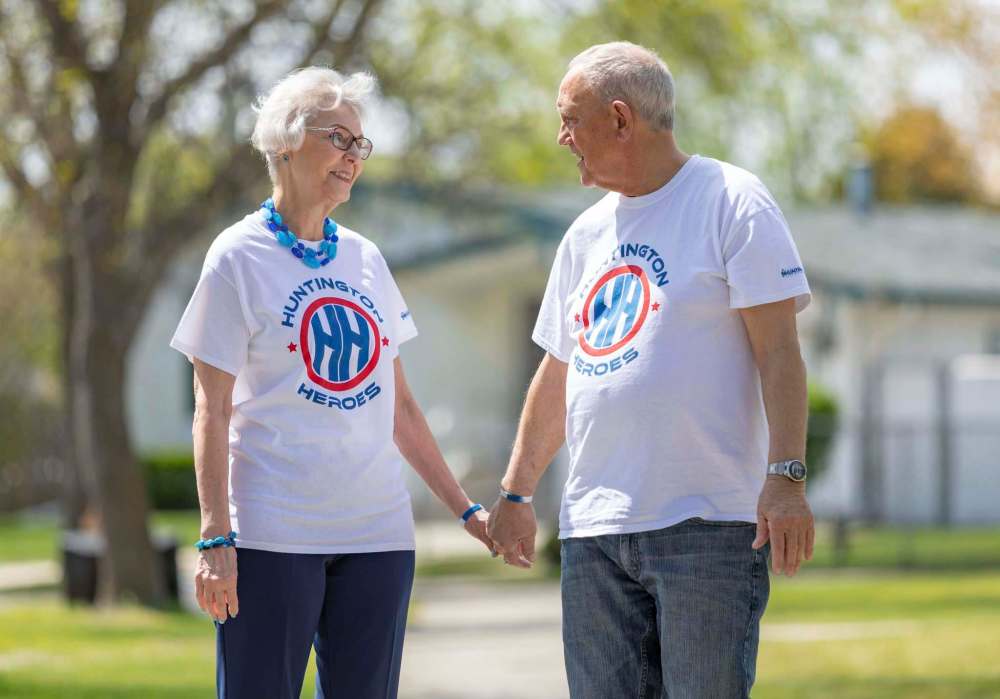
The Barretts shared a connection with the Guthries in this respect. Ellen’s aunt had been diagnosed in the 1970s and committed to the Selkirk Mental Health Centre. And Marjorie Guthrie had agreed to come to Winnipeg to help them raise awareness of the disease, which resides in family trees often as a dreadful secret until symptoms appear, usually in a person’s 30s or 40s.
The Barretts are grateful for Guthrie’s help those years ago.
“She got us on the radar a little bit and helped out with a Canadian presence,” says Vern Barrett, president of the Winnipeg chapter of the Huntington Society of Canada.
Fast-forward a few decades, and Huntington’s disease still has a low profile. Only around 250 Manitobans are living with the disease.
Yet, awareness and support for the illness has come a long way, in large part thanks to the efforts of the Barretts, Guthrie and events like the upcoming Huntington Heroes Walk/Run to Cure HD on Saturday.
Taking place at Assiniboine Park, the event might not draw thousands of participants like other charitable events. Yet Huntington Heroes — in its ninth year — packs a big punch for a gathering of a couple of hundred people, says social worker Marla Buchholz, director of the Manitoba Huntington Disease Resource Centre.
“It absolutely has an element of community and emotional support for impacted individuals and family members,” says Buchholz, one of the few health-care professionals in the province specifically supporting individuals and families impacted by Huntington’s.
Raising awareness is a key reason for the walk, because Huntington’s isn’t just rare. The path of the disease also involves a deeply difficult journey for sufferers and their families.
“I can definitely say with confidence that Huntington’s is among the worst,” says Buchholz, who works two days a week with families out of a small rented space in the Movement Disorder Clinic at Deer Lodge Centre.
Funded by the Huntington Society, in part from money raised by the walk, the resource centre is a linchpin for families dealing with the disease.
“Every single one of us has (this gene) on our fourth chromosome, a combination of proteins that repeat themselves in a certain pattern a number of times, and the average number is about 17,” she says. “With Huntington’s, that number has gone sort of wacko, so if you have 40 (repeats) or more, you will absolutely manifest Huntington’s in your lifetime.”
The mutation causes the production of a malformed protein that accumulates in the brain, damaging and eventually killing neurons. The condition is progressive, often aggressive and always terminal.
A blood test has been available since the mid-1990s to identify the mutation. Prior to that, the disease was often misdiagnosed.
Yet, some who have family members with the disease decide not to get tested.
“One of the challenges of getting a test means that you’re living knowing you will get this fatal disease,” Buchholz says, adding the lifespan once symptoms manifest is about 10 to 15 years.
Typically, the first signs of Huntington’s mimic mental illness — anxiety, depression and even psychosis. Memory loss soon develops, and so does behavioural change, often exacerbated by a lack of insight.
“(Patients) may no longer see themselves as being impaired in any way, so they may make some very poor choices,” Buchholz adds. Think selling your car for a baseball cap, or riding your bike down the middle of a major road at rush hour.
“The problems they can get themselves into can be very challenging,” she says.
People with the disease also gradually lose control of their movements.
“If you imagined someone walking down the street looking absolutely drunk, staggering this way and that way, and loosey-goosey… that’s what it may look like,” Buchholz says, adding that individuals usually end up in personal-care homes in their 40s or 50s.
Those with more expressions of the mutation often develop more aggressive symptoms earlier, while others may develop a less aggressive version later on. The latter describes Ellen Barrett, whose “number of repeats are on the lower side, so age of onset was later for her,” her husband says.
Despite an eventual grim prognosis, she is doing well, he adds.
“She has really cared for her brain, because if you have a compromised brain, anything you do to impact it can make it worse.”
As a result, the 72-year-old is living as best she can with the disease.
“Her neurologist says she’s the poster child for how to live with Huntington’s.”
Yet, Ellen’s course of illness is rare. Most people develop symptoms much earlier, sometimes in their teens. Although no treatment or cure exists, promising experimental treatments are in development.
Researchers have an advantage compared to those working on Alzheimer’s and Parkinson’s, for example. They know its cause, and that allows them to narrow their focus on finding a way to treat the mutation.
In the meantime, families with the disease need support and understanding. To that end, the walk also goes a long way, Buchholz says.
“It helps people feel empowered who may not be able to work anymore, because at least they can get out and help raise some money, feel a sense of contribution and a bit of hope, too.”
joelschles@gmail.com