
Jury deciding if immigration detainees must get minimum wage

Advertisement

Advertise with us

SEATTLE (AP) — A federal jury is deciding whether one of the nation's biggest private prison companies must pay minimum wage — instead of $1 a day — to immigration detainees who perform tasks like cooking and cleaning at its jail in Washington state.

Read this article for free:

or

Already have an account? Log in here »

To continue reading, please subscribe:

Subscribe and receive a limited-edition Free Press branded hat or tote.

Digital Subscription

One year of digital access for only $205*

  • Enjoy unlimited reading on winnipegfreepress.com
  • Read the E-Edition, our digital replica newspaper
  • Access News Break, our award-winning app
  • Play interactive puzzles

*First annual payment billed as $205.00 + GST for one year. This annual subscription will automatically renew at $233.00 + GST every 52 weeks (10% off the regular annual price of $259.35). Offer available to new and qualified returning subscribers only. Cancel any time.

To continue reading, please subscribe:

Add Free Press access to your Brandon Sun subscription for only an additional

$1 for the first 4 weeks*

  • Enjoy unlimited reading on winnipegfreepress.com
  • Read the E-Edition, our digital replica newspaper
  • Access News Break, our award-winning app
  • Play interactive puzzles
Start now

*Your next Brandon Sun subscription payment will increase by $1.00 and you will be charged $17.95 plus GST for four weeks. After four weeks, your payment will increase to $24.95 plus GST every four weeks.

Hey there, time traveller!
This article was published 15/06/2021 (1877 days ago), so information in it may no longer be current.

SEATTLE (AP) — A federal jury is deciding whether one of the nation’s biggest private prison companies must pay minimum wage — instead of $1 a day — to immigration detainees who perform tasks like cooking and cleaning at its jail in Washington state.

Democratic Washington Attorney General Bob Ferguson sued the Florida-based GEO Group in 2017, saying the company had unjustly profited by running the Northwest detention center in Tacoma on the backs of captive workers.

A separate lawsuit filed on behalf of detainees was also filed that year, seeking back pay. Tacoma-based U.S. District Judge Robert Bryan, who rejected several attempts by GEO to dismiss the lawsuits, consolidated the cases for trial, which he conducted via Zoom because of the pandemic.
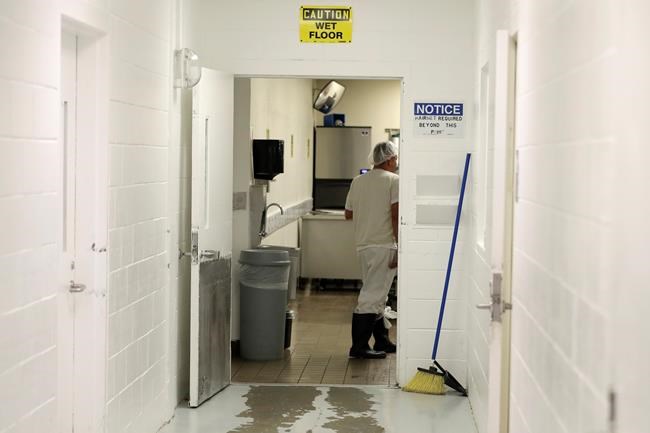
In this photo taken Sept. 10, 2019, a detainee works in a kitchen area at the GEO Group’s immigration jail in Tacoma, Wash., during a media tour. After nearly four years of litigation and pandemic-related delays, a federal jury on Tuesday, June 15, 2021, began deliberating whether the GEO Group must pay minimum wage to detainees who perform cooking, cleaning and other tasks at the facility – instead of the $1 per day they typically receive. (AP Photo/Ted S. Warren)

“What GEO is doing to exploit captive detainee workers at the Northwest detention center is for real — and at a massive scale,” Assistant Attorney General Andrea Brenneke told the jury in closing arguments Tuesday. “GEO could easily pay detainee workers the minimum wage and still make millions of dollars in profits from the facility each year.”

GEO’s response is that the detainees simply aren’t employees. Even if they were, the company says, it would be unlawfully discriminatory for Washington to require GEO to pay them minimum wage — now $13.69 an hour — when the state doesn’t pay minimum wage to inmates who work at its own prisons or other detention facilities.

In her closing argument, GEO attorney Joan Mell accused the state and detainee advocates of using the lawsuits to attack the immigration detention system. GEO has operated the detainee work program for more than a decade, and the state made no effort to get the company to pay the minimum wage until 2017, amid a flurry of lawsuits Ferguson filed against the Trump administration.

“If the plaintiffs can prove the Minimum Wage Act is – quote — applicable … then they can reform immigration detention without ever having to go to Congress,” she said. “They’re taking a shortcut via the courthouse to get what they want.”

The Northwest detention center houses people who are in custody while the government seeks to deport them or reviews their immigration status. It can hold up to 1,575 detainees, making it one of the nation’s largest immigration jails, though as of early this month its population was just 216, largely due to the pandemic.

U.S. Immigration and Customs Enforcement, which pays GEO to run the facility, requires the company to operate a “voluntary work program” to keep the detainees occupied. It requires them to be paid at least $1 per day for work that includes cleaning bathrooms, showers and industrial kitchens; washing and folding laundry; sweeping and buffing floors; preparing and serving food; and cutting hair.

Former detainees testified that they worked because they needed money to buy extra food or clothing at the commissary or to make phone calls to loved ones.

The shifts often last just an hour or two. GEO’s own analysis said it that if detainees didn’t do the work, it would need to hire 85 full-time workers from the community.

GEO’s contract with ICE also requires it to comply with applicable state and local law — which, the state says, includes the Washington Minimum Wage Act.

Washington appears to be the only state suing a private detention contractor for not paying minimum wage to immigration detainees. But similar lawsuits have been brought on behalf of immigration detainees in other states, including New Mexico, Colorado and California, seeking to force GEO and another major private detention company, CoreCivic, to pay minimum wage to detainees there.

The Colorado and California cases are pending, but a federal judge rejected the lawsuit brought by former detainees of CoreCivic’s Cibola detention center in New Mexico — a decision upheld by a federal appeals court panel in March.

“Persons in custodial detention—such as appellants—are not in an employer-employee relationship but in a detainer-detainee relationship,” the panel wrote.

That is the crux of GEO’s argument in the Washington case. The company acknowledges it has the money to pay detainees the minimum wage if it wants. In 2018 GEO made $18.6 million in profits from the facility; it would have cost $3.4 million to pay the minimum wage to detainees.

Mell also pointed to provisions in GEO’s contract with ICE that state that any employees GEO hires must have legal status in the U.S. Many of the detainees don’t. “The contract spells it out: The detainees are not employees,” Mell said. “They can’t be.”

But the definition of “employee” in Washington’s minimum wage law is extremely broad — it includes anyone who is permitted to work by an employer, without regard to immigration or legal work status. The law says residents of “a state, county, or municipal” detention facility are not entitled to minimum wage.

According to lawyers for the state and for the detainees, that exception doesn’t cover a private, for-profit jail such as GEO’s. Further, GEO oversaw the scheduling and performance of the work just as a typical employer does, they said.

If the jury finds that the minimum wage law applies to GEO, a second phase of the trial will be held to determine damages. Jurors did not reach a verdict Tuesday; they were to resume deliberations Wednesday.

In a separate effort, Washington is trying to close the detention center entirely. This spring Gov. Jay Inslee signed a law that would ban for-profit detention centers in the state. GEO has sued to block it.

Report Error Submit a Tip

More Stories

Drunk driver who killed cycling couple, orphaned their infant daughter, sentenced to eight years

Dean Pritchard 4 minute read Preview

Drunk driver who killed cycling couple, orphaned their infant daughter, sentenced to eight years

Dean Pritchard 4 minute read Yesterday at 5:47 PM CDT

A Winnipeg man responsible for a drunk-driving crash that killed two cyclists last summer and left their infant child an orphan has been sentenced to eight years in prison.

Kuldeep Singh Gill was arrested Sept. 13 after fleeing from a high-speed collision on Kenaston Boulevard that killed 31-year-old Egor Popov and his 25-year-old common-law partner Kerry Ashley Bonner.

Gill, 46, pleaded guilty earlier this year to two counts of impaired driving causing death and two counts of failing to stop at the scene of a collision.

Gill, who has a prior conviction for impaired driving, made a conscious decision to drive drunk, knowing it made him a danger on the road, provincial court Judge David Ireland said at a sentencing hearing Tuesday.

Read
Yesterday at 5:47 PM CDT

Man faces assault with weapon charge in road rage incident

1 minute read Yesterday at 11:18 AM CDT

A 29-year-old man is facing an assault with a weapon charge after he allegedly brandished a handgun during a road rage incident on St. James Street early on Monday.

Winnipeg Police Service officers were called to St. James Street and Ness Avenue at about 6 a.m., where they spoke with the victim, a 53-year-old man.

Another man pulled his vehicle next to the 53-year-old and began arguing with him over his driving, but the fight soon escalated into the other man brandishing what appeared to be a black handgun, police said.

The 53-year-old drove off, but the other man followed him, forced him to stop by pulling in front of him, and then got of his vehicle while still brandishing the gun, police said. He got back in his vehicle and peeled off after he saw the victim calling police.

Canadian centre adds size to Sea Bears playoff push

Joshua Frey-Sam 4 minute read Preview

Canadian centre adds size to Sea Bears playoff push

Joshua Frey-Sam 4 minute read Yesterday at 6:33 PM CDT

The Winnipeg Sea Bears have added some size ahead of the playoffs.

The club announced the signing of 6-10 Canadian centre Ben Stevens on Tuesday. Stevens was released by the Montreal Alliance on July 30 and scooped up by the Sea Bears ahead of the Aug. 3 transaction deadline.

The 27-year-old from Halifax appeared in 10 games for the Alliance this summer, where he played a limited role off the bench, averaging 1.9 points and two rebounds per game in 7.5 minutes per game. Stevens had a more elevated role with Montreal in 2025, where he appeared in 20 contests, started five, and averaged 5.4 points and 3.8 rebounds in 13.2 minutes of action per game.

Stevens, at worst, adds some height and physicality off the bench that has been lacking for the Sea Bears this season. The club has struggled with rebounds for many stretches and appeared outmatched by teams with larger personnel.

Read
Yesterday at 6:33 PM CDT

‘Catastrophic’ ending to eventful Manitoba Derby

Mike McIntyre 6 minute read Preview

‘Catastrophic’ ending to eventful Manitoba Derby

Mike McIntyre 6 minute read Yesterday at 5:56 PM CDT

It had everything you could have wanted for the signature racing event of the season, including plenty of drama and excitement in front of a packed crowd at Assiniboia Downs.

Unfortunately, Monday night’s Manitoba Derby also served up another painful reminder of the potential perils of “The Sport of Kings” and what can occasionally happen when these magnificent animals are pushed to their limits.

Forty Twenty, a three-year-old bay colt who was one of the morning line favourites, looked to be in great shape as he approached the final turn and was near the lead in the nine-horse race.

But disaster struck as he approached the final turn and suddenly pulled up as the rest of the packed passed him.

Read
Yesterday at 5:56 PM CDT

Bell sheds 19 more Manitoba employees

Gabrielle Piché 3 minute read Preview

Bell sheds 19 more Manitoba employees

Gabrielle Piché 3 minute read Yesterday at 6:30 PM CDT

At least 19 Manitoba jobs were lost recently during Bell Canada’s ongoing restructuring.

Parent company BCE Inc. confirmed in June it’d axe nearly 700 jobs through organizational changes. Those changes began last year.

A dozen Manitoba staff were laid off on July 30, according to Team-IFPTE Local 161, the union representing the workers.

Another seven union members left voluntarily though a departure program, the union reported Tuesday.

Read
Yesterday at 6:30 PM CDT

‘Beautiful game’ stained by Trump, Infantino

Editorial 4 minute read Preview

‘Beautiful game’ stained by Trump, Infantino

Editorial 4 minute read Yesterday at 2:01 AM CDT

FIFA President Gianni Infantino has improbably managed to turn the success of the recently completed and profoundly challenged World Cup finals into a defeat.

Just two weeks ago, with confetti from the World Cup final still hanging in the air, Infantino unveiled plans for FIFA Forward Enterprise, a US$20-billion company that would run future FIFA events including the World Cup. The entity would sell a US$4 billion stake to a company called Thrive Eternal, which is owned by the family of Jared Kushner, U.S. President Donald Trump’s son-in-law.

The nature of the proposal and the people who are involved in it sent shock waves through the global football community. Reverberations so severe, they could knock Infantino from his perch atop the footballing world.

Within the week, the 55 member nations of UEFA, the governing body for football in Europe, the 47 members of the Asian Football Confederation (AFC) and the 41 nations represented by CONCACAF (North America, Central America and the Caribbean) rejected Infantino’s proposal. UEFA went the furthest by unanimously threatening to boycott future FIFA events, including the 2030 World Cup to be hosted in Morocco, Portugal and Spain.

Read
Yesterday at 2:01 AM CDT